- It’s a provider duty, not a Google rule. The EU asks the AI companies to mark their output. It asks nothing of you.
- Your readers see nothing. No logo, no footer, no little symbol, and no change to what the text says.
- There’s no public checker. At all 3 companies, detection sits with a short list of approved organizations.
- Short and edited passages carry a weak signal, and the providers say so themselves.
- A mark means an AI system touched the text. Not that it’s wrong, not that it isn’t yours, not how much of you is in it.
When I read that Claude now hides a watermark in its text, my first thought wasn’t about my readers. It was about Google.
If you write with AI help, you’ve probably seen one of these headlines by now. ChatGPT watermarks its answers in Europe. Gemini has been doing it since 2024. And the word watermark lands so badly, because everyone pictures that thing stamped across a stock photo, and then pictures a search engine spotting it on their best post.
So let me save you the spiral. That’s not what this is. A text watermark is a faint statistical pattern in word choice. Your readers can’t see it, there’s no public tool anyone can paste your post into, and what it signals is a lot narrower than it sounds. Give me 10 minutes and you’ll know exactly what it does and doesn’t say about your writing.
What Changed
3 companies, and each one went about it differently. What they have in common is the law pushing them: Article 50(2) of the EU AI Act, which has applied since 2 August 2026. That article asks providers of AI systems to mark their output so a machine can read it. It’s a duty for the companies building the models. Not for the person publishing a blog post.
| Since | Where | Who can check | |
|---|---|---|---|
| Anthropic (Claude) | August 2026 | All Claude products and the API, at the model level | Private preview for approved organizations |
| OpenAI (ChatGPT) | Announced October 2026 | ChatGPT and Codex in the EU only. In the API worldwide, off by default | Approved researchers and expert organizations |
| Google (Gemini) | 2024 | Gemini app and web experience | No public text detector |
2 things in that table are worth pulling out. Anthropic put the mark at the model level, so it makes no difference whether your text came out of the Claude app or through the API, and it says it’s adding the watermark to its older models too. OpenAI went the other way and isn’t making text watermarking a global default at launch, so outside the EU, ChatGPT text isn’t marked at all, and API output stays off unless a developer switches it on.
How a Text Watermark Works
Nothing gets added to your page. No pixel, no hidden footer, no stray line in your HTML. OpenAI calls it an invisible statistical signal in the model’s word choices. Where the model could reasonably pick any of several words, it leans toward some of them, in a pattern only the key holder can test for.
Anthropic says its mark is woven directly into the text itself and doesn’t change the meaning, quality or readability. It doesn’t publish how. OpenAI says it sees no meaningful performance difference on its own benchmarks with the watermark on or off.
Which leads to 2 consequences, and they pull in opposite directions. Because the pattern lives in the words, it survives a copy and paste into your editor. And because it lives in the words, it starts fading the moment you change them.
Who Can Read It
Here’s the part the headlines skipped, and honestly it’s the part that answers the Google worry sitting underneath all of this. There is no public checker. Not at one of the 3.
- ✓Anthropic: detection is in private preview for eligible organizations. The page lists regulators, law enforcement, media, fact-checkers, independent researchers, educational organizations and EU civil society groups, plus companies checking their own compliance.
- ✓OpenAI: access goes to approved researchers and expert organizations, and the company says flat out that it isn’t making it publicly available at launch. The reason it gives is the one you’d hope for: missed marks and false alarms.
- ✓Google: SynthID Text is open source and ships in Hugging Face Transformers, but Google says a watermarking configuration should be stored securely and privately, and its public SynthID Detector covers image, video and audio. Not text.
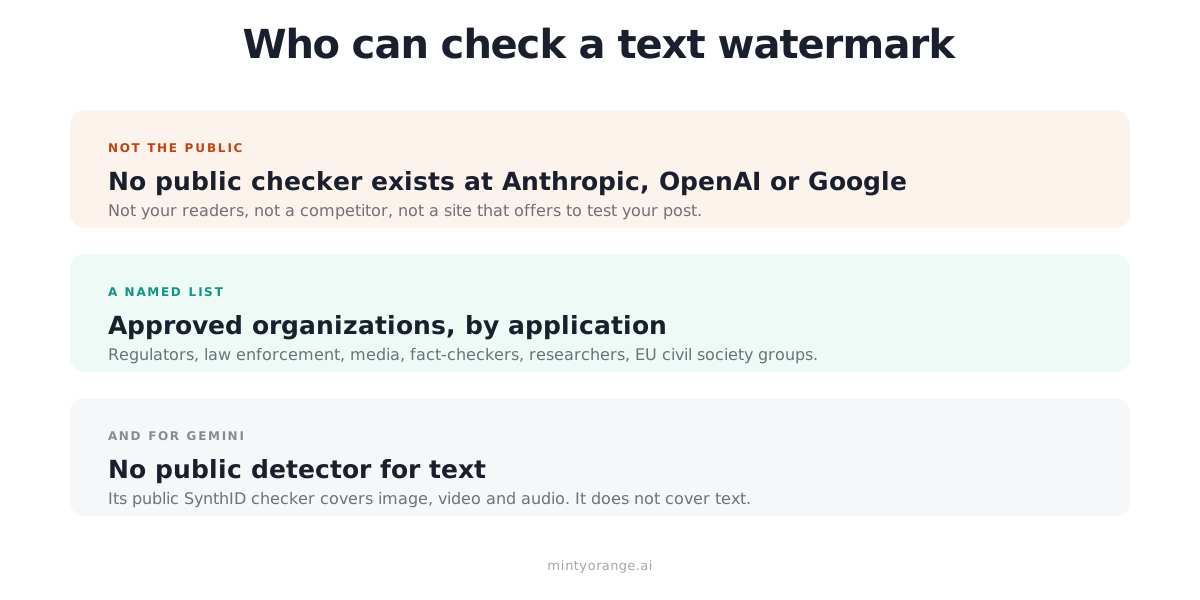
So nobody is pasting your post into a box. Not your readers, not a competitor, not one of those sites that promises to tell you whether an article was written by AI. None of the 3 companies lists Google among the organizations with access, and Google hasn’t said it reads anyone else’s watermarks. That cuts both ways, though, and I’m not going to sit here and tell you Google ignores them either. What I can tell you is what Google’s own documentation says, and that’s further down.
How Reliable It Is on Short or Edited Passages
The only solid public numbers come from OpenAI, testing its own method. At a 1% false alarm rate, it caught about 80% of 200-token passages and about 95% of 400-token ones. On those 400-token passages, swapping 10% of the words for synonyms dropped detection from roughly 92% to 66%. Swap out 25% and you’re down to 17%.
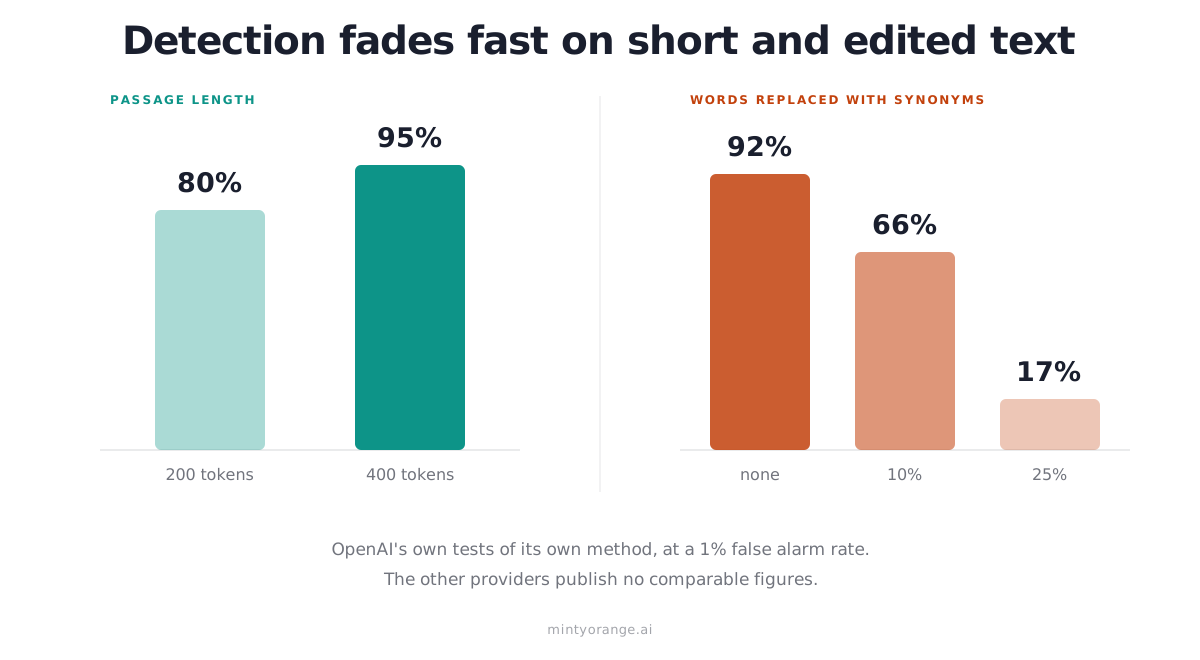
Take those for what they are. They describe OpenAI’s method, on English answers, in one test, published by the company that built the thing. Not Claude’s, not Gemini’s. But the direction is the same everywhere you look.
Anthropic lists when its own mark is likely to be missing, and that list reads like a description of ordinary blogging: when text has been heavily edited, paraphrased, translated, or mixed into other writing, or when a passage is very short and there just isn’t enough text for a reliable signal. Google says much the same about SynthID: weaker on factual answers, and detector confidence drops a lot once text is thoroughly rewritten or translated.
What nobody has published is a number for the case most of us have: one short answer or a single paragraph sitting inside an article a person wrote. OpenAI’s figures start at 200 tokens and cover whole generated passages. So the honest answer is a direction, not a percentage. Shorter, mixed in and rewritten all make the signal weaker, and all 3 companies say so themselves.
What a Watermark Can’t Tell Anyone
This is where the word watermark does the most damage, because it sounds like ownership and it sounds like a verdict. It’s neither. OpenAI spells it out in 5 sentences, and they’re the clearest thing anyone has written on this:
A watermark does not measure human contribution. A watermark does not establish ownership or responsibility. A watermark does not identify the user. A watermark does not verify accuracy. The absence of a detected watermark does not prove human authorship.
Anthropic adds the one that matters most for how we work. A detected mark is a signal that content was processed by Claude, but is not fully conclusive, and Claude may not be the original author at all, because people use it to proofread, translate and summarize their own writing. Think about what that means. Run your own paragraph through an AI to tighten it up, and what comes back can carry a mark. The thinking was yours. The reporting was yours. The sentence was yours.
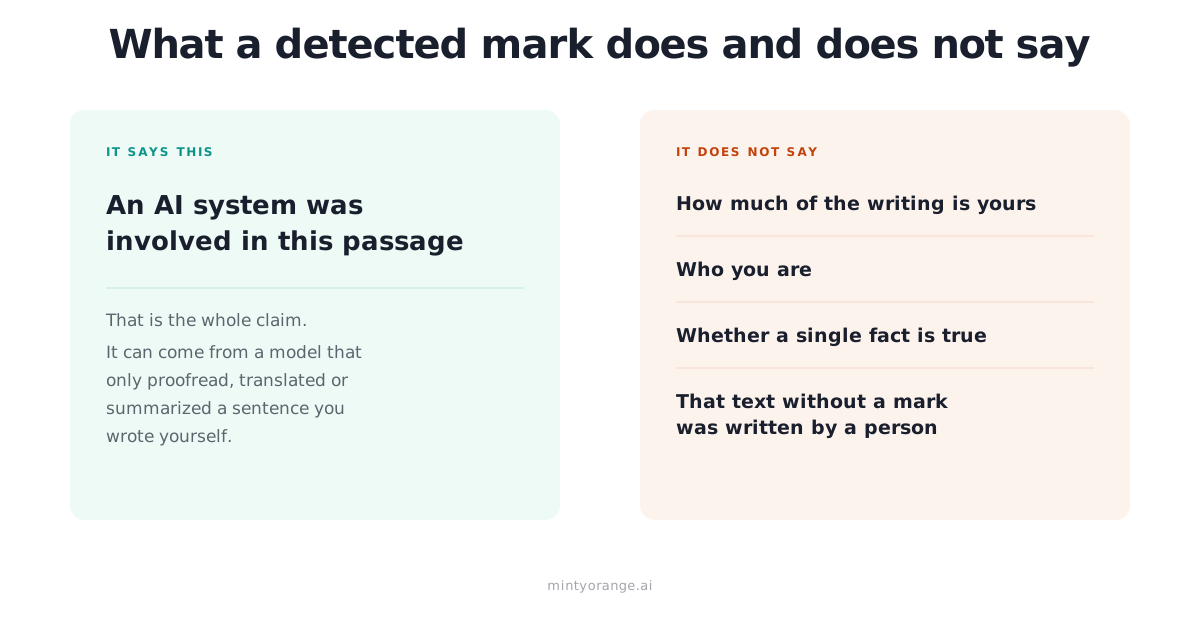
A hit means an AI system was involved somewhere in that passage. That’s it. It doesn’t mean the post is AI content, it doesn’t mean a word of it is wrong, and it doesn’t say whose work it is.
Does Google Care?
Google’s guidance on using generative AI content was last updated on 1 October 2026, which is after all 3 announcements. It doesn’t mention watermarks. Or SynthID. Or AI detection. What it does say is that generative AI can be particularly useful when researching a topic and to add structure to original content, that publishing many pages without value for users is scaled content abuse, and that it’s critical to manually factcheck and review all AI-generated content for accuracy and trustworthiness before you publish it.
That’s the same line Google has held since February 2023, under the heading Rewarding high-quality content, however it is produced. The risk it keeps describing is volume without review. Not a pattern in word choice. We went deep on the ranking side of this in will Google penalize your post for AI-written sections.
One more line from that guidance is worth knowing, because it’s the only thing Google says about disclosure at all: sharing information about how a piece of content was created can help give your readers more context. Can. Not must.
Do You Have to Label It?
The watermark is the provider’s obligation, and the provider has already met it. It doesn’t hand you a labeling duty. The EU rule that covers visible labels on text applies to content published to inform the public on matters of public interest, and even there it falls away when a person has reviewed the content and takes editorial responsibility for publishing it. If you read your drafts and your name is on the byline, that exception is describing you. We took the law apart sentence by sentence in do you have to label AI-assisted blog posts.
Images are the one place this gets different, because AI image tools have carried visible credentials and invisible marks for a while now, and a photorealistic AI image a reader would take for a real photo is a genuinely different question from a sentence. That post covers it.
What Matters
Here’s where I keep landing. Every habit that protects a post from a rough Google update, from a reader who quietly stops trusting you, and from your own worst Monday, is the same habit. And the watermark changes exactly none of them.
- 1.Read every AI sentence like you signed it. Because you did. The byline is yours, and so is the mistake if one slipped through.
- 2.Check the numbers at a source you opened yourself. Prices, dates, opening times, rules. They go stale fastest, and they’re exactly what a model will state with total confidence and zero doubt.
- 3.Rewrite it in your voice and keep the parts only you have. Your photos, the detour you had to take, the restaurant that was closed on a Monday. No model is producing that.
That third one happens to weaken a watermark, since rewriting is what detection survives least well. But that’s not the reason to do it. The reason is that it’s the only part of your post nobody else could have written.
And if this made you want to go dig through your archive, the checklist we use for that is in how to update old blog posts, and the case for why your own experience is the part that carries weight is in what E-E-A-T means for bloggers.
Key Takeaways
- ✓Text watermarks are a provider duty under Article 50(2) of the EU AI Act, which has applied since 2 August 2026. The duty sits with the AI companies, not with you.
- ✓Anthropic marks Claude output at the model level across its products and API. OpenAI is adding the mark to ChatGPT text in the EU only and leaves the API off by default. Gemini text has carried SynthID since 2024.
- ✓The mark is a statistical pattern in word choice. Nothing is visible, and no public tool exists to check a text at any of the 3 companies.
- ✓Detection weakens on short passages, on text mixed into other writing, and on anything rewritten. All 3 providers document this themselves.
- ✓A detected mark means an AI system was involved. It doesn’t measure how much of the writing is yours, doesn’t identify you, and doesn’t say whether the text is accurate.
- ✓Google’s guidance was updated on 1 October 2026 and doesn’t mention watermarks. It asks for factchecking and human review, which is what it has asked for since 2023.
Questions
Frequently Asked.
There’s no published answer either way, and anyone telling you otherwise is guessing. Here’s what is documented: Anthropic and OpenAI both limit detection access to a named list of approved organizations, and Google isn’t on either list. Google’s own guidance on generative AI content was updated on 1 October 2026, after all 3 announcements, and never mentions watermarks, SynthID or AI detection. What that guidance does ask for is a factcheck and human review before you publish.
No. A text watermark is a statistical pattern in word choice, not a visible mark. There’s no logo, no footer, no symbol, and nothing changes about what the sentence says. Anthropic states that its mark doesn’t change the meaning, quality or readability of the text, and OpenAI reports no meaningful performance difference on its benchmarks with the watermark on or off. Nothing shows up on the page, and there’s no reader-facing tool to test for one.
Nothing in Google’s documentation describes a mechanism by which it would. Google has judged content on quality rather than production method since February 2023, under the heading Rewarding high-quality content, however it is produced, and the current generative AI guidance from 1 October 2026 repeats that and never mentions watermarks. What it does name as a problem is scaled content abuse, meaning many pages published without value for users. That’s about volume and review, not about a pattern in word choice.
The watermark is the AI provider’s obligation under Article 50(2) of the EU AI Act, and the provider has already met it. It creates no labeling duty for you. The EU rule on visible labels for text applies to content published to inform the public on matters of public interest, and it carries an explicit exception where a person has reviewed the content and holds editorial responsibility for publishing it. Google says only that sharing how content was created can help give readers context, which is a can, not a must.
Nothing in the 3 announcements gives you a reason to. The mark doesn’t identify you, doesn’t show up for your readers, and no search engine has said it uses one. Anthropic even points out that a detected mark doesn’t mean its model wrote the text, since people use these tools to proofread, translate and summarize work they wrote themselves. The thing worth changing isn’t which tool you use. It’s how carefully you read what comes out of it before your name goes on it.