A reader wrote to us last week, and the same worry turns up in our inbox most months: “I’ve been copying your suggested new sections into my articles, and I’m wondering if this will negatively affect my content going forward by flagging parts of my most popular posts as being AI-generated.”
Short answer: no, and the mechanism the question assumes does not exist. Google has never banned AI-written text, no ranking update has ever been announced as a move against it, and the one spam rule that mentions generative AI needs 2 things at once that a single edited section cannot meet.
- Google's rules have no AI clause. The spam policy covers scale and intent, not how text was produced.
- No update targeted AI writing. Not one announcement between 2022 and today names it as the target.
- Nobody can reliably detect it. OpenAI withdrew its own detector for being wrong too often.
- Mixed pages rank. Pages under 50% AI hold 82.2% of the top 3 in the largest 2026 sample.
- The real risks are errors and sameness, not origin. Both are things you control.
What Google's Rules Really Say
Start with the document that governs this, the spam policies. The relevant rule is called scaled content abuse, and it is defined like this: “Scaled content abuse is when many pages are generated for the primary purpose of manipulating search rankings.”
That rule has 2 parts, and you have to do both to break it. You have to publish many pages, and you have to publish them mainly to game rankings. Adding one section to one article you wrote yourself does neither, whoever or whatever typed the words.
Generative AI does appear on that page. It is the first example under the rule: “Using generative AI tools or other similar tools to generate many pages without adding value for users.” The operative words are many pages and without adding value. The rule itself says the practice is abusive “no matter how it’s created,” which is Google saying in its own policy that the production method is not the thing being judged.
That has been the written position since 8 February 2023, when Google published its guidance on AI-generated content under the heading “Rewarding high-quality content, however it is produced.” The line it draws there is about purpose, not production: using automation, including AI, with the primary purpose of manipulating ranking in search results is what violates the spam policies. The post also makes the comparison explicit, pointing out that the earlier wave of mass-produced human content never led anyone to propose banning human writing.
No Update Has Ever Targeted AI Writing
Google has run core and spam updates every few months since 2022, and each one is logged with a name, a start date and a stated goal on the Search Status Dashboard. Not one of them names AI-written text as its target. The closest any announcement comes is the March 2024 spam policy update, which added the rule quoted above.
Everything else that gets called an AI crackdown is inference. A core update lands, sites that published at volume lose traffic, and the industry works backwards to a cause. The sites that fell had something in common, but it was not a text generator. It was the scale.
What Got Penalized
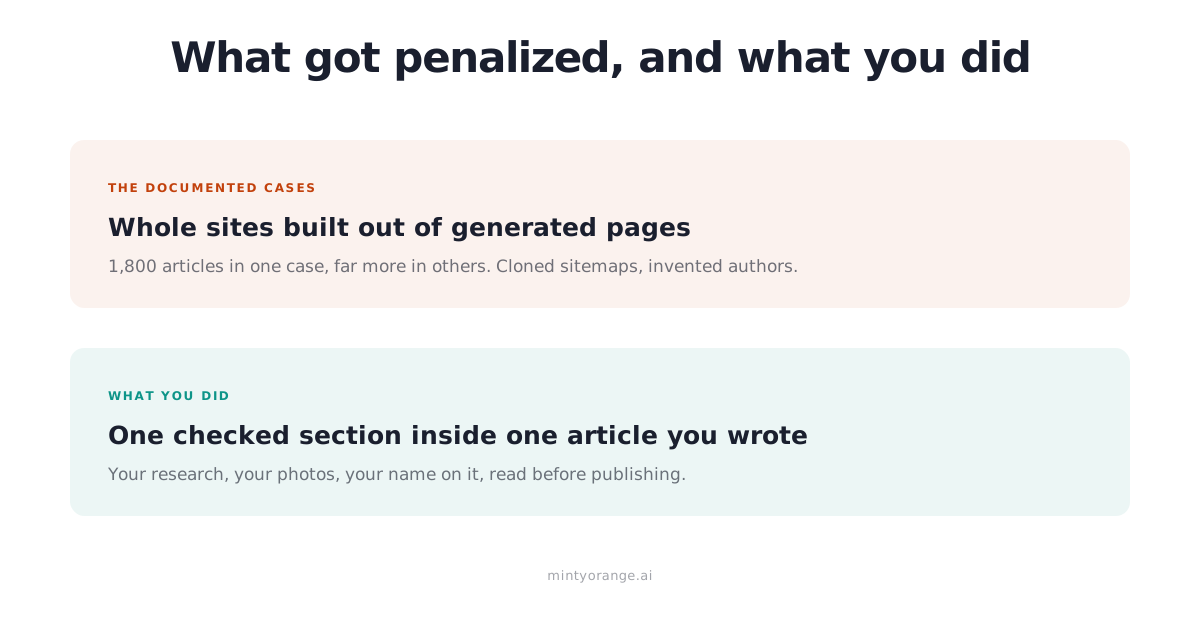
The documented cases share a profile, and it is not subtle. The best known is the 2023 “SEO heist,” where an operator exported a competitor’s sitemap and generated roughly 1,800 articles from it. Ahrefs put numbers on it a year later: estimated organic traffic down from 307,158 to 1,485 visits a month, top-3 keywords from 8,969 to 26. Ahrefs attributes that to a manual penalty. Google has never confirmed one, which is worth saying because the case gets cited as proof of things Google never said.
The other cases look the same from a distance: whole sites built out of generated pages, cloned sitemaps, invented author names, and no editor anywhere in the chain. If you are adding a section to an article you researched and published yourself, you are not in that category. You are not even in the same order of magnitude.
Nobody Can Reliably Detect AI Text
The question assumes a detector exists that could flag part of your post. The evidence says detection at that level does not work, and the most direct proof came from the company with the most to gain from it. OpenAI withdrew its own AI text classifier on 20 July 2023 with a one-line note: no longer available due to its low rate of accuracy. It had caught 26% of AI-written text and wrongly flagged 9% of human writing.
Independent testing is worse. Researchers at Stanford ran 7 detectors over 91 TOEFL essays written by non-native English speakers and got an average false positive rate of 61.22%. The mechanism is the problem: detectors score how predictable the writing is, so they flag anyone writing in plain, careful prose, including non-native speakers and anyone who edits tightly.
Google has never said it runs a detector in ranking. John Mueller was asked in 2022 whether Google could identify AI text and answered that he could not claim that. The rater guidelines tell human raters to judge effort and quality even when they are unsure how a page was made, which is a system designed around not knowing.
What The Numbers Say About Mixed Pages
The largest recent measurement comes from Ahrefs, which sampled 100,000 Google result pages in June 2026: a million pages from the top 10, of which 150,000 had enough text to score. Sorted by how much of the page their detector called AI, the top 3 results break down like this.
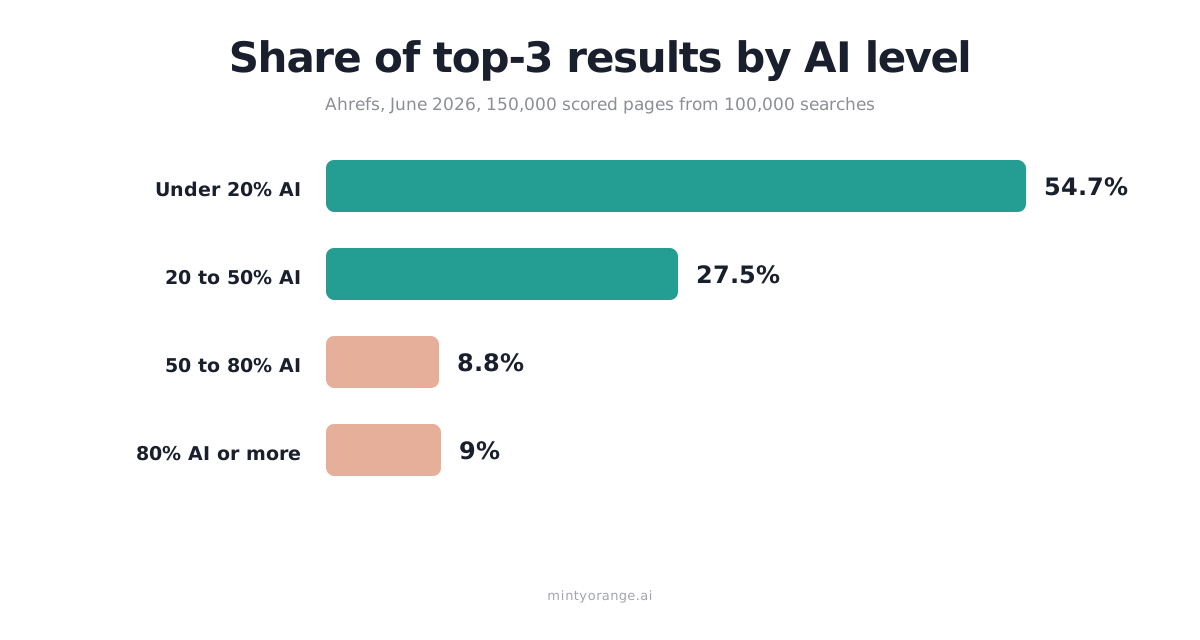
Pages under 50% AI hold 82.2% of the top 3. The 20 to 50% band alone, which is roughly where an article with a few added sections sits, holds 27.5%. That is not a fringe. That is the second largest group on the first page.
Ahrefs does report a gradient. Average AI share rises from 27.1% at position 1 to 30.9% at position 10, and pages in their high and very high buckets got 2 to 3 times fewer impressions than the low and moderate ones. But the gradient lives at the top of the scale, and Ahrefs reads it the same way we do: their own conclusion is that heavy AI use travels with falling quality, and quality is the likelier driver. They also list their caveats, which you should keep in mind for every number in this section: the detector is imperfect, the sample only contains pages Google already indexed, and sites publishing at high AI levels tend to be newer and weaker to begin with.
The 2 Risks That Are Real
Risk 1: The Facts
Google's guidance on AI-generated content, updated on 1 October 2026, says it is critical to manually factcheck and review all AI-generated content for accuracy and trustworthiness before publishing. Every documented media embarrassment in this area has been a factual error, not a stylistic one: wrong prices, invented quotes, a recipe nobody cooked.
A generated FAQ answer that states a visa rule, a price or an opening time is a claim you are publishing under your own name. If you did not check it, you now own a mistake you never made yourself.
Risk 2: The Sameness
The second risk is not one AI section in one post. It is the same words in 200 posts.
Repeating a structure is not the problem, and that is worth saying clearly, because the opposite advice is everywhere. Every recipe post on a food blog has the same shape: ingredients, times, steps, notes at the end. No site has ever been penalized for that. Readers count on it. We argue for the same thing: one answer block at the top, an FAQ, takeaways at the end, on every post.
What does not survive repetition is what sits inside the blocks. A recipe blog gets away with the same shape because the recipe is different every time. If your FAQ asks the same 3 generic questions on 200 posts and answers them with the same 3 generic paragraphs, the block has stopped carrying information.
That will not trigger the spam rule, because you are not generating pages at scale. But it is the part of this a reader can see, and Google's rater guidelines are explicit about main content produced with little to no effort. So the test is not where a block sits or how often you use it. The test is whether a reader of this post learns something from it that a reader of your other 199 posts would not.
What To Check Before You Publish
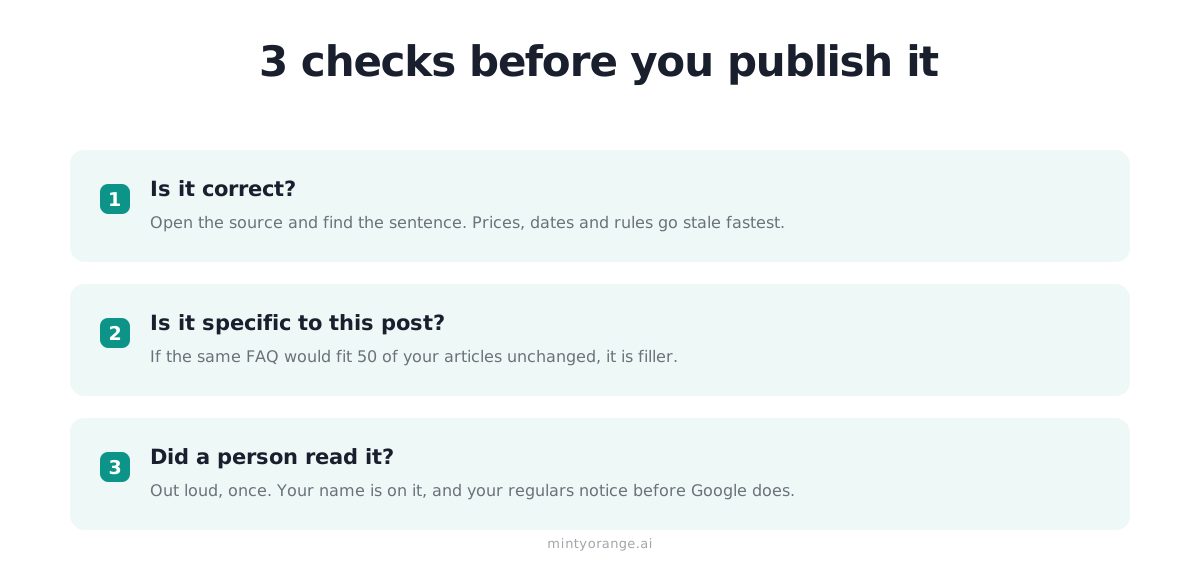
- 1.Check every fact the section states. Open the source in a fresh tab and find the sentence. Prices, dates, rules and opening times go stale fastest, so mark them for a recheck later too.
- 2.Make it specific to this article. If the new FAQ would fit unchanged on 50 of your posts, it is filler. Rewrite the questions so they are the ones a reader of this post would ask.
- 3.Read it out loud once. If a sentence does not sound like you, change it or cut it. You are publishing it under your name, and your regulars will notice before Google does.
- 4.Keep what only you have. Your photos, your experience, your opinion. That is the part no generator can produce and the part Google's own guidance calls out as the thing that matters most.
If you want the rest of the checklist for a refresh, we wrote it up in how to update old blog posts. And if you are worried about the legal side rather than the ranking side, the short version is that the EU rule has an explicit exception for content a person reviewed, which we covered in do you have to label AI-assisted posts.
Key Takeaways
- ✓Google's spam rule on AI needs many pages AND the intent to manipulate rankings. One edited section in one article meets neither.
- ✓No Google ranking update between 2022 and 2026 has been announced as targeting AI-written text.
- ✓OpenAI withdrew its own detector in July 2023 for low accuracy, and Stanford measured a 61.22% false positive rate across 7 detectors on non-native English essays.
- ✓Pages under 50% AI hold 82.2% of the top 3 in Ahrefs' June 2026 sample of 150,000 scored pages. The 20 to 50% band alone holds 27.5%.
- ✓The 2 risks that are real are wrong facts and blocks that say the same thing on every post. Both are yours to control.
Questions
Frequently Asked.
Not for being AI-generated. Google's spam policy targets scaled content abuse, defined as many pages generated for the primary purpose of manipulating search rankings, and it says the practice is abusive no matter how it is created. Google’s written position since February 2023 is that it rewards high-quality content however it is produced, and that the violation is using automation with the primary purpose of manipulating rankings. What gets penalized is volume without value, not the tool that produced a paragraph.
There is no evidence it can, and good evidence that nobody can. OpenAI withdrew its own classifier in July 2023 after it caught 26% of AI text and wrongly flagged 9% of human writing. Stanford researchers measured an average 61.22% false positive rate across 7 detectors on essays by non-native English speakers. Google has never said it runs a detector in ranking, and its rater guidelines instruct human raters to judge quality even when they cannot tell how a page was made.
No study has measured exactly that. What we can say is that the rules describe no mechanism that would catch it, and that pages in the 20 to 50% AI band hold 27.5% of top-3 results in Ahrefs' June 2026 sample. The risk worth managing is not the FAQ itself but what is in it: check the facts, and make the questions specific to that article rather than pasting the same 3 onto everything.
There is no Google requirement to, and no US law that obliges a blogger. The EU AI Act asks for disclosure on text published to inform the public on matters of public interest, but it carries an explicit exception where the content has undergone human review or editorial control and a person takes editorial responsibility. Ad networks draw a similar line: Mediavine's March 2024 policy says it does not monetize low-quality, mass-produced, unedited or undisclosed AI content that is scraped from other websites.
Google publishes no percentage, and its rater guidelines only describe the bottom of the scale, where all or almost all of the main content was produced with little to no effort. A more useful test than counting: if you removed the generated parts, would the article still be recognizably yours, with your experience and your evidence in it? If yes, you are fine. If no, you have a different problem than a Google update.