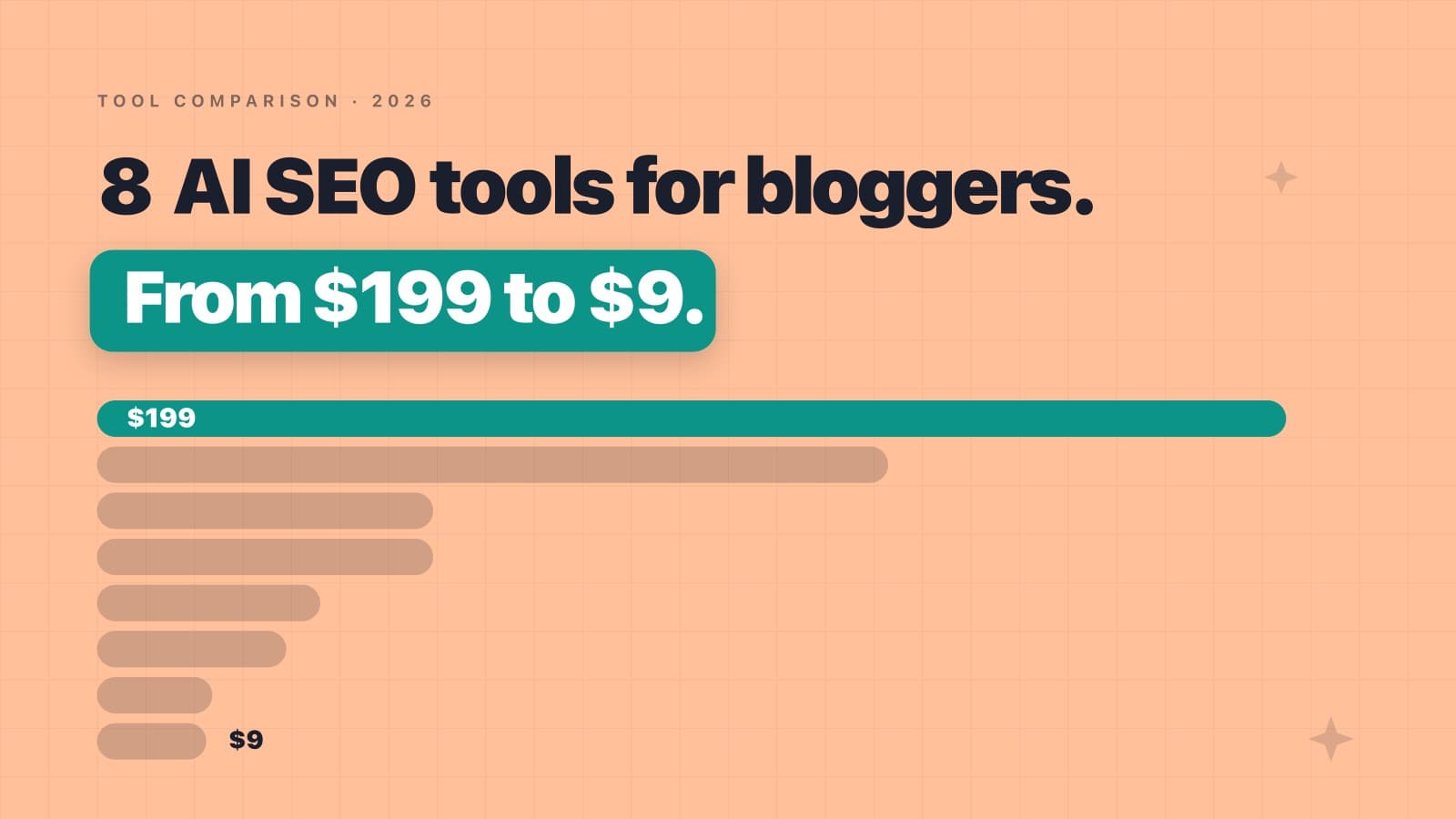
As a blogger or a website owner you are flooded with SEO and GEO tools. They all promise the same thing: more traffic, more readers, more income. So which ones actually earn their keep right now? Which one is right for whom? And is the expensive one really the best? We took a close look at the 8 that matter most. Here they are, and who each one is for.
- Semrush runs a whole team on one platform.
- Ahrefs has the deepest data on who gets named in AI answers.
- Minty Orange rebuilds the posts you already published.
- GetGenie drafts new posts inside WordPress for almost nothing.
- NeuronWriter scores content at the lowest entry price.
- Otterly watches AI answers and nothing else.
- Frase writes new posts from a research brief.
- Surfer scores drafts against live Google data.
But first, let’s talk about why you are reading this at all. Something happened to your traffic over the last two years, and it happened to almost everybody.
Why Every Blogging Tool Suddenly Says AI
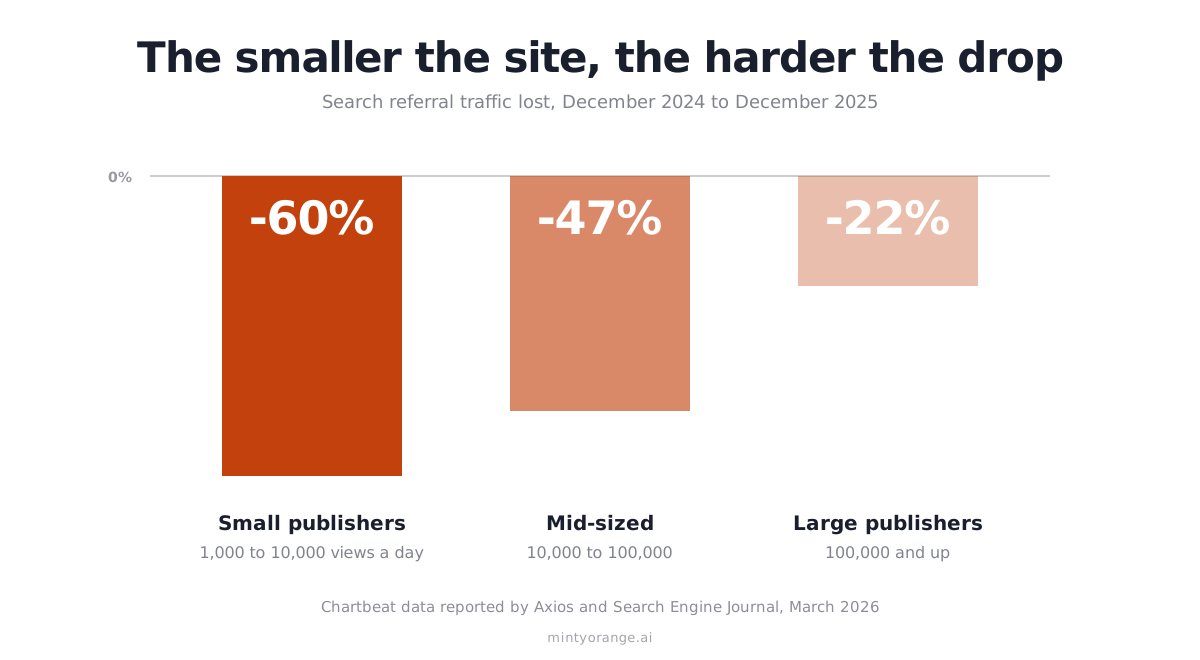
Because the traffic went somewhere else. Chartbeat data reported by Axios and Search Engine Journal in March 2026 shows small publishers, the ones between 1,000 and 10,000 pageviews a day, lost 60% of their search visitors between December 2024 and December 2025. Mid-sized publishers lost 47%. The largest lost 22%. The smaller you are, the harder it hit.
The click data shows why. Seer Interactive measured a 3.82% click-through rate in February 2026 for searches with no AI Overview, against 2.36% for searches that had one. Searches with an AI Overview send fewer clicks. The answer already sits on the page.
The 4 Questions That Decide Which Tool You Need
- 1.Does it fix the posts you already have, or only write new ones? If you have 80 published articles and write 4 a month, your archive is the bigger lever. Some of these tools barely touch it.
- 2.Does it show you whether AI engines cite you, and which ones? Tracking is a separate feature, and it usually sits on a much higher plan than you expect.
- 3.Does it work inside WordPress, without copy and paste? A plugin that writes into the block editor beats a web app you paste out of every single day.
- 4.What happens to your links and images when it rewrites a post? For an affiliate blog this decides everything. A rewrite that drops half your outbound links costs more than the subscription saves.
The 8 Tools At A Glance
Here they are side by side. After that we go through them one at a time, starting with the 2 big platforms, because you might already pay for one of those.
| Tool | Entry price per month | Rewrites existing posts | AI citation tracking | WordPress | Link and image handling |
|---|---|---|---|---|---|
| Semrush | From $99 for AI tracking, $199 with SEO | Yes, AI Search Optimizer | ChatGPT, Google AI, Gemini, Perplexity | Editor plugin, scoring only | Not documented |
| Ahrefs | From $129 on Lite, 5 AI prompts | Not documented | Brand Radar: AI answers, YouTube, Reddit | No plugin since February 2026 | Not documented |
| Minty Orange | Free, then from $9 | Yes, that is the core job | ChatGPT, Perplexity, Google AI Mode | Free plugin | 99.4% preserved, measured |
| GetGenie | Free, then from $10 | Content Rewriter | None documented | Plugin | Not documented |
| NeuronWriter | From $23, or $19 billed yearly | Optimize and AutoInsert | Paid add-on, price not published | From the Gold plan, no plugin | Not documented |
| Otterly | From $29, or $25 billed yearly | No, it measures only | From the entry plan, 4 platforms | Bot analytics only | Not applicable |
| Frase | From $49, or $39 billed yearly | Content Guard | From entry plan: ChatGPT and Google AI | Plugin | Not documented |
| Surfer | From $49 billed yearly | Auto-Optimize | From $82 a month | Plugin | Not documented |
Semrush: Best For Teams That Want Everything On One Platform
Semrush is the biggest suite here and probably already sits in your company’s stack. Its AI Visibility Toolkit tracks 25 custom prompts daily on one domain across ChatGPT, Google AI, Gemini and Perplexity, for $99 a month per domain billed annually. The Starter plan adds the SEO side for $199. Semrush rewrites too: the AI Search Optimizer imports a page by URL and scores it for classic search and AI search at once. So drop the old line that big platforms only measure while small tools fix. It stopped being true. On WordPress, the Semrush plugin scores and advises inside the editor. Semrush does not document rewriting a published post in place. If your business already pays Semrush, you own AI tracking. Use it before you buy anything on this list.
Marketing teams who already run their SEO on Semrush and want AI tracking behind the same login.
Solo bloggers paying out of their own income. The cheapest door here is $99 a month.
Ahrefs: Best For The Deepest Data On Who Gets Named
Brand Radar is the Ahrefs answer to AI search. In their words it tracks “your brand’s visibility across AI answers, YouTube, and Reddit,” either through prompts it checks daily or an AI Visibility Index built on more than 449 million prompts. It starts on the Lite plan at $129 a month and includes 5 tracked prompts. Standard gives you 10 for $249, Advanced 20 for $449. The standalone Index starts at $199, and the $29 Starter plan leaves Brand Radar out. Compare that to Otterly: 15 prompts across 4 AI platforms for $29. WordPress is out entirely, because Ahrefs closed its plugin for good in February 2026. For research, though, Ahrefs beats everything else here and it is not close. They publish a lot of it for free, no account needed. It is built for people whose job title says SEO, not for someone paying out of a blog’s own income.
SEO professionals who want the deepest research data in this comparison and watch AI answers alongside it.
Anyone who works inside WordPress. Ahrefs closed its plugin for good in February 2026.
Minty Orange: Best For Updating The Posts You Already Have
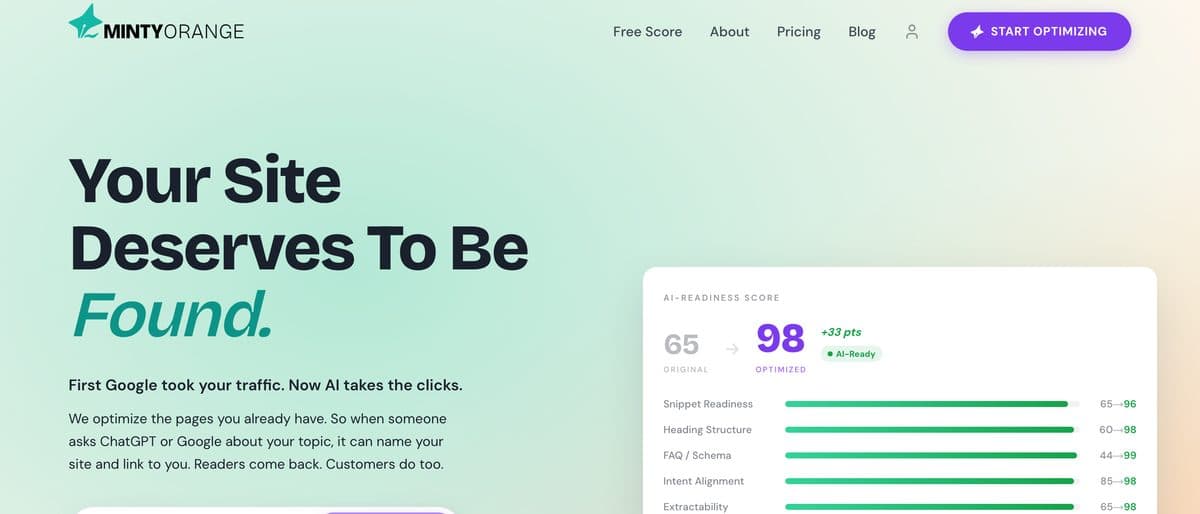
Minty Orange rebuilds articles you already published. You hand it a URL. It measures that article against the pages currently ranking on Google and against what AI engines need in order to quote a page, then rewrites it section by section in your voice. Both at once: classic search and AI search in one pass, not an AI feature bolted onto an old plugin. It does not write new posts from a blank page, and that focus is what keeps it cheap.
It tracks citations on ChatGPT, Perplexity and Google AI Mode, and rechecks twice a month, so you can watch one article after you update it. You can also do this by hand for free: it just takes time. we wrote a guide to the manual version and a piece on why the 3 engines cite such different pages.
The free plan gives you 2 preview optimizations and 2 citation checks, no card. Paid starts at $9 a month, or $7.50 billed yearly, for 5 optimizations. The free WordPress plugin applies changes one card at a time in the block editor. Accept, skip or undo each one, or undo everything. It writes your title and meta description into Yoast, Rank Math or All in One SEO. It also spots affiliate programs already in your article and leaves them alone.
It is not the biggest tool here, and it does not try to be. Semrush and Ahrefs carry far more data, Surfer and Frase have deeper content scoring, Otterly watches more platforms. And if your archive holds 5 posts, a tool built for archives is not the one you need yet.
Small publishers with an archive worth saving, especially one that earns money through links.
Anyone who needs new articles written. It only works on posts that already exist.
GetGenie: Best For Writing Inside WordPress On A Small Budget
GetGenie lives in your WordPress dashboard instead of a browser tab beside it. Keyword research, competitor analysis, writing and an AI readiness score, all in the admin you already have open. Its Content Rewriter works on a published post right in the editor.
The free tier gives you 2,500 AI words a month and never expires. The first paid plan lists at $10 a month with a 14-day money back guarantee. At 80,000 or so active installations and 4.8 stars it is by far the most used software in this comparison, which counts for something: a lot of people have tested it for you already.
It does not track whether AI engines cite you. Since July 2026 it connects to GA4, so you can see visitors arriving from AI sources. That answers a different question: who came, not who named you. GetGenie documents no citation monitoring, and its “Writing History” lists earlier drafts rather than undoing a rewrite.
If you want one plugin that researches keywords and writes new posts inside WordPress, nothing else here matches that range at $10. What you give up is the AI side: no citation tracking, and nothing documented about what a rewrite does to your links.
Bloggers on the smallest budget who want keyword research and drafting inside WordPress.
Anyone who needs to know whether AI engines name them. GetGenie documents no citation tracking.
NeuronWriter: Best For The Lowest Entry Price On Content Scoring
NeuronWriter does roughly what Surfer does for roughly half the money. It analyzes what currently ranks, designs new drafts, and imports an existing URL in Optimize mode to suggest terms and structure. AutoInsert drops recommended terms in for you, and you accept each suggestion on its own rather than in one block.
Bronze costs $23 a month, or $19 billed yearly, and covers 2 projects and 25 analyses. The 7-day trial runs at Gold level. Of all 8 makers here, NeuronWriter is the only one whose own marketing names freelancers and bloggers rather than teams and agencies.
Check 2 things before you buy the bottom tier. WordPress connects only from the Gold plan at $69 a month, and not through a directory plugin: you connect with a WordPress username and an application password. And AI visibility, which covers Google AI Overviews, Google AI Mode, ChatGPT and Perplexity, costs extra as a monitoring add-on. NeuronWriter publishes neither the price nor the required plan. Budget above $23 if either matters to you.
Freelancers and bloggers who want content scoring without a team-sized bill.
Bottom-tier buyers who need WordPress. That connection starts on the Gold plan at $69.
Otterly: Best For Watching What AI Answers Say About You
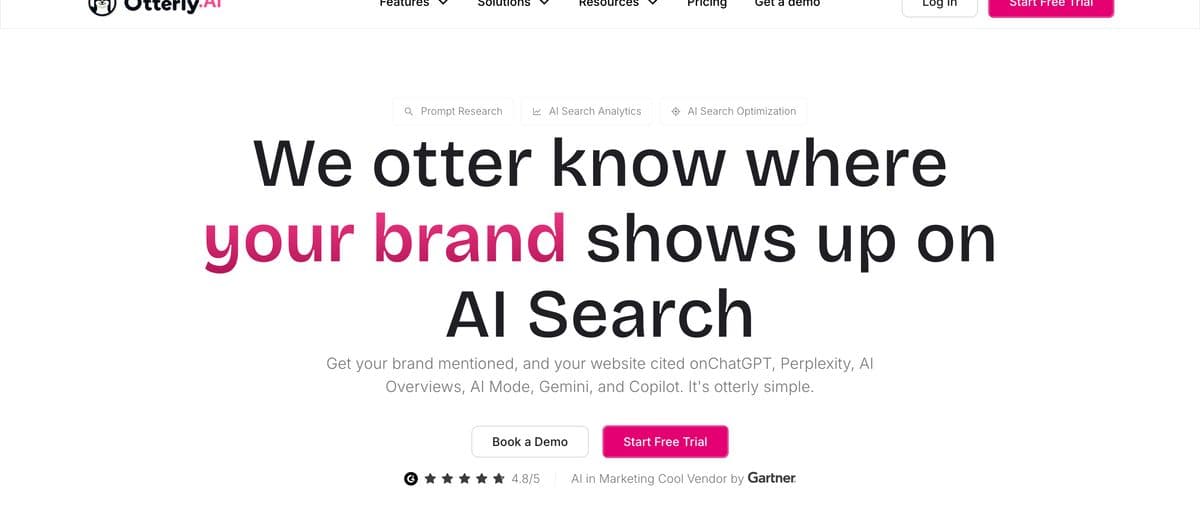
Otterly is the specialist, deliberately. It changes no text. It asks AI engines the questions your readers ask, counts how often they name you, compares you against competitors and shows the gaps. That is the whole product, and no tool here reaches 4 platforms more cheaply.
Lite costs $29 a month, or $25 billed yearly, and already covers ChatGPT, Google AI Overviews, Perplexity and Microsoft Copilot at 15 prompts a month. Claude, Google AI Mode and Gemini cost extra. There is a 7-day trial and no free tier. The WordPress plugin reports which AI bots visited your site. It does not edit anything.
15 prompts a month is small, and the next plan jumps from $29 to $189. Otterly builds its pricing for marketing teams and agencies, and describes its users that way. But if you want the clearest picture of where you stand in AI answers and you plan to write everything yourself, this is the cheapest serious way to get it.
Writers who do their own writing and just want to see what AI answers say about them.
Anyone expecting it to fix a page. Otterly measures, and that is the whole product.
Frase: Best For Writing New Posts From A Research Brief
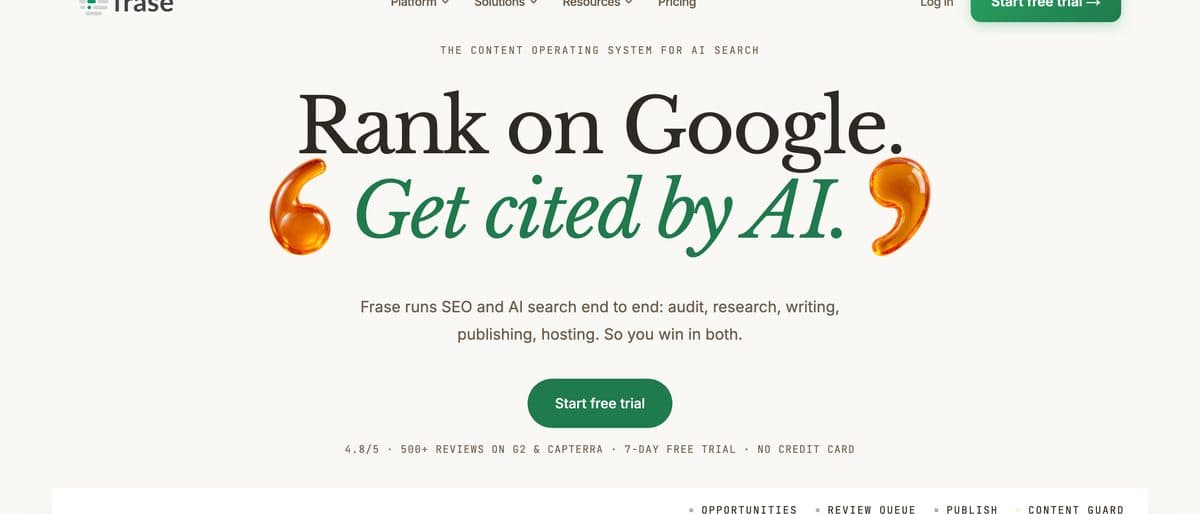
Frase starts where a writer starts, with the question and the competition. It pulls the pages that currently rank, builds a brief from them, and scores your draft for search and AI search side by side. For an existing blog the feature that matters is Content Guard. It watches pages you already published, drafts a correction when one starts losing ground, and waits for your approval before anything reaches your CMS. We like that design.
Frase starts at $49 a month, or $39 billed yearly, with a 7-day trial and no card. One seat, one site. Check the article allowance first: the pricing page says 10 articles and 50 audit pages, the help documentation says 5. Citation tracking comes with the entry plan for ChatGPT and Google AI at 50 queries a month. Perplexity arrives on the $129 tier.
The WordPress plugin publishes to your site and fills Yoast and Rank Math fields. It carries 300 or so installations and last saw an update 11 months ago, which is worth knowing before you build a workflow on it. Frase names content marketers, SEO teams and agencies as its audience, and the price fits exactly those people. If you write a lot of new posts and want a research brief behind each one, nothing here beats it.
Content marketers who publish new posts regularly and want a research brief behind each one.
Bloggers on a tight budget. It starts at $49, and the WordPress plugin last changed 11 months ago.
Surfer: Best For Content Scores And Keyword Coverage

Surfer is the tool most SEO people already know. The Content Editor scores a draft from 0 to 100 against live Google data, and in 2026 that score includes an AI Search Score beside the classic one. Auto-Optimize extends an existing piece while, in Surfer’s own words, keeping your tone and structure intact.
Surfer also documents an undo, the only other tool here that does. Every Auto-Optimize run saves a version you can compare or roll back. That is the feature we would want before we let any software touch a post that earns money. Credit where it is due: they shipped it and they wrote it down.
The pricing ladder is the catch. Discovery costs $49 a month billed yearly and covers 120 documents, but AI citation tracking appears in neither Discovery nor Standard. It starts on AI Search Analytics at $82 a month and then covers ChatGPT, Perplexity, Google AI Mode, Google AI Overviews and Gemini. Their free Surfer Pulse tracker shows how much AI citations swing from week to week, no account needed. Spend 10 minutes with it even if you never buy anything.
The WordPress plugin carries 6,000 or so installations and can pull an existing post in and write the update back. If your budget reaches the tracking tier, Surfer is the most complete mid-priced tool here.
Agencies and SEOs who work in content scores and want a version history they can roll back.
Anyone who wants cheap AI citation tracking. That starts at $82, two tiers above entry.
How To Choose In 5 Minutes
So where does that leave you? Run down this list and you will land on the right one.
- 1.Check what your business already pays for. If Semrush or Ahrefs sits on the invoice, you own AI visibility tracking. Use it before you buy a second tool for the same job.
- 2.Run the 4 questions above against your own blog. The answers cut 8 tools down to 2 or 3 in a couple of minutes.
- 3.Start free. GetGenie and Minty Orange both have a free tier, and the other 6 run trials. Put one real article through before you pay for a year of anything.
Then measure. Google Search Console has reported AI Overview and AI Mode impressions worldwide since August 2026, so you can watch the AI side of your own traffic for free, without any tool in this post. And if you want to know how often this actually ends in a citation, we published the numbers from our own articles instead of an estimate.
Want to see what a rebuild does to one of your own posts? Run one article through for free. No card, and you see the before and after score before anything gets published.
Key Takeaways
- ✓No single tool wins. Each one owns a job, so pick by what you need: fix old posts, write new ones, or just watch AI answers.
- ✓Small publishers lost 60% of their search visitors in a year, according to Chartbeat data reported by Axios.
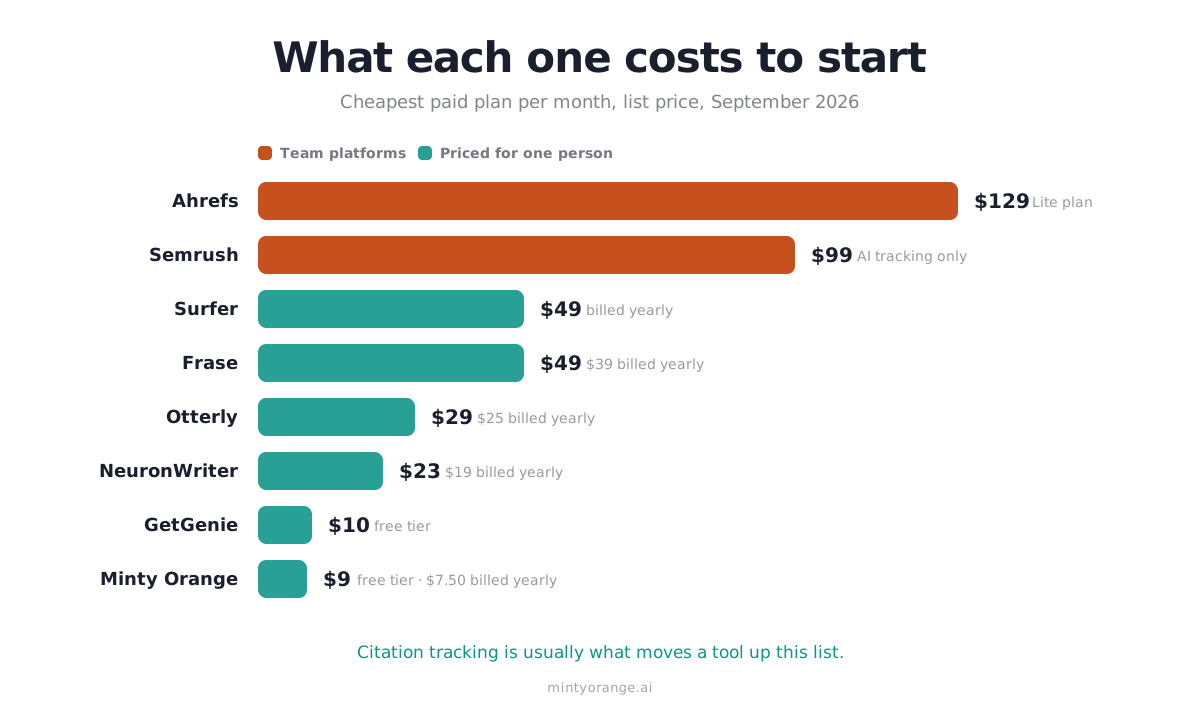
- ✓Entry prices run from $9 to $199 a month. Citation tracking is usually the expensive part.
- ✓Ask what happens to your links before an AI rewrites a post that earns money. Only 2 of these tools document a safety net at all.
Questions
Frequently Asked.
It depends on the job. Minty Orange rebuilds articles you already published. GetGenie writes cheaply inside WordPress. Surfer scores content and keyword coverage. NeuronWriter scores at the lowest entry price. Frase writes new posts from a research brief. Otterly tracks what AI answers say about you without touching your text. Semrush and Ahrefs are the most powerful of the 8 and the most expensive, and they make sense when a business already pays for the platform.
Usually not as a first purchase, and price is the reason, not quality. Semrush AI visibility tracking costs $99 a month per domain billed annually, and the plan that bundles SEO with AI Search costs $199. Ahrefs puts Brand Radar on its $129 Lite plan with 5 tracked prompts, and its standalone AI Visibility Index starts at $199. Otterly tracks 15 prompts across 4 platforms for $29. If your business already subscribes to either platform, use the AI tracking you own before you buy anything else.
Not to start. Google Search Console has shown AI Overview and AI Mode impressions worldwide since August 2026, for free, and you can ask ChatGPT and Perplexity your own key questions by hand in 10 minutes a month. A paid tracker earns its price once you make decisions based on the answer, because the manual version stops working past a handful of questions.
Nobody can promise they will not, so test on a post that earns nothing first. Of the 8, only Minty Orange publishes a measurement: 99.4% of protected links, images and embeds survived unchanged across 585 optimizations in 2026. Surfer documents version history you can roll back after an Auto-Optimize run. The other 6 document link handling neither way, which is not the same as handling it badly.
For one article, yes. GetGenie gives you 2,500 AI words a month for free, and Minty Orange gives you 2 preview optimizations and 2 citation checks without a card. Semrush, Ahrefs, Frase, Surfer, NeuronWriter and Otterly run trials, most of them 7 days. Put one real post through and look at the output before you commit to a year.
Give it a few weeks, and measure something specific instead of watching total traffic. Pick the articles you changed, watch their impressions and their AI Overview impressions in Search Console, and check by hand whether the engines name you for the 2 or 3 questions that matter most. Total site traffic moves for a dozen reasons at once and will never tell you what your edits did.