How Many Blog Articles Get Cited by AI After Optimization?
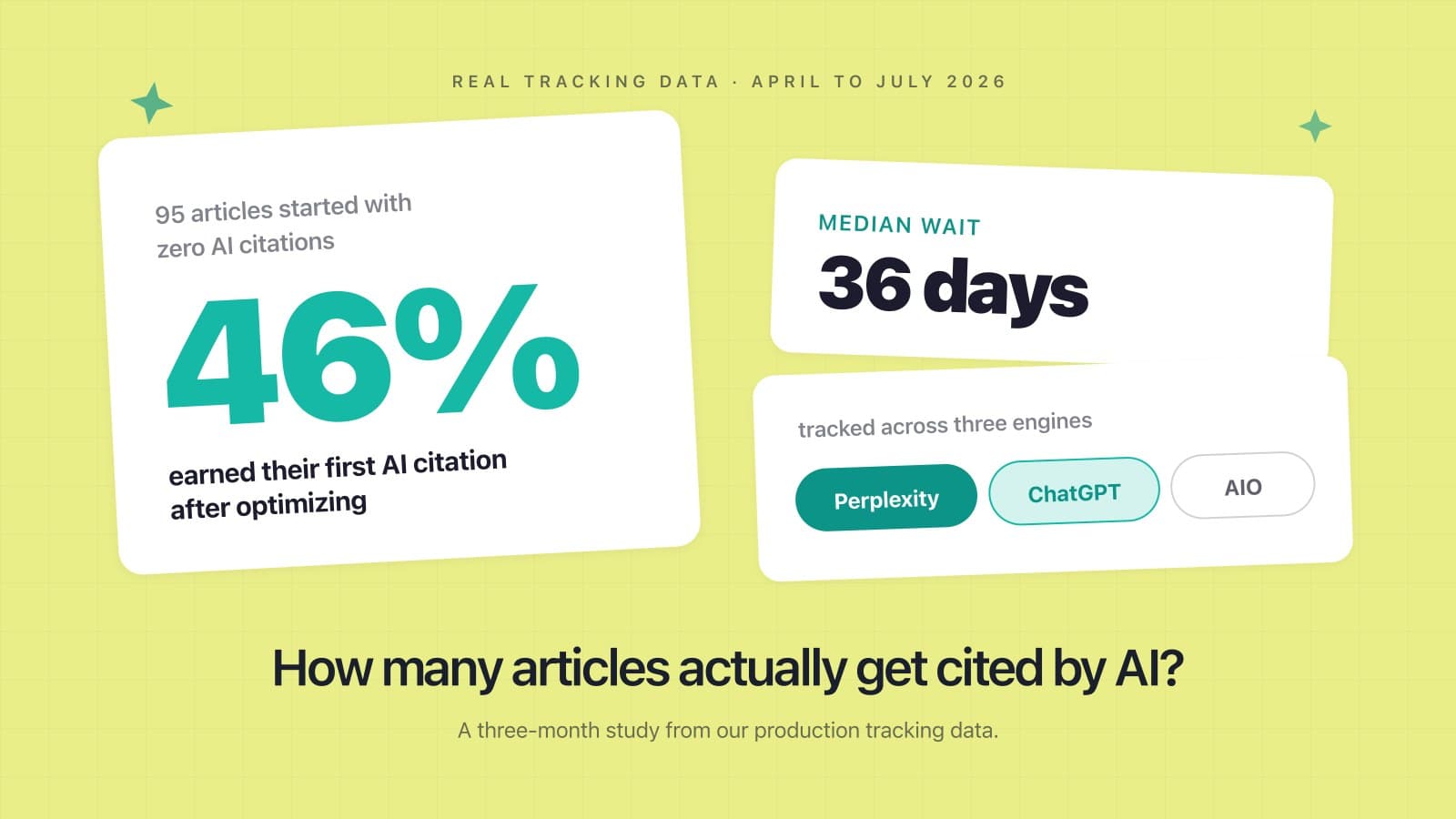
46% of blog articles that started with zero AI citations earned their first citation within three months of being optimized, with a median wait of 36 days. That is the headline result from tracking 95 articles across ChatGPT, Perplexity, and Google AI Overviews between April and July 2026. This post breaks that number down into eight findings, with the full methodology attached.
Every AI search tool promises visibility. Almost none of them will show you a number. And we kept getting the same question from bloggers, in emails and in comments: if you actually put in the work and optimize an article, what are the odds that ChatGPT or Perplexity starts citing it?
We could not find a single tool in our price class that publishes that number. So we pulled it out of our own production database instead. Minty Orange tracks every optimized article across ChatGPT, Perplexity, and Google AI Overviews, and re-checks each one every two weeks.
Quick Facts
| Metric | Value |
|---|---|
| Measurement window | April 1 to July 29, 2026 |
| Tracked keywords | 316 |
| Citation checks executed | 4,038 |
| Study cohort (started at zero citations) | 95 articles |
| Earned their first AI citation | 44 articles (46%) |
| Median wait to first citation | 36 days |
| Fastest first citation | 5 days |
| Slowest first citation | 109 days |
| Citations still standing after 30+ days | 75% (86% on Perplexity) |
| Share of citations placed in the answer's top 3 sources | 62% |
Methodology
Everything below comes from the Minty Orange production database. No sampling, no manual selection. Here is exactly how we counted.
The sample
Between April 1 and July 29, 2026, users optimized and tracked 316 keywords. Each tracked keyword is checked against three engines (ChatGPT, Perplexity, Google AI Overviews) roughly every two weeks, which produced 4,038 citation checks in the window. The articles are real content from blogs using Minty Orange in production, mostly travel and family-travel sites, with a few food and local-business sites mixed in.
The study cohort
For the headline conversion number we only counted keywords that can give a fair answer: the article had zero AI citations on any engine at its first check, and it was either observed for at least 21 days afterwards or earned a citation before that. That leaves 95 articles. Articles that were already cited when tracking started are excluded, because they cannot tell us anything about going from zero to cited.
What counts as cited
A check counts as a citation when the engine's answer links or references the tracked article's domain for the tracked query. We count actual source references, not brand mentions in passing. Google AI Overview checks where no AI Overview was shown for the query (309 checks) count as not cited, because for the searcher, the citation opportunity did not exist.
The three-check loss rule
AI retrieval is wobbly. A citation can vanish at one check and be back at the next without anything changing on the page. So we never treat a single bad check as a loss: a citation only counts as lost after it has been absent for three consecutive checks. This mirrors how the Minty Orange product reports losses to users, and it matters for the durability numbers below.
Finding 1: 46% Went From Zero to Cited
Of the 95 articles that started with zero AI citations, 44 earned their first citation after optimizing. That is 46%, with a median wait of 36 days.
Some context, because 46% sounds modest until you see the baseline. Semrush analyzed 126 million AI search prompts in 2026 and found that even pages ranking in Google’s top 10 only appear in AI answers 44.3% of the time. Ranking on page one and getting cited by AI are two different games. Our 46% was measured on articles that started out completely invisible to AI.
Finding 2: The Median Wait Is Five Weeks
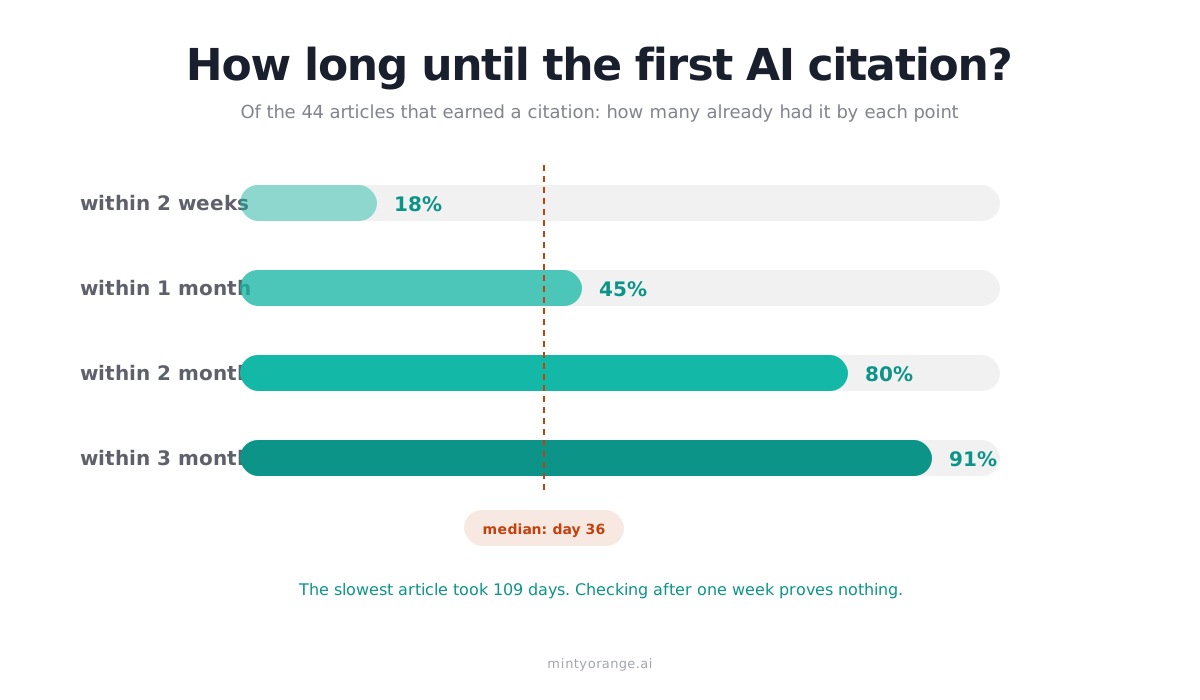
The median wait was 36 days, and the spread matters more than the median. Of the articles that earned a citation, 18% got it within two weeks, 45% within a month, 80% within two months, and 91% within three. The fastest article was cited after just 5 days, the slowest took 109.
If you optimize an article and check back after a week, you will usually see nothing, feel disappointed, and conclude it did not work. It almost certainly did not fail. The engines simply have not re-read your page yet. A month is normal. Two months is still normal.
Finding 3: Perplexity Cites Blogs the Most
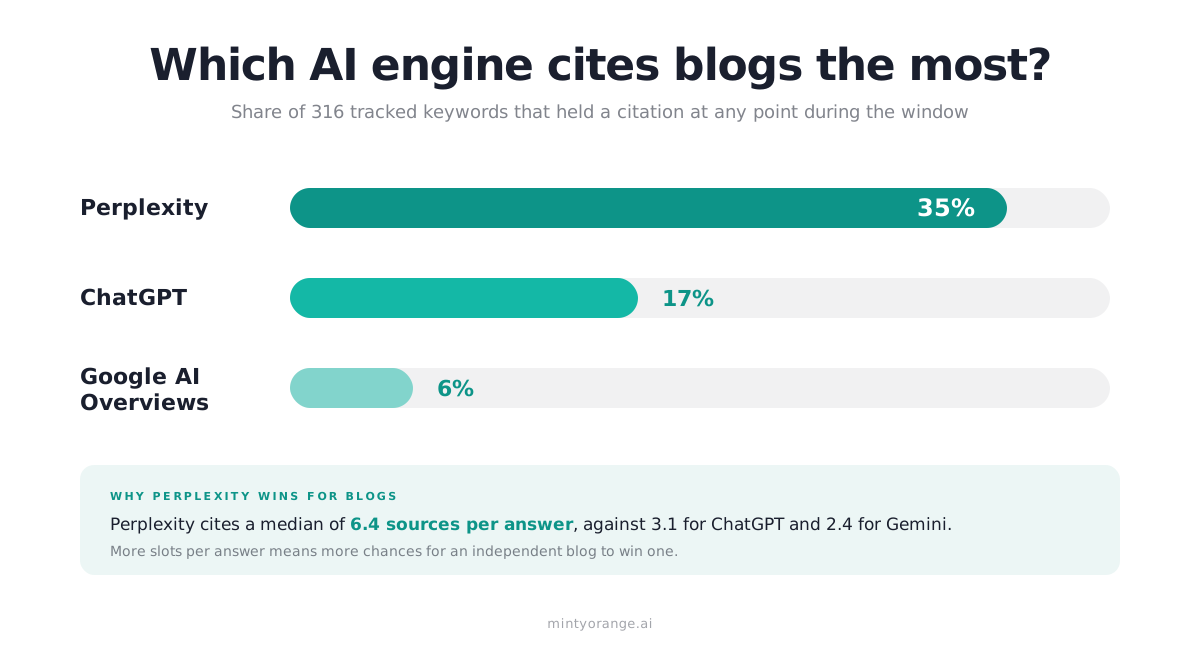
Perplexity is by far the friendliest engine for bloggers, and the reason is structural: a 2026 study of 14,400 prompt runs found Perplexity cites a median of 6.4 different domains per answer, against 3.1 for ChatGPT and 2.4 for Gemini. More slots per answer means more chances for an independent blog to win one.
Google AI Overviews are the hardest surface by a wide margin. When one of our tracked articles landed there, it was an event, not a routine. If your citations are mostly on Perplexity right now, that is not a consolation prize. That is the normal shape of the market.
Finding 4: Articles Already Ranking in Google Converted at 100%
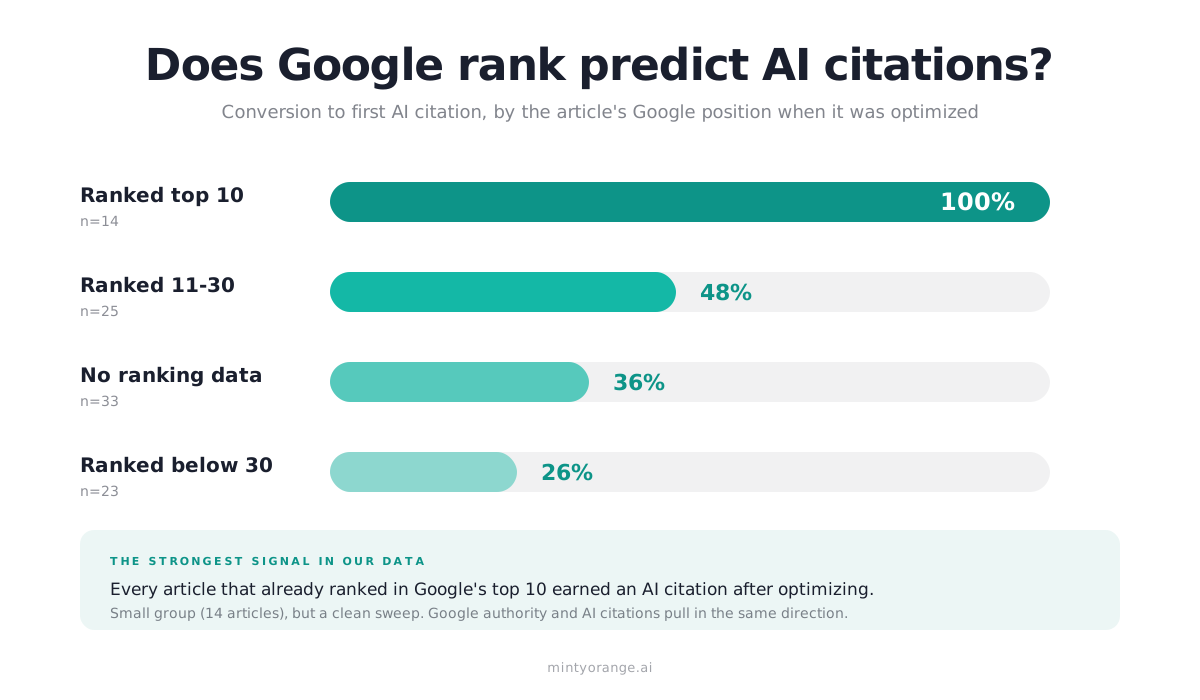
For every optimized article we store its Google position at optimization time when Search Console data is available. The pattern is unambiguous: all 14 articles that already ranked in Google's top 10 earned an AI citation. Articles ranked 11 to 30 converted at 48%. Articles ranked below 30 converted at 26%.
Fourteen articles is a small group, so treat the 100% as a strong signal rather than a law of nature. But the direction is consistent across all tiers: existing Google authority and AI citations pull in the same direction. Optimization is not a way around building authority. It is a way to convert the authority you have into AI visibility.
The most interesting tier is the middle one. Articles stuck on page two or three of Google converted at roughly the study average. If you have articles sitting at position 15 with solid content, those are your best candidates: too weak to get AI attention on their own, strong enough to convert once the structure is right.
Finding 5: When AI Cites You, It Cites You High
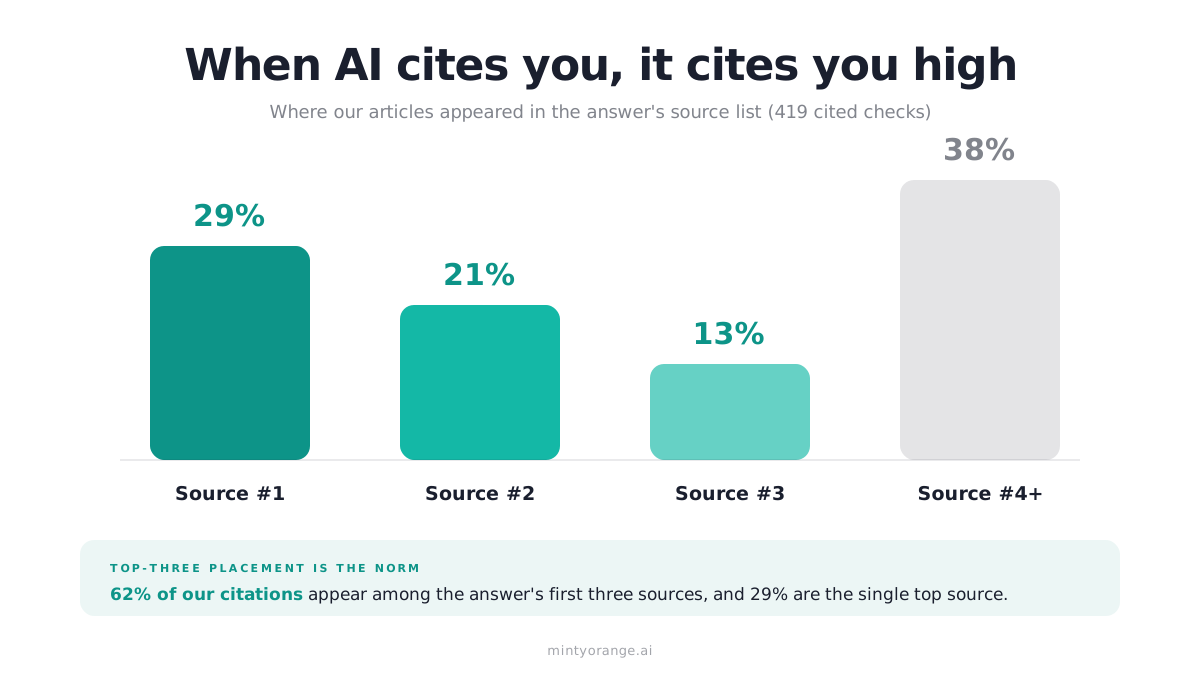
Getting cited is not the same as being visible. An answer can list ten sources, and being source number nine is worth little. So we checked where our articles landed: across 419 cited checks, 29% appeared as the answer's single first source, and 62% landed among the top three.
That distribution surprised us. We expected optimized articles to scrape into answers at the tail end. Instead, when an engine decides to cite a well-structured article, it tends to lean on it as a primary source. Citations are closer to winner-take-most than to a lottery of honorable mentions.
Finding 6: Who Gets Cited Instead of Blogs
Every citation check also records which domains the engine cited for that query. Across the latest check of every tracked keyword, the most-cited domains in our niches look like this:
| Rank | Domain | Appearances |
|---|---|---|
| 1 | youtube.com | 233 |
| 2 | reddit.com | 123 |
| 3 | tripadvisor.com | 101 |
| 4 | facebook.com | 87 |
| 5 | instagram.com | 49 |
| 6 | google.com (Maps) | 45 |
| 7 | getyourguide.com | 45 |
| 8 | en.wikipedia.org | 40 |
The competition for citation slots is not other blogs. It is platforms: video, forums, review sites, and social. Individual blogs barely register in the top ranks, which is exactly why a blog that structures its content for extraction can jump the queue. You are not fighting a thousand other bloggers for the slot. You are offering the engine something the platforms cannot: a direct, self-contained answer written by someone who was actually there.
The engines also have distinct tastes. ChatGPT leans on Google Maps and YouTube. Perplexity loves YouTube, TripAdvisor, and Reddit. Google AI Overviews pull heavily from Reddit and social platforms. Same query, three different source diets, which is one more reason single-engine strategies underperform.
Finding 7: Citations Mostly Stick
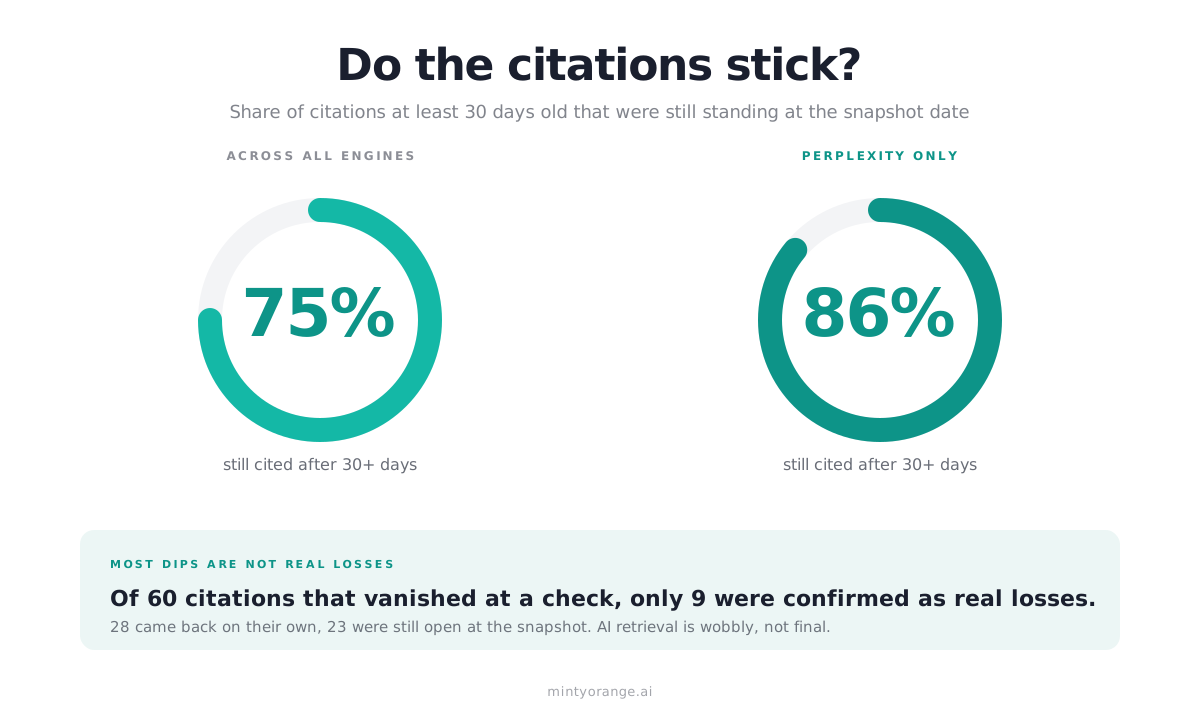
A citation you lose next week is worth nothing, so we checked durability too. Of all citations in our data that were at least 30 days old at the snapshot, 75% were still standing under our three-check loss rule. On Perplexity it was 86%.
And most dips are not real losses. Across three months we watched 60 citations disappear at a check. Only 9 of them were confirmed as lost under the three-check rule. 28 came back on their own within a check or two, and 23 were still open at the snapshot. One bad check is noise, not news.
Finding 8: Most Winners Win on One Engine
Of the 44 articles that earned citations, 36 were cited on exactly one engine, 7 on two, and only one article was cited on all three. Perplexity-only is the most common pattern by far.
There is no portfolio effect where one citation unlocks the others. Each engine runs its own retrieval, has its own source diet, and re-reads the web on its own schedule. ChatGPT was also the fastest to cite in our data (median 27 days for its winners, against 38 for Perplexity), it just cites blogs less often. Treat every engine as a separate market with its own timeline.
This Is an Ongoing Measurement
Every optimized article in Minty Orange gets re-checked every two weeks, so the dataset expands automatically. We would rather share what we see than let the numbers sit in a database, so we will publish an updated version of this analysis every quarter.
Some of the numbers will move as the sample grows. The median wait may shift. Perplexity's dominance may soften or sharpen. Retention will become more reliable at higher n. The point of this post is not any single number. It is the ongoing measurement, and we will keep documenting it in public.
Limitations
- ✓No control group. We cannot prove these 44 articles would have stayed uncited without optimization, because we do not deliberately leave articles unoptimized to watch them fail. The honest claim is: 46% of articles that started at zero earned their first citation after optimizing.
- ✓It measures people, not just software. An optimization only exists once you publish it. Some articles that never got cited may simply never have gone live with their changes.
- ✓Some sub-analyses are small. The 100% conversion of top-10 articles rests on 14 articles. The per-engine speed comparison rests on 14 ChatGPT winners. We report the n alongside every such number.
Key Takeaways
- ✓46% of articles that started with zero AI citations earned their first one after optimizing (44 of 95 articles, April to July 2026).
- ✓The median wait was 36 days. Checking after one week proves nothing, and two months is still a normal timeline.
- ✓Perplexity cites blogs the most by far (35% of tracked keywords). ChatGPT is second at 17%. Google AI Overviews are rare and hard at 6%.
- ✓Articles that already ranked in Google's top 10 converted at 100%. Google authority and AI citations pull in the same direction.
- ✓When AI cites you, it cites you high: 62% of citations land in the answer's top three sources.
- ✓Your real competition for citation slots is YouTube, Reddit, and TripAdvisor, not other blogs.
- ✓Citations mostly stick: 75% of citations older than 30 days were still standing, 86% on Perplexity, and only 9 of 60 dips were confirmed losses.
- ✓Most winners win on one engine. Treat ChatGPT, Perplexity, and Google AI Overviews as separate markets.
Questions
Frequently Asked.
In our data the median was 36 days. About 18% of articles that earned a citation got it within two weeks, 45% within a month, 80% within two months, and 91% within three. The slowest took 109 days, so patience is part of the strategy.
Perplexity, by a wide margin: 35% of the keywords we track held a citation there during the study window, against 17% on ChatGPT and 6% in Google AI Overviews. Perplexity also cites more sources per answer than any other engine, which means more slots an independent blog can win.
Strongly, in our data. Every one of the 14 articles that already ranked in Google's top 10 earned an AI citation after optimizing, articles ranked 11-30 converted at 48%, and articles below position 30 converted at 26%. Google authority and AI citations pull in the same direction.
Higher than you would expect. Across 419 cited checks in our data, 29% of citations appeared as the answer's first source and 62% landed in the top three. When an engine picks up a well-structured article, it tends to use it as a primary source rather than a footnote.
Mostly yes. In our tracking, 75% of citations that were at least 30 days old were still standing, and on Perplexity it was 86%. Short dips are common: of 60 citations that vanished at a check, only 9 were confirmed as real losses.
No, and you should be suspicious of anyone who promises it. AI engines decide what they cite. What a tool can do is make your article easy to cite: clear answers, verifiable facts, clean structure. That is what moved 46% of the articles in our data from zero citations to their first one.
Featured in Search Engine Roundtable, August 4, 2026.
Want to know what your own odds look like? Minty Orange optimizes your article in place and then tracks it in ChatGPT, Perplexity, and Google AI Overviews for you. The free plan covers your first two articles, so you can test it on your most stubborn post.