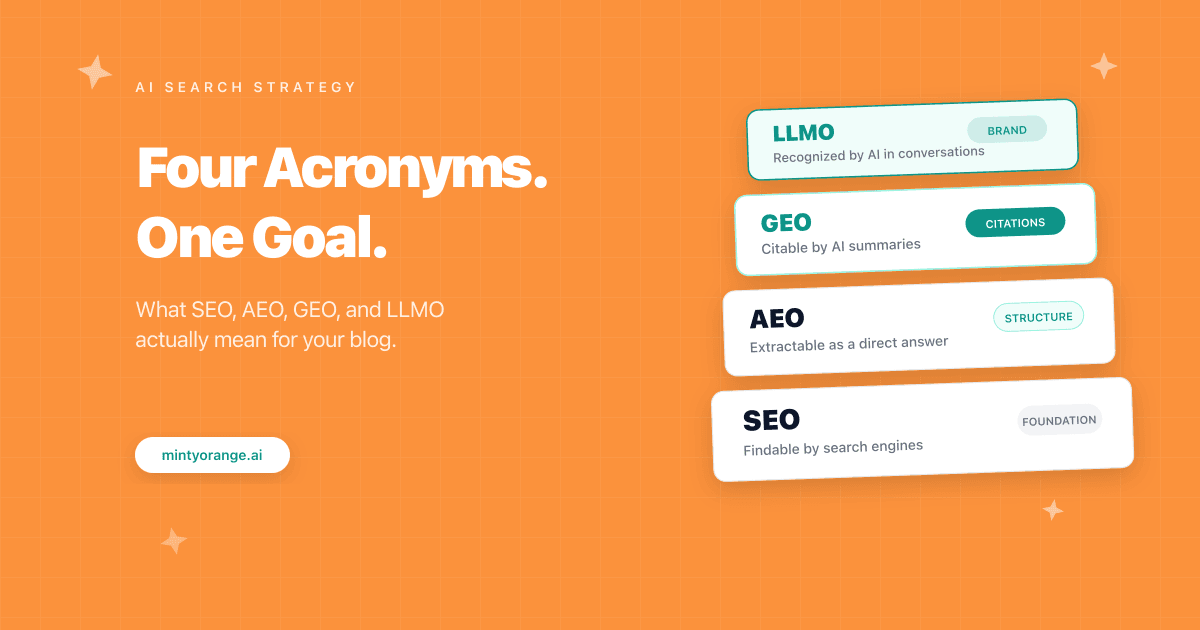
What Is the Difference Between SEO, GEO, AEO, and LLMO?
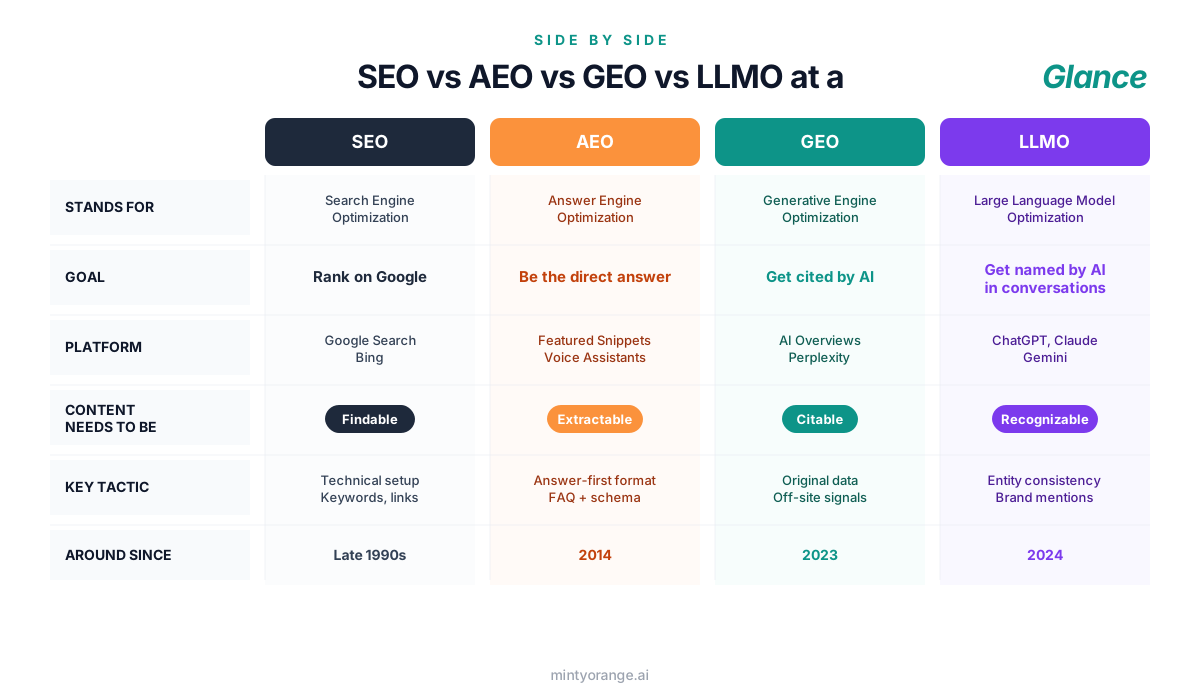
SEO (Search Engine Optimization) is the practice of making your content findable on Google. AEO (Answer Engine Optimization) focuses on structuring your content so it can be extracted as a direct answer in featured snippets, voice results, and answer boxes. GEO (Generative Engine Optimization) is about making your content citable by AI-generated summaries like Google AI Overviews and Perplexity. LLMO (Large Language Model Optimization) targets LLMs directly (ChatGPT, Claude, Gemini) so they recognize and recommend your brand in conversations. In practice, these four disciplines share about 80% of the same work. The differences are in which system you are optimizing for, not in what good content looks like.
If you have spent any time in marketing corners of the internet lately, you have probably seen these four acronyms show up everywhere. Sometimes in the same sentence. Often with conflicting definitions. And usually presented as if each one requires a completely separate strategy.
That is not how it works. And for most publishers and bloggers, the confusion these acronyms create is worse than the problem they describe.
SEO: The Foundation That Still Holds
SEO is the one you know. Search Engine Optimization. Make your site findable on Google. Clean structure, relevant content, good technical setup, links from trusted sites. This has been the baseline since the late 1990s, and it still is.
Nothing about SEO stopped working. Google still crawls your site, still indexes your pages, still ranks them based on relevance, quality, and authority. Your title tags still matter. Your page speed still matters. Your internal linking still matters.
What changed is that SEO alone produces fewer clicks than it used to, because 60% of Google searches now end without a click. AI answers satisfy many queries before anyone reaches your page. But the pages that AI pulls from? Those are still the ones with strong SEO fundamentals. You cannot skip this layer. Everything else builds on top of it.
In one sentence: SEO makes your content findable by search engines.
AEO: Be the Direct Answer
AEO stands for Answer Engine Optimization. It is about structuring your content so systems can extract a clean, direct answer from it.
Think of Google’s featured snippets (the box at the top that answers your question without you clicking). Think of voice assistants reading an answer out loud. Think of any system that needs to pull a short, precise response from your page and display it somewhere.
AEO has been around for a while, since Google introduced featured snippets in 2014. The practice is straightforward: write clear answers to specific questions, use proper heading structure, add visible FAQ sections (Google retired FAQ rich results in May 2026, so the visible question-and-answer text is what counts, not the markup), and make your key points scannable and extractable.
If you have ever written a blog post with a clear Q&A at the top, or formatted an FAQ so Google could pull it into a rich result, you have done AEO. The name just gives a label to work many publishers were already doing.
In one sentence: AEO makes your content extractable as a direct answer.
GEO: Get Cited in AI-Generated Summaries
GEO is Generative Engine Optimization. This is the newer one, and it is where most of the confusion lives.
When Google AI Overviews, Perplexity, or a similar system generates a summary answer to a query, it pulls information from multiple sources and combines them into one response. GEO is the practice of making your content the kind of source these systems choose to pull from and cite.
The key difference between AEO and GEO: AEO is about being extracted (your content pulled and displayed as the answer). GEO is about being cited (your page referenced as a source within a generated summary that may combine information from several places).
GEO involves deeper work than AEO. Beyond having a clean answer, your content needs enough Information Gain (original data, unique perspective, verifiable claims) that the AI considers your page worth citing over the dozens of other pages on the same topic.
It also involves off-site signals. AI engines check whether your content is referenced, discussed, and trusted across the web before deciding to cite it. Community mentions, external citations of your data, and ecosystem visibility all feed into this.
In one sentence: GEO makes your content citable by AI-generated summaries.
LLMO: Make AI Know Who You Are
LLMO stands for Large Language Model Optimization. This is the newest term and the one with the fuzziest boundaries.
LLMO is about making your brand recognizable to AI models like ChatGPT, Claude, and Gemini, not just within search results, but in open-ended conversations. When someone asks ChatGPT “what tools help with AI search optimization?” and ChatGPT mentions your product by name, that is LLMO at work.
In practice, LLMO is mostly a subset of GEO with extra emphasis on brand signals. It includes things like consistent entity information across the web (same name, same description, same domain everywhere), schema markup that helps AI understand who you are and what you do, and being mentioned on trusted third-party sources so the AI’s training data includes your brand.
The honest assessment: if you are doing solid GEO work (original content, off-site presence, clean structure), you are already doing about 90% of LLMO. The remaining 10% is brand-level work like entity consistency and making sure your brand shows up in the right contexts across the web.
In one sentence: LLMO makes your brand recognizable to AI models in conversations.
How They All Overlap (a Lot)
Here is what nobody selling you a “GEO strategy” or an “LLMO audit” wants you to know: the work involved in all four is remarkably similar.
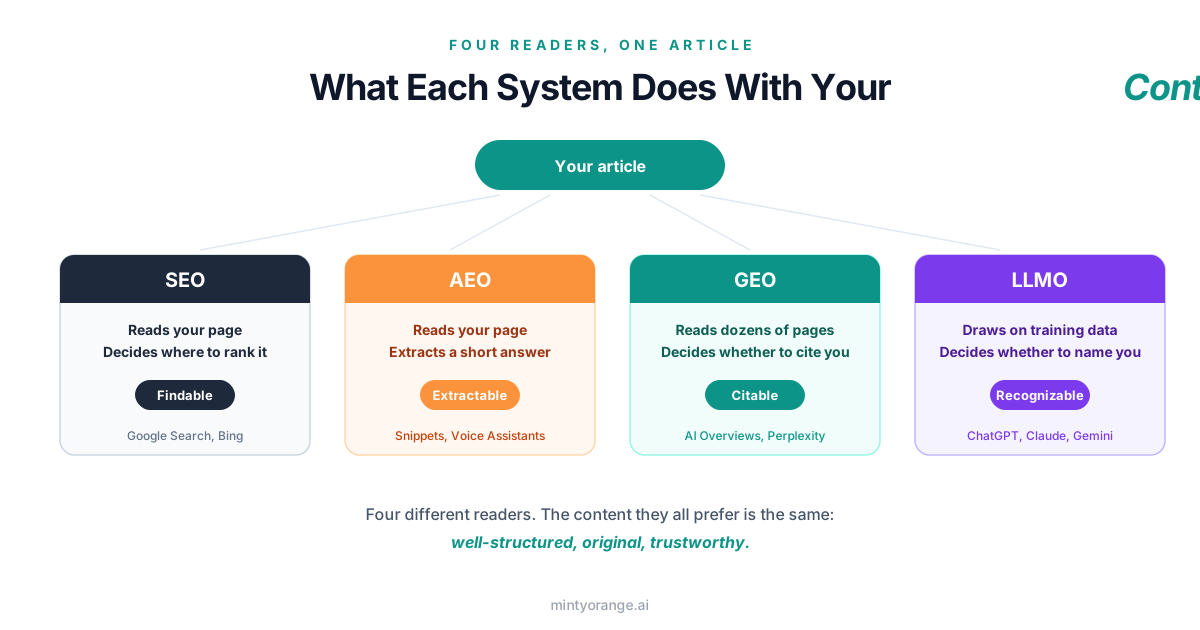
Good content structure helps SEO, AEO, GEO, and LLMO. Original data helps all four. A clean FAQ section helps all four. Strong E-E-A-T helps all four. Being referenced on trusted external sites helps all four.
The differences are real but narrow. They come down to which system is doing the reading and what format it expects:
Google Search reads your page and decides where to rank it. That is SEO.
Answer boxes and voice assistants read your page and extract a short answer from it. That is AEO.
AI Overviews and Perplexity read your page alongside dozens of others and decide whether to cite you in a generated summary. That is GEO.
ChatGPT, Claude, and Gemini draw on their training data and retrieval systems to decide whether to mention your brand in a conversation. That is LLMO.
What Bloggers and Publishers Should Focus On
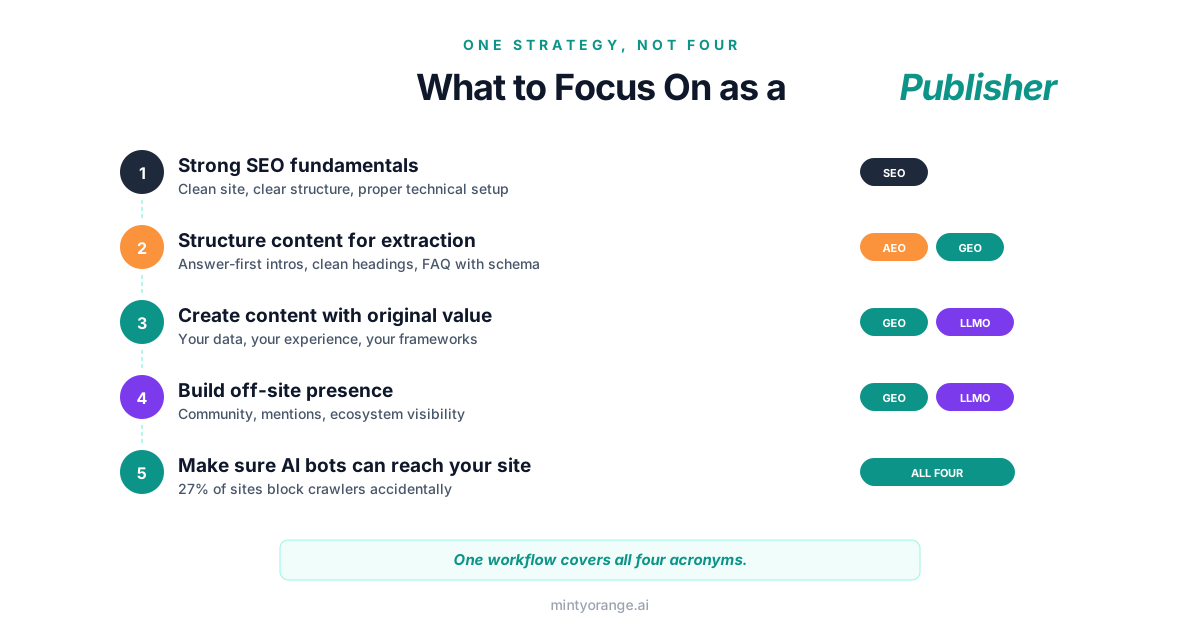
If you are a blogger or small publisher, here is what I would focus on instead of trying to build four separate strategies.
Start with strong SEO fundamentals. Clean site, clear structure, relevant content, proper technical setup. This is the base layer. Without it, nothing else works.
Structure your content for extraction. Answer-first intros, clean headings, visible FAQ sections. This covers both AEO and the structural requirements of GEO. One set of practices, two acronyms handled.
Create content with original value. Your own data, your own experience, your own frameworks. This is what separates content that gets cited (GEO) from content that gets summarized away. It is also what makes LLMs more likely to reference your brand (LLMO). We wrote an entire guide on this.
Build off-site presence. Community engagement, being referenced by other sites, ecosystem visibility. This strengthens GEO and LLMO signals simultaneously.
Make sure AI bots can reach your site. In a recent audit, roughly 1 in 4 sites blocked at least one major AI crawler without knowing it. If the bots cannot reach your pages, none of the optimization work matters.
Track both channels. Traditional rankings on Google and AI citations across ChatGPT, Perplexity, and AI Overviews. Without that visibility, you cannot tell what is actually working.
If that sounds like a lot of moving parts, it is. That is also why we built Minty Orange: it scores your content for both Google ranking and AI citation in one pass, then tracks where it ends up across all three engines, so the optimization work and the measurement live in one place instead of in five different tools.
Key Takeaways
- ✓SEO makes your content findable. AEO makes it extractable. GEO makes it citable. LLMO makes your brand recognizable to AI.
- ✓About 80% of the work is the same across all four: good structure, original content, strong trust signals, clean technical setup.
- ✓The differences are in which system reads your content and what format it expects, not in what good content fundamentally looks like.
- ✓LLMO is largely a subset of GEO with extra emphasis on brand consistency and entity signals. If you are doing solid GEO, you are doing most of LLMO.
- ✓For bloggers and publishers, building four separate strategies is unnecessary. Focus on strong SEO fundamentals, structure content for AI extraction, create original content, and build off-site presence.
- ✓These are layers, not replacements. Each one builds on top of the previous. Skip SEO and none of the others work.
The Bottom Line
The acronyms will keep multiplying. Marketing loves new labels. But the work underneath stays more consistent than the terminology suggests.
Write content that says something worth saying. Structure it so machines can parse it. Make sure AI can reach it. Build trust signals beyond your own site. And track where you show up, on Google and in AI answers.
That covers SEO, AEO, GEO, and LLMO. And whatever acronym comes next.
Questions
Frequently Asked.
No. About 80% of the work overlaps. Strong content structure, original information, clean technical setup, and good trust signals serve all four disciplines. The differences are in which platform reads your content (Google Search, answer boxes, AI summaries, or LLM conversations), not in what makes content good. One well-executed content strategy covers most of the requirements across all four.
SEO is still the foundation. Without it, the other three cannot function because your content needs to be crawlable and indexable first. GEO is the fastest-growing in importance because AI-generated answers appeared in 48% of Google searches as of February 2026 (BrightEdge) and became the default experience after Google I/O 2026. AEO and LLMO matter but are narrower in scope.
GEO optimizes your content for AI systems that generate search answers (Google AI Overviews, Perplexity). LLMO optimizes your brand for large language models used in open-ended conversations (ChatGPT, Claude, Gemini). In practice, LLMO is a subset of GEO with extra emphasis on brand consistency, entity recognition, and being mentioned across trusted third-party sources so AI models know who you are.
AEO started with featured snippets but now covers any system that extracts direct answers from your content. This includes Google’s featured snippets, voice assistant responses, answer boxes, and the extractable sections that AI Overviews pull from your page. AEO is about making your content easy to quote directly.
You can, and your Google rankings will still benefit. But you will miss the growing share of visibility that comes through AI-generated answers. In 2026, 60% of Google searches end without a click, and AI citations are becoming a separate traffic channel. Doing “just SEO” means you are optimizing for one channel while a second one grows around it. The good news is that the additional work to cover GEO and AEO is relatively small if your SEO fundamentals are strong.
Minty Orange combines SEO and GEO optimization in one workflow. It analyzes your content for both traditional ranking factors and AI citation readiness, tracks where you appear across Google, ChatGPT, Perplexity, and AI Overviews, and identifies gaps in both on-page structure and off-site signals. Instead of needing separate tools for each acronym, you get both eras of search covered in one place.