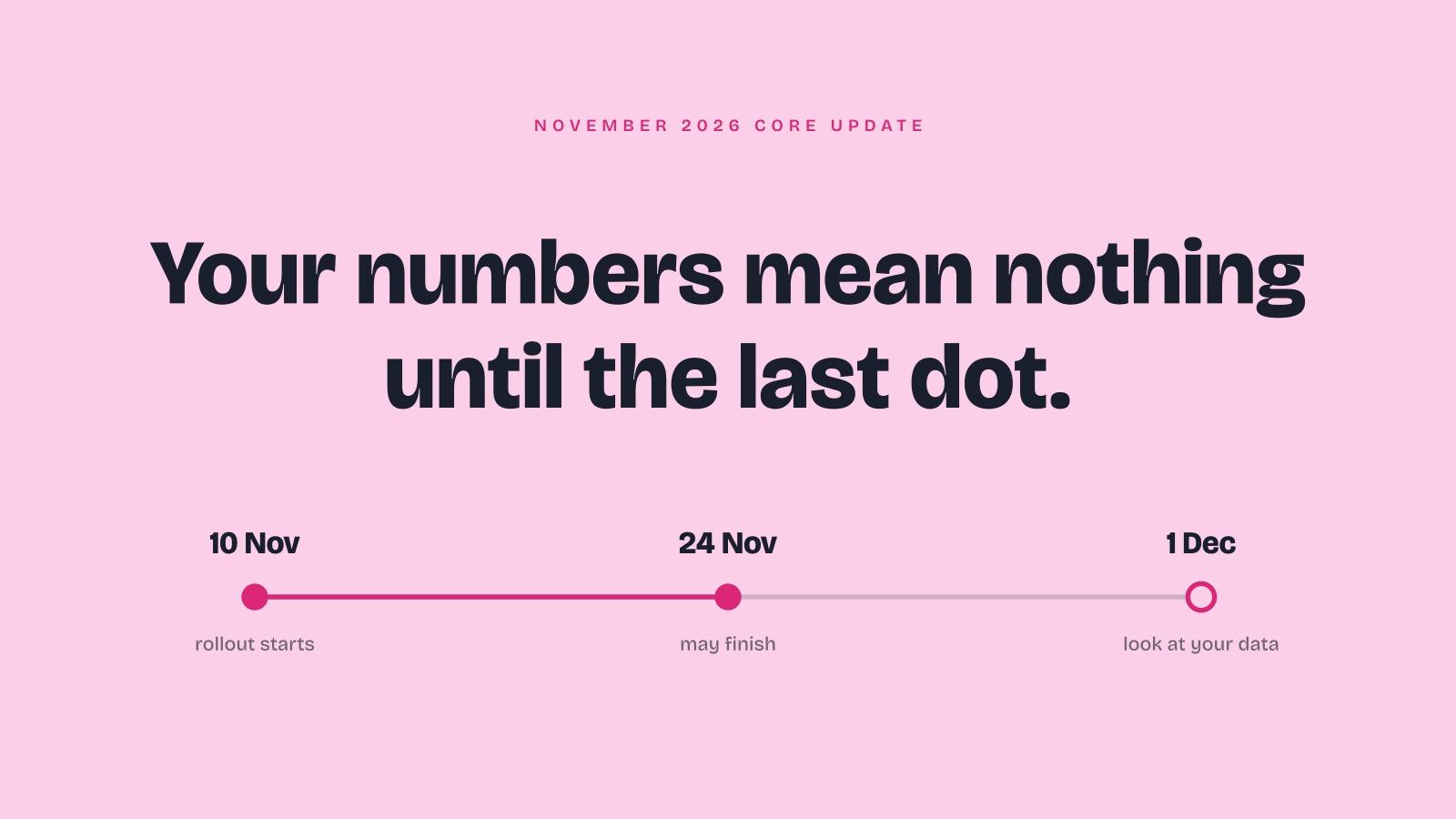
- It started on 10 November and may run until around the 24th. Global, every language.
- Your numbers right now mean nothing. Rankings move in both directions while a core update rolls out, then settle.
- Google says wait a full week after it completes before you analyze anything in Search Console.
- Google also says avoid quick fixes. Changes made mid-rollout teach you nothing, because you cannot tell your change from the update.
- Take your baseline now, from the week before 10 November. In 3 weeks you will not be able to reconstruct it.
Google started rolling out a core update yesterday. I know exactly what I did the last time that happened, and it was the wrong thing. I opened Search Console. Then I opened it again an hour later.
So this is the post I wish someone had put in front of me in December 2025, when a core update took 87% of my travel blog’s search traffic over a single weekend. Not because there is a trick that saves you. Because there are 2 weeks in front of you now, and what you do with them decides whether you learn anything from this one.
What Google Said
The facts are short, and all of them sit on the Search Status Dashboard. The November 2026 core update began on 10 November at 10:06 Pacific. It applies globally and to all languages. The rollout may take up to 2 weeks to complete, which puts the likely end around 24 November.
That is the entire announcement. There is no list of what it targets, no named content type, no guidance specific to this one. Core updates never come with that, and this is the third of 2026 after March and May.
Why Your Numbers Mean Nothing This Week
A core update rolls out over 2 weeks, and different parts of the index get reassessed at different times. A page can drop on Thursday, come back on Sunday and settle somewhere else entirely by the time it finishes.
Google is unusually direct about what to do with that: we recommend waiting at least a full week after a core update completes before analyzing your site in Search Console. Add that to a rollout that may run to 24 November and you are looking at the start of December before your own data can tell you anything.
I find that genuinely hard, and I am not going to pretend otherwise. But every number you read before then is a number from the middle of a process, and reacting to it is how people break pages that were going to recover on their own.
Do This Part Today
There is exactly one time-sensitive job, and it takes 10 minutes. Write down your baseline. Google’s own instruction for later is to compare the week after against the week before the rollout started, so you need the week before 10 November captured while it is still easy to reach.
- 1.Open Search Console, Performance, Search results. Set the date range to 3 to 9 November, the last clean week.
- 2.Export the Pages tab. Clicks, impressions, position, per URL. A CSV in a folder is enough. This is the thing you cannot reconstruct later once the comparison windows move.
- 3.Do the same for Queries. If a term drops out entirely, a ranking tool will not tell you it was ever there. Your own export will.
- 4.Note the date you exported it. Sounds trivial. In 4 weeks you will not remember whether that file was before or after the update started.
That is it for today. Everything else on your to-do list can wait 3 weeks without costing you anything.
Someone Will Tell You This Targets AI Content
Give it a few days and you will read that this update targets AI-written content. It happens after every core update, and it is worth knowing where that claim comes from before it reaches you.
It comes from inference, not from Google. No ranking update between 2022 and today has been announced as a move against AI-written text, and the one spam rule that mentions generative AI is about publishing many pages without value for users. We went through the whole evidence base, including what the documented penalties had in common, in will Google penalize your post for AI-written sections.
Google’s own framing for core updates is the opposite of targeting: core updates don’t target specific sites or individual web pages. The restaurant comparison on that page is the useful bit. Restaurants that move down the list aren’t necessarily bad. Other restaurants made the top 20.
Which is cold comfort when it is your restaurant. But it does change what you go looking for afterwards, and that matters more than it sounds.
What Not To Do For The Next 2 Weeks
- ✓Do not mass-rewrite anything while the rollout is running. Not with a tool, not by hand.
- ✓Do not delete or noindex pages because they dropped this week. Dropped is not the same as gone.
- ✓Do not buy anything sold as a recovery package in the next fortnight.
- ✓Do not compare yourself to a screenshot someone posts of their own traffic. You have no idea what site that is or what it published.
The refresh work itself is not urgent this week, and when you do come back to it the checklist is in how to update old blog posts, with the case for your own experience in what E-E-A-T means for bloggers.
Key Takeaways
- ✓The November 2026 core update started on 10 November at 10:06 Pacific, applies globally and to all languages, and may take up to 2 weeks.
- ✓Google recommends waiting a full week after the rollout completes before analyzing Search Console, which means early December for this one.
- ✓Export your 3 to 9 November Search Console data today. It is the baseline Google’s own comparison method asks for, and it gets harder to reach later.
- ✓Google says avoid quick fixes and make changes that are sustainable for users.
- ✓Core updates don’t target specific sites or pages, and no update has ever been announced as targeting AI-written text.
- ✓Changes made during the rollout cannot be told apart from the update itself, so you lose the experiment and the week.
Questions
Frequently Asked.
Google says the rollout may take up to 2 weeks from its start on 10 November, which puts the likely completion around 24 November. That is an estimate. Past core updates have run both shorter and longer. Google marks the update as complete on its Search Status Dashboard, so that page is where to check.
A core update is not a penalty. Google states that core updates don't target specific sites or individual web pages, and compares it to a list of restaurant recommendations where the ones that move down aren't necessarily bad, other restaurants simply made the top 20. A manual action is a different thing entirely and appears in Search Console under Manual actions. If there is nothing there, you have not been penalized.
Google advises against quick fixes, and there is a practical reason beyond that. While the index is still moving, a page can change for 2 reasons at the same time, so you cannot tell your edit from the update. Anything you learn is unreliable, and you have spent the week guessing. Routine publishing can carry on as normal. It is the reactive mass-editing that costs you.
Nothing in the announcement says so. Google's entry for this update names no content type at all, and no ranking update between 2022 and today has been announced as a move against AI-written text. The spam policy that does mention generative AI is about publishing many pages without value for users, which is about publishing at volume without value. It says nothing about how a paragraph was written.
Export Search Console Performance data for 3 to 9 November, the last full week before the rollout started, for both Pages and Queries, including clicks, impressions and average position. Google's own guidance is to compare the week after against the week before, so that week is your reference point. Queries matter in particular, because a term that disappears completely will not show up in a later export at all.