How Does ChatGPT Decide Which Blogs to Cite in Its Answers?
When a user asks ChatGPT a question, the system searches the web in real time (through a mix of Bing’s index, OpenAI’s own crawl, and Google-aligned results), retrieves a set of relevant pages, reads through them, evaluates which ones contain trustworthy and useful information, generates a combined answer, and attaches source links to the pages it drew from. Your blog either makes it into that set of cited sources or it does not. The decision depends on whether ChatGPT’s search bot can access your page, whether your content is structured in a way the AI can extract from, and whether your page contains information the AI considers worth citing over the alternatives.
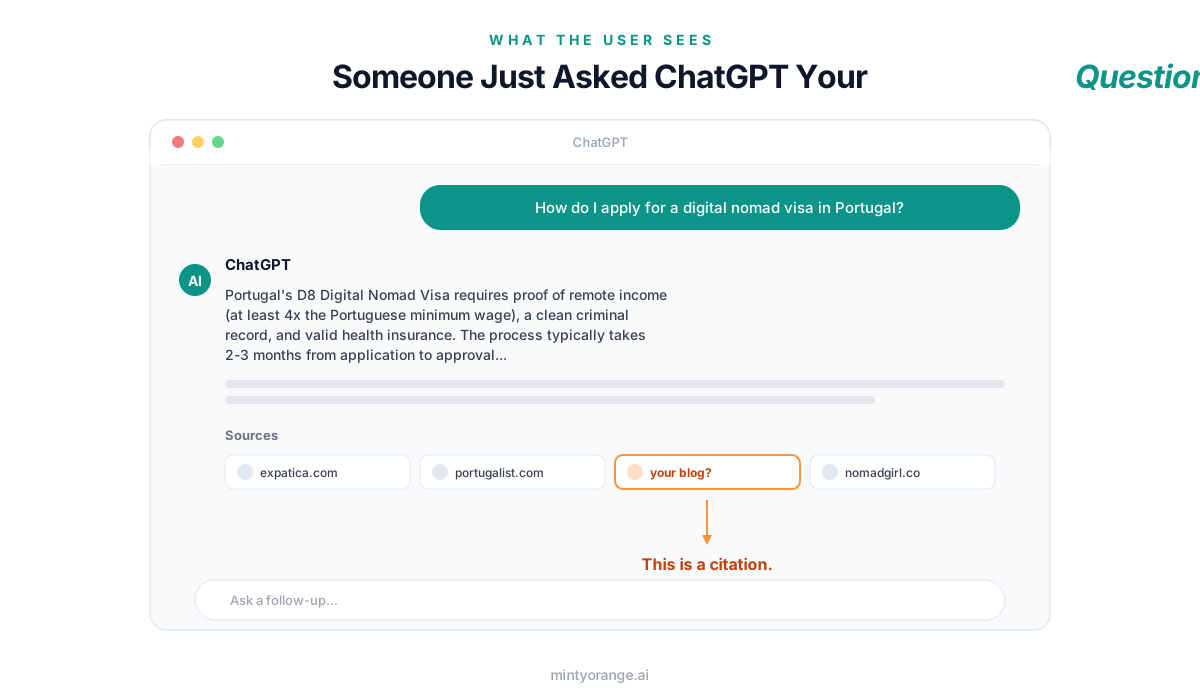
Try this right now. Open ChatGPT. Type a question that one of your blog posts answers. Something specific, like “how do I apply for a digital nomad visa in Portugal” or “what is the best way to clean a cast iron pan” or whatever your blog covers.
Look at the answer. Look at the sources listed underneath.
Is your blog there?
If the answer is no, it helps to understand what just happened behind the scenes. Because ChatGPT did not randomly skip you. A chain of decisions played out in a few seconds, and somewhere in that chain, your blog did not make the cut. Understanding where and why is the first step to changing it.
Step 1: The User Types a Question
This part is obvious, but what matters is how people ask questions in ChatGPT versus Google.
On Google, people type short keyword phrases. “Digital nomad visa Portugal.” Three words. On ChatGPT, they type full sentences the way they would ask a friend. “I want to move to Portugal as a digital nomad. What visa do I need and how long does the process take?”
The ChatGPT question is longer, more specific, and often contains multiple sub-questions in one. This changes everything about which content the AI looks for, because it needs pages that answer the full question, not just pages that contain the right keywords.
Step 2: ChatGPT Searches the Web
This is the part most bloggers do not realize. ChatGPT does not just pull answers from its training data. When you ask a factual question, it runs a live web search to find current information.
That search draws on three sources. Bing’s index, which carried most of it in 2025. OpenAI’s own crawler, OAI-SearchBot, which indexes pages directly for ChatGPT and has expanded steadily since the GPT-5 launch in August 2025. And results that increasingly line up with Google: when Lily Ray tracked 11 sites that lost Google visibility in early 2026, their ChatGPT citations fell 27.8%, a bigger drop than on Gemini. The mix has moved from “Bing only” to “Bing, plus OpenAI’s own index, plus whatever ranks.”
For bloggers, the practical implication is that you need both bases covered. Your site needs to be indexed in Bing for the bulk of ChatGPT’s discovery (Bing Webmaster Tools is the easiest check, free, 20 minutes). And OAI-SearchBot needs to be able to reach your pages without being blocked by Cloudflare, a WordPress security plugin, or a robots.txt rule. If either base is missing, ChatGPT cannot reliably see your content.
Step 3: ChatGPT Reads Your Page (and 20 Others)
Assuming your page is accessible, ChatGPT now has it in the candidate set alongside a bunch of other pages on the same topic. This is where the evaluation begins.
The AI reads through each page and assesses a few things:
Can it extract a clean answer? If your content has a clear, direct answer to the question near the top of the page, the AI can pull from it easily. If your post starts with three paragraphs of personal backstory before getting to the point, the AI has to work harder to find the useful part, and it may just use a different source that gets to the answer faster.
Does the content say something the other pages do not? If your article contains the same information as 15 other articles, the AI does not need your specific page. It can generate the same answer from any of them. But if your page has original data, a personal experience, or a detail the other pages lack, the AI has a reason to cite you specifically. This is what Google calls Information Gain.
Is the source trustworthy? ChatGPT evaluates author information, site reputation, and whether the content is corroborated by other sources across the web. A page on a site with clear authorship, consistent branding, and mentions on other trusted sites gets a trust advantage over an anonymous page on a site the AI has never encountered before.
Step 4: ChatGPT Generates the Answer
Now the AI combines information from the pages it evaluated and writes a response. This is where it gets interesting.
The answer is not a copy of any single page. ChatGPT synthesizes information from multiple sources into one coherent response. It takes a fact from one page, a detail from another, a number from a third, and weaves them together into a paragraph that reads like it was written from scratch.
Think of it like a journalist writing a report after interviewing five experts. The final article is a synthesis, not a copy of any single interview. But the journalist still cites their sources.
ChatGPT does the same thing. After generating the answer, it attaches links to the sources it drew from most heavily. Those links are the citations.
Step 5: ChatGPT Decides Who Gets Cited
This is the make-or-break moment. The AI generated an answer using information from 10 or 20 pages. But it only cites a handful of them (usually 3 to 6 sources per answer).
Which pages make the cut?
Pages that contributed unique information. If your page provided a specific detail that made the answer better, and that detail was not available on other pages in the set, you are more likely to be cited. This is why original data and first-person experience get cited disproportionately.
Pages the AI can attribute confidently. If your site has clear authorship, schema markup that identifies who you are, and consistent entity information across the web, the AI can attribute the information to you with confidence. If your site is anonymous or the AI cannot verify who is behind it, it is less likely to attach your name to a claim.
Pages with clean, extractable content. If the AI can pull a clear, self-contained statement from your page, it can cite you precisely. If your content is winding and the key point is buried in the middle of a long paragraph, the AI may use your information without citing you, because it cannot cleanly attribute the specific claim.
What This Means for Your Blog
Here is the full chain again, simplified:
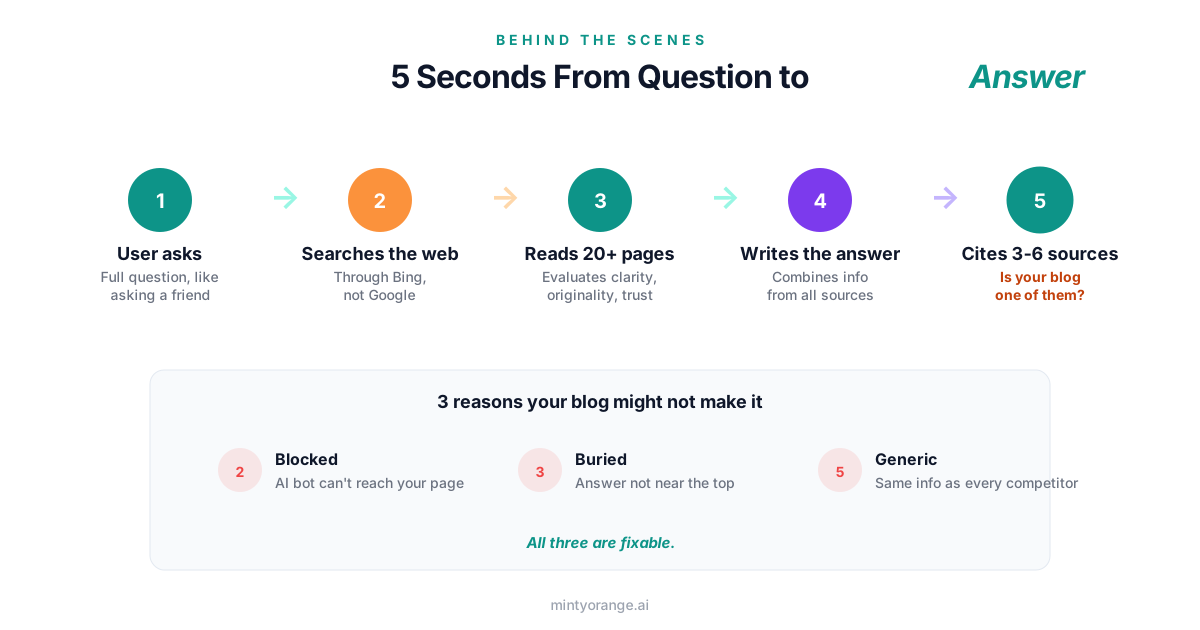
Every step is a place where your blog can fall out of the process:
At Step 2, if your site blocks OAI-SearchBot, or your page is indexed nowhere ChatGPT looks, you are invisible before the process begins.
At Step 3, if your content does not have a clear, extractable answer near the top, the AI may skip to a page that does.
At Step 3 again, if your content says the same thing as every other page, the AI has no reason to cite your page specifically.
At Step 5, if your authorship and entity signals are weak, the AI may use your information without citing you.
Each of these is fixable. And fixing them does not require a complete rewrite of your blog. It requires understanding where in the chain your content is falling through.
The 5-Minute Version
If you do not want to read all the details, here is what to do today:
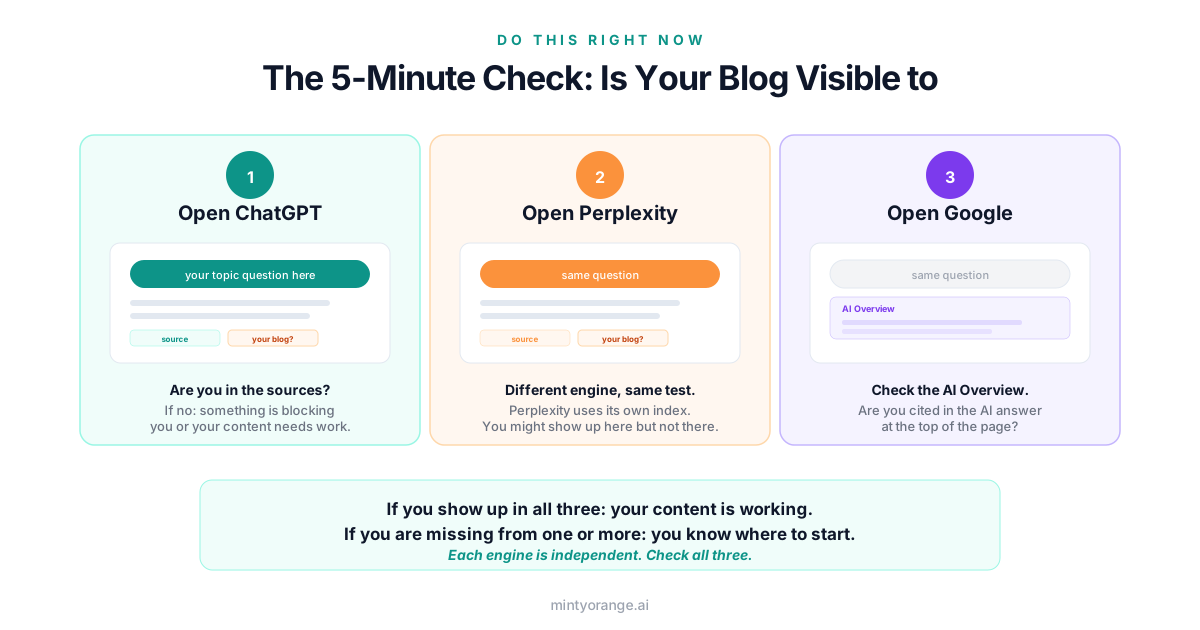
Check if ChatGPT can see you. Open ChatGPT, ask a question your blog answers, see if you show up. Do the same with Perplexity and Google. If you are missing from all three, there may be a technical blocker.
Check if your answer comes first. Open your blog post. Is the actual answer to the question in the first paragraph, or buried after an intro? AI extracts from the top. Move your answer up.
Check if you say something unique. Read the ChatGPT answer to your question. Does your blog post contain anything the AI answer missed? If yes, that is your competitive advantage. If no, that is what you need to add.
The process is a chain of decisions, and each one is something you can influence. Minty Orange optimizes your content for both Google ranking and AI citation: it makes sure your answer is in the right place, your information is original enough to cite, and your structure is clean enough for ChatGPT, Perplexity, and Google AI Overviews to extract from. Tracking is built in too, so you can see which of your articles make it into the cited sources.
Key Takeaways
- ✓When someone asks ChatGPT a question, the AI runs a live web search (through Bing, its own crawl, and Google-aligned results), reads dozens of pages, generates a combined answer, and cites 3-6 sources.
- ✓Your blog needs to be accessible to OAI-SearchBot, indexed in Bing, and free of accidental blockers to even enter the process.
- ✓The AI looks for pages with clear, extractable answers near the top, original information the other candidates lack, and trustworthy authorship it can verify.
- ✓ChatGPT synthesizes information from multiple sources. Being cited means your page contributed something the AI considered worth attributing.
- ✓Every step in the chain is a specific, fixable point where your blog can either make the cut or fall through.
Questions
Frequently Asked.
Not directly, but its citations increasingly track Google’s rankings. In 2025 ChatGPT’s web search ran mostly through Bing’s index. Through 2026 that share has shrunk while OpenAI’s own crawler, OAI-SearchBot, indexes more content directly, and citation studies now find ChatGPT reacting to Google ranking changes more sharply than Gemini does. The practical implication for bloggers: make sure OAI-SearchBot can reach your pages (no Cloudflare blocks, no aggressive WordPress security plugin rules, no robots.txt disallow), keep your Google rankings healthy, and treat Bing Webmaster Tools (free, 20 minutes) as a bonus that also covers Copilot.
In most cases, yes. ChatGPT’s search bot (OAI-SearchBot) can access any publicly available page unless something is blocking it. Common blockers include Cloudflare’s “AI Scraper” toggle, WordPress security plugins that flag unfamiliar bots, and robots.txt rules that block OAI-SearchBot. In a recent 3,000-site audit, roughly 1 in 4 had at least one of these blockers active without the site owner knowing.
Typically 3 to 6 sources, depending on the complexity of the question. For simple factual queries, it may cite 2-3. For multi-part questions that require information from different topic areas, it may cite 5-6 or more.
No. For general knowledge questions that do not require current information, ChatGPT may answer from its training data without running a web search. For questions about current events, specific products, recent data, or anything time-sensitive, it runs a live search. If your content covers factual, informational topics that change over time, the web search path is the one that matters for you.
There are several possible reasons. Your page may not be indexed in Bing. OAI-SearchBot may be blocked from accessing your site. Your content may not have a clear, extractable answer near the top. Your article may cover the same information as competitors without adding anything original. Or your site may lack the authorship and trust signals that help ChatGPT cite with confidence. Each of these is a specific, fixable issue.
Yes. Structure your most important pages with a direct answer in the first paragraph, add FAQ sections, include original data or observations competitors do not have, and make sure your author information is consistent across your site and external profiles. These steps make it easier for ChatGPT to find, extract from, and cite your specific pages.