What Is Information Gain and Why Should I Care?
Information Gain is a simple idea: how much does your article add that someone could not find anywhere else? Google has a patent that describes exactly this. It measures the new, unique information in your content compared to everything else written on the same topic. If your article says something nobody else is saying, it scores high. If it rephrases what ten other articles already cover, it scores low. Google has never officially confirmed it as a ranking factor, but its guidelines explicitly reward original reporting and research, and AI engines like ChatGPT and Perplexity only cite pages that add something they do not already have. In 2026, that is the game.
Here is a question for you: If you took your latest blog post, and someone asked ChatGPT the same question your post answers, would your post add anything the AI missed?
If yes, your content has Information Gain. If no, you are writing the same thing a machine can generate for free in ten seconds. And Google knows the difference.
I have been doing this for 21 years. In that time, Google has come up with a dozen different ways to say the same thing: write something worth reading. They said it through PageRank (get links from people who trust you). They said it through Panda (stop publishing thin garbage). They said it through E-E-A-T (show expertise and experience). Now they are saying it through Information Gain: tell people something they cannot find anywhere else.
The concept is simple. The stakes in 2026 are higher than they have ever been.
The Simple Version
Think of it like a dinner party conversation. Ten people are all talking about the same topic. Nine of them are repeating the same facts, the same statistics, the same advice. Then one person says something nobody else has said. Maybe they share a personal experience. Maybe they have data from their own work. Maybe they see the issue from an angle nobody else considered.
That one person is the one everyone remembers. That is Information Gain.
Google and AI search engines work the same way. When they look at 20 articles about the same topic, they are asking: which of these adds something the others do not? The ones that do get ranked higher, shown in AI answers, and cited as sources. The ones that do not get buried under the pile.
Why This Matters More Now Than Ever
You could get away with writing “The Complete Guide to X” for years. Take the top 10 search results, combine all their points into one longer article, add some formatting, publish. It worked because Google rewarded thoroughness.
That strategy stopped working in 2026 for one simple reason: AI can now do exactly that, instantly, for free.
When someone asks ChatGPT or Google AI a question, the AI reads thousands of pages and generates a comprehensive answer in seconds. If your article is just another comprehensive summary of the same information, the AI already has everything you wrote. There is no reason to send anyone to your page.
The only content AI cannot generate on its own is content that contains something new. Something the AI has not seen before. That is what makes Information Gain the dividing line between content that gets traffic and content that gets ignored.
What “New” Means (With Examples)
“Be more original” is vague advice. Here is what original content looks like in practice.
Share your own numbers
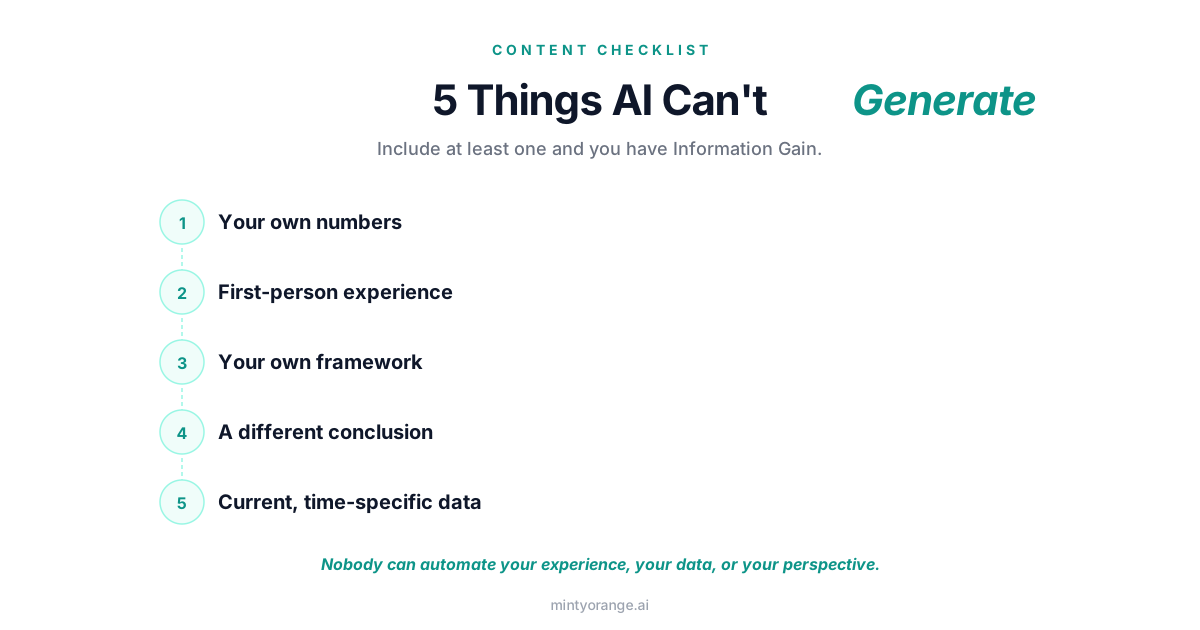
You do not need a research team. You need your own data.
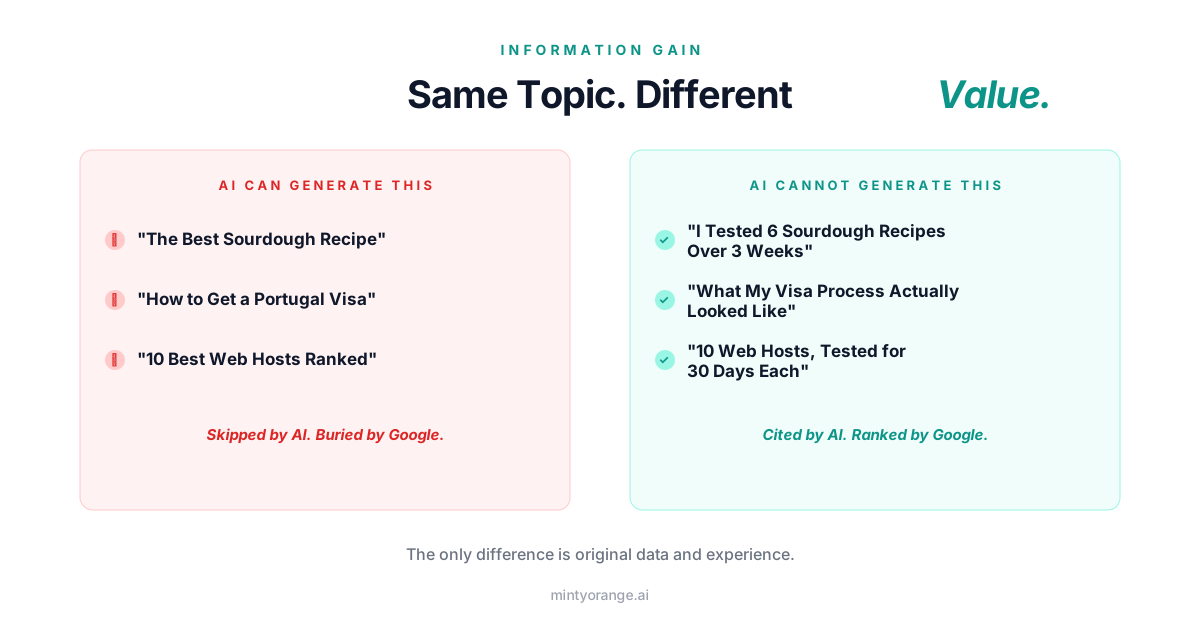
A food blogger who writes “I tested 6 sourdough recipes over 3 weeks and here are my actual rise times, temperatures, and results” has massive Information Gain. A food blogger who writes “The best sourdough recipe: combine flour, water, and starter” has zero. The first post contains information that exists nowhere else on the internet. The second post restates what thousands of pages already say.
Your Google Analytics trends, your email open rates, your revenue breakdown, your before-and-after results, your pricing research. Any numbers from your actual experience are original by definition.
Write from what you did, not what you read
There is a huge difference between “How to get a Portugal visa” (compiled from government websites) and “What my Portugal visa process actually looked like, including the three things every guide gets wrong.”
The first article compiles public information. Useful, but nothing new. The second article contains observations that could only come from someone who went through the process. That direct experience is something AI cannot generate from its training data, and it is exactly what both Google and AI search engines are looking for.
You do not need to write in first person to do this. You need to include details that only someone with real experience would know. The specific problem that surprised you. The step that took longer than expected. The thing that worked differently than the advice said.
Develop your own way of looking at things
If you have a framework, a checklist, a scoring system, or a way of categorizing things that you developed yourself, that is Information Gain. It does not need to be complex.
“I evaluate web hosting using these 5 criteria, weighted based on running 12 sites for 8 years” has Information Gain. “Top 10 Web Hosts Ranked” (with descriptions copied from marketing pages) has none.
Your way of thinking about a problem is unique to you. Publishing it gives AI something it cannot find elsewhere.
Say something others are not saying
When every article on a topic reaches the same conclusion, an article that reaches a different conclusion (and backs it up with evidence) stands out completely. The more every competitor says the same thing, the more your different take scores.
This only works when you can support it. An unsupported hot take is just noise. A data-backed argument that challenges what everyone else is saying is the highest form of Information Gain.
Include information that is current
An article updated with June 2026 data beats an article from 2024 on the same topic, even if the 2024 article is more detailed. Current pricing, current features, current regulations, current results. Time-specific information creates Information Gain automatically because the older competing articles do not have it.
How This Connects to AI Citations
When ChatGPT, Perplexity, or Google AI Overviews answer a question, they pull from many sources. But they only cite the ones that add something the AI could not say on its own.
If your page contains the same information the AI already has from its training data, there is no reason to link to you. The AI just says it directly. But if your page contains data, observations, or analysis the AI does not have, it needs to cite you to make its answer more complete.
This is why original research gets cited so often. This is why personal case studies show up in AI answers. And this is why the publishers who invest in original content are gaining visibility while the ones publishing reworded summaries are losing it.
The connection to off-site signals matters here too. When other sites reference your original data, that reinforces the signal that your content contains something worth citing. Information Gain and off-site trust work together.
Key Takeaways
- ✓Information Gain measures how much new information your content adds compared to everything else on the same topic. It comes from a Google patent granted in 2022.
- ✓In 2026, AI can generate comprehensive summaries of any topic instantly. The only content that stands out is content with information the AI does not already have.
- ✓Five types of content score high: your own data, first-person experience, unique frameworks, contrarian analysis with evidence, and current time-specific information.
- ✓“The Complete Guide to X” (compiled from other sources) was a strong strategy for years. In 2026, it produces near-zero Information Gain.
- ✓AI search engines cite sources that contain information they cannot generate on their own. If you want to be cited, you need to say something nobody else is saying.
The Simple Test
Before you publish anything, ask yourself one question.
If someone pasted my headline into ChatGPT right now, would my article tell them something the AI answer did not?
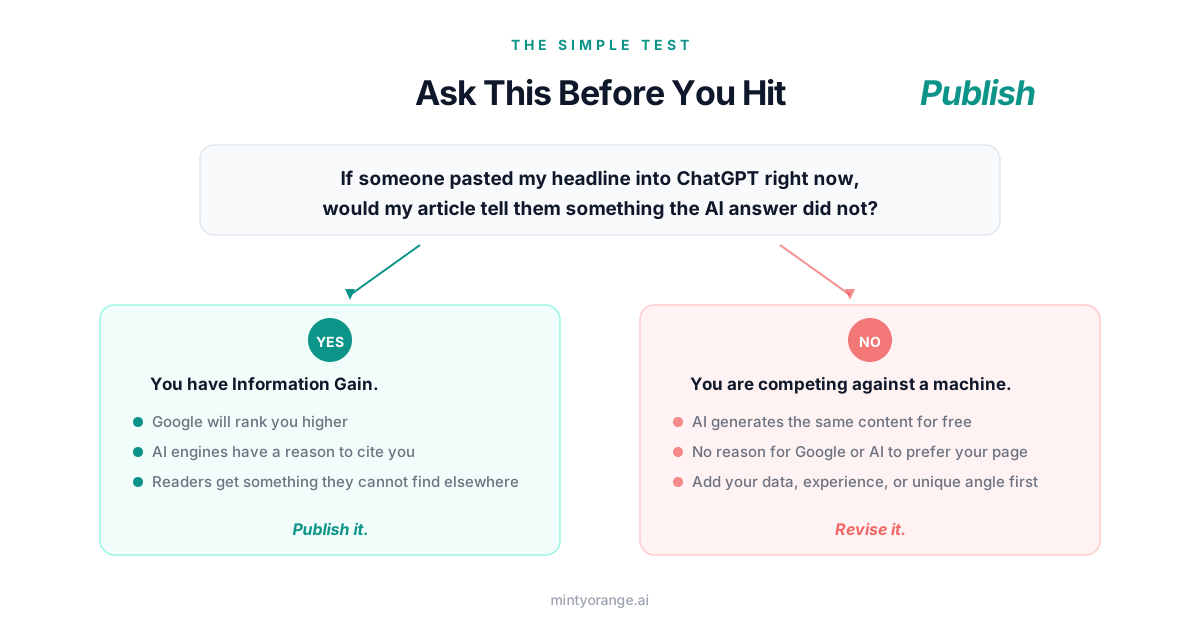
If the answer is yes, publish it. You have Information Gain.
If the answer is no, your article is competing against a machine that writes the same thing faster, for free, and without needing your page to do it. That is a competition you will not win.
The good news: nobody can automate your experience, your data, or your perspective. Those are yours. Tools like Minty Orange can help you structure that content so AI engines find and cite it. But the original insight has to come from you.
Questions
Frequently Asked.
Information Gain measures how much new, unique information your article adds compared to everything else written about the same topic. If your content says something nobody else is saying, it scores high. If it rephrases what other articles already cover, it scores low. Google uses this to decide which pages deserve to rank, and AI engines use the same logic to decide which sources to cite.
No. Original research is one of the strongest forms, but it is not the only one. Your own experience counts (what you learned doing something yourself), your own metrics count (traffic data, revenue, results), and your own frameworks count (a unique way of evaluating or categorizing something). Anything from your direct experience that a reader could not find on another page qualifies.
Only if it works with inputs that are genuinely original. An AI article that summarizes publicly available information has zero Information Gain. An AI article that analyzes your proprietary data, structures your unique observations, or presents your original framework could have Information Gain, because the underlying information is new. The originality comes from what you feed in, not from the writing itself.
Google has not officially confirmed it. But the patent exists (US20200349181A1, granted 2022), and SEO professionals widely observe its effects, especially after the March 2026 core update. Google’s own guidelines explicitly reward “original information, reporting, research, or analysis,” which is exactly what Information Gain measures.
AI search engines cite sources that contain information they cannot generate from their training data. If your page says the same thing the AI already knows, there is no reason to cite you. If your page contains original data, observations, or analysis the AI does not have, citing you makes the AI answer more complete. Information Gain is essentially the test AI engines run when deciding who to cite.
Start with what you already know from experience. The specific results you got. The thing that surprised you. The step that was harder than expected. The comparison you ran yourself. The framework you developed. These are all things nobody else can write, and they are exactly what Information Gain rewards. You do not need to be a researcher. You need to share what you actually know.