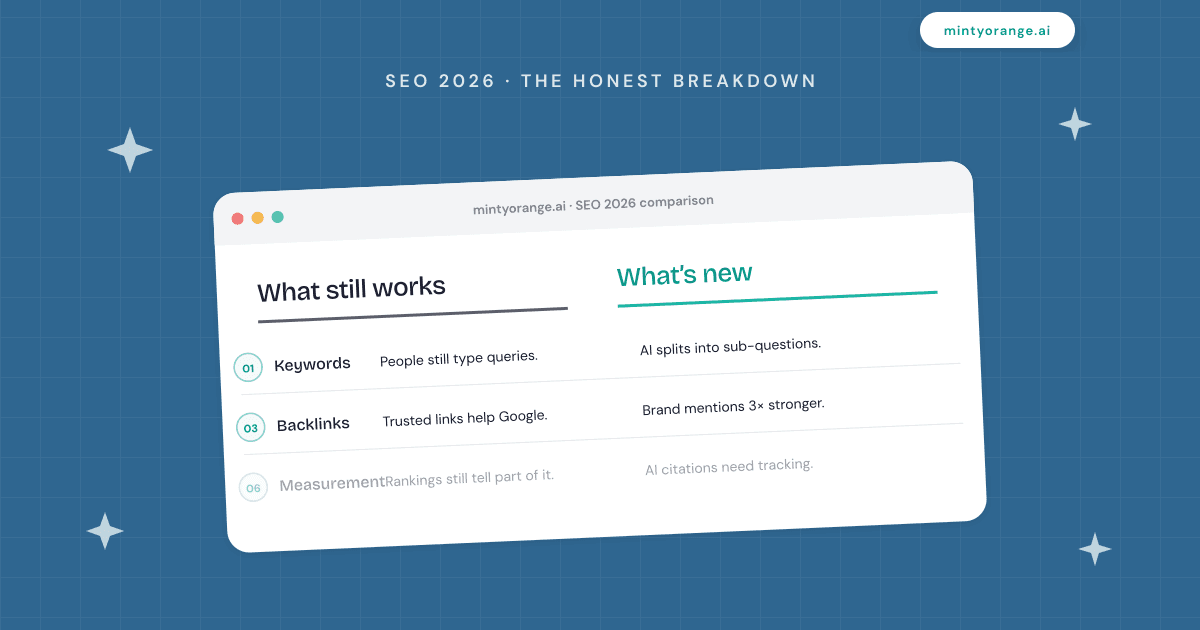
Has SEO Completely Changed in 2026?
No. Some fundamentals still work exactly the way they always have. Others shifted significantly. And a few entirely new signals appeared that did not exist before AI search became mainstream. The mistake most publishers make is treating everything as either “completely changed” or “nothing changed.” The reality is more specific than that.
This guide breaks down 10 areas of SEO into what still works and what is new in 2026.
Framing SEO as “old vs new” implies the old rules stopped working. They did not. Google still crawls, indexes, and ranks pages. Keywords still matter. Technical SEO still matters. If you abandon the fundamentals because someone told you everything changed, you will lose visibility on both Google and AI search simultaneously.
What happened is more nuanced. Some things stayed the same. Some things shifted. And some entirely new signals appeared that sit on top of the existing system, not in place of it. Understanding which is which is the difference between adapting well and chasing the wrong changes.
From my experience, the pattern is always the same when a major shift happens: people overcorrect, and the ones who do best are the ones who figure out what changed and what just looks like it did.
Here are 10 areas, broken down honestly.
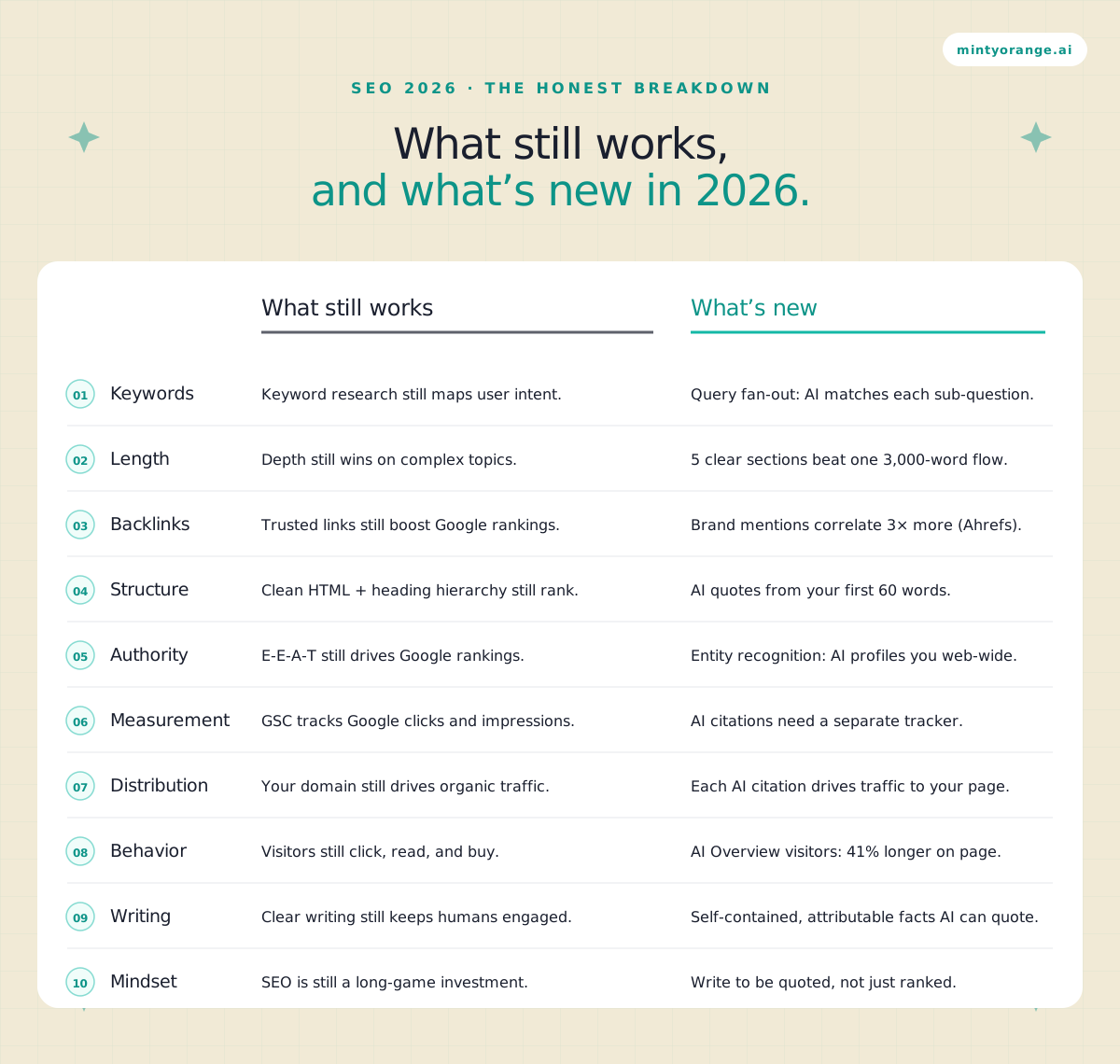
1. Keywords
Still true: People still type words into search boxes. Google still matches those words to pages. Keyword research still tells you what your audience is looking for and how they phrase it.
Changed: Queries are getting longer and more conversational. People type full questions into ChatGPT and Perplexity the way they would ask a friend. “Best hiking boots” became “what hiking boots work best for wide feet on rocky trails in wet weather.” Your content needs to answer the specific question, not just target the broad keyword.
New: AI engines break complex queries into sub-questions and look for pages that answer each one. A single article that clearly answers a specific sub-question can get cited even if it does not rank for the broad keyword at all.
2. Content Length
Still true: Thin content still loses. A 200-word page on a complex topic will not rank on Google or get cited by AI. Depth still matters when the topic demands it.
Changed: “Longer is better” stopped being true. The 5,000-word comprehensive guide that repeats itself to hit a word count now gets outperformed by a 1,500-word article that says something original. AI search engines can synthesize comprehensive guides from multiple sources instantly. Length without Information Gain is just padding.
New: Modular content structure matters more than total word count. AI engines extract specific sections, not entire articles. An article with five clearly defined sections, each answering a distinct question, is more useful to AI than one continuous 3,000-word flow that covers the same ground.
3. Backlinks
Still true: Links from trusted, relevant sites still help your Google rankings. A strong backlink profile still signals authority. Technical link health (no broken links, clean redirects) still matters.
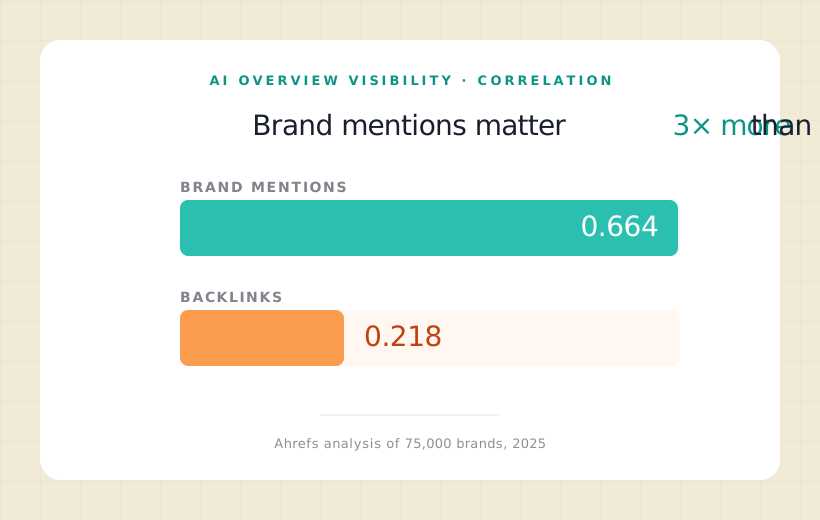
Changed: The weight of backlinks relative to other signals dropped. Ahrefs found that branded web mentions correlate with AI Overview visibility at 0.664, roughly three times stronger than backlinks at 0.218. For AI citations specifically, where your brand gets mentioned matters more than where it gets linked.
New: Off-site signals beyond links now influence AI visibility. Reddit threads discussing your content, podcast mentions, community references, and forum recommendations all create corroboration signals that AI engines use to decide whether to cite you.
4. Content Structure
Still true: Clean HTML, proper heading hierarchy, and organized content still help Google crawl and understand your page. Technical structure has always mattered and still does.
Changed: Structure is now functional for AI extraction, not just for readability. Answer-first paragraphs, clear visible FAQ sections, and self-contained content blocks all make it easier for AI engines to pull clean quotes and cite your page. A well-structured article can get cited for a query it was not specifically targeting, because the AI found a section that answered a sub-question cleanly.
New: The first 60 words of your article now function as a potential citation candidate. AI engines frequently extract the opening paragraph as the answer. If your intro is a generic preamble instead of a direct answer, you lose the citation opportunity before the reader even scrolls.
5. Authority and Trust
Still true: E-E-A-T (Experience, Expertise, Authoritativeness, Trustworthiness) still matters. Author bios, credentials, and demonstrable expertise still influence how Google evaluates your content. Publishing under a real name with a real track record still outperforms anonymous content.
Changed: Experience (the first E) moved from “nice to have” to essential. AI engines specifically look for first-person observations, original data, and content that could only come from someone who did the thing they are writing about. Generic expertise without direct experience gets outranked by specific experience without formal credentials.
New: Entity recognition became a core signal. AI engines build profiles of who you are and what you are known for across the entire web. Consistent branding, schema markup with sameAs properties, and appearing in relevant contexts outside your own site all strengthen your entity profile. If AI does not know who you are, it is less likely to cite you even if your content is good.
6. Measurement
Still true: Google Search Console, rankings, organic clicks, and impressions still matter and still tell you how you perform in traditional search. Track them. Search Console also grew an AI report of its own in 2026, so part of your AI visibility now sits in the same tool.
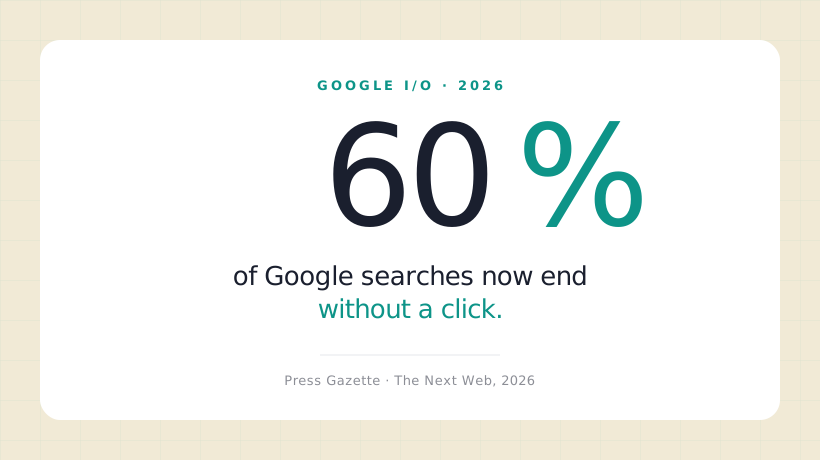
Changed: These metrics alone now tell an incomplete story. Your rankings can be stable while your traffic drops, because AI Overviews answer the query before the user clicks. After Google I/O 2026, 60% of searches end without a click. If you only track rankings, you will miss the traffic decline until it is too late.
New: AI citation tracking is a separate metric that traditional dashboards do not capture. Whether ChatGPT, Perplexity, or Google AI Overviews cite your content requires dedicated monitoring. Tools like Minty Orange track citations across all three engines alongside traditional rankings, so you see both channels in one place.
7. Distribution
Still true: Publishing on your own domain and building organic traffic through search still works. SEO is still a distribution channel. Your website is still the hub.
Changed: Single-channel dependence became dangerous. If 60% of your traffic comes from Google organic, the I/O 2026 changes put 60% of your business at risk. Email lists, direct audiences, and social presence went from “growth tactics” to survival infrastructure.
New: AI engines are a distribution channel themselves. When ChatGPT cites your article, that is distribution. When Perplexity links to your page in an answer, readers click through. When Google AI Overviews quotes your content, you are visible to users who never would have scrolled to your organic result. The citation itself is distribution.
8. User Behavior
Still true: People still click on search results. People still read articles. People still buy things they find through search. The user journey did not disappear.
Changed: The journey got shorter. Users now get the factual answer before they visit any page. The people who do click through are more intentional. Fewer visitors, but more engaged ones.
New: Some users never search at all. Google’s new information agents monitor topics 24/7 and push updates automatically. A user who sets up an agent for “best coffee shops in Lisbon” may never search that phrase again. The agent does it for them, pulling from sources without the user ever typing a query.
9. Writing Style
Still true: Clear, well-written content still wins. Sloppy grammar, confusing structure, and walls of text still lose. Writing for humans still matters because the humans who click through are the ones who generate engagement signals.
Changed: AI-generated writing that is technically correct but informationally generic now gets filtered out. “Comprehensive” writing that compiles known facts was a strength when humans evaluated it visually. When AI evaluates it programmatically, it scores near-zero on originality. The writing itself can be polished. The information inside it needs to be unique.
New: Citation-ready formatting became a skill. Short, self-contained statements that can be extracted as standalone answers. Clear attribution of claims. Specific numbers instead of vague qualifiers. These are not just good writing practices. They are structural choices that determine whether AI can cleanly quote your content.
10. Mindset
Still true: SEO is a long-term investment. Quick hacks still get punished eventually. Consistency, quality, and patience still produce the best results over time.
Changed: “Rank and bank” (rank for a keyword, collect traffic) is no longer the whole game. Ranking gives you a position. That position generates fewer clicks than it used to. You need a second layer of value to justify your presence: original data, unique perspective, or experience that the AI answer alone cannot replace.
New: The mindset shift is from content creator to cited source. In the old model, you published and hoped people found you. In the new model, you publish and make it easy for AI to find, extract, and credit you. You are not just writing for readers. You are writing to be the source that AI engines trust enough to quote.
Key Takeaways
- ✓SEO in 2026 is an expansion, not a replacement. The fundamentals (keywords, structure, authority, links, quality) still hold. New signals (entity recognition, AI citations, off-site corroboration, modular content) sit on top of them.
- ✓The biggest error is treating SEO as “old vs new” and abandoning what still works. The second biggest error is ignoring what changed and doing 2019 SEO in 2026.
- ✓Backlinks still help Google rankings, but branded web mentions correlate 3x more strongly with AI visibility (Ahrefs, 75K brands).
- ✓60% of Google searches now end without a click. Rankings alone no longer tell the full story. Track AI citations alongside traditional metrics.
- ✓The core question for every piece of content: does this say something AI cannot generate on its own? If yes, it wins in both eras of search. If no, it competes against a machine.
Both Eras, One Workflow
The publishers who do best in 2026 are the ones who stopped asking “is it the old rules or the new rules?” and started asking “which rules apply where?”
Google rankings still drive traffic. AI citations drive a new kind of visibility. The fundamentals support both. The new signals amplify both. And the publishers who work on all of it, in one workflow, are the ones who show up everywhere their readers are looking.
Questions
Frequently Asked.
No. Keywords, content quality, technical SEO, backlinks, and E-E-A-T all still matter for Google rankings. What changed is that these fundamentals alone produce fewer clicks than before because AI Overviews answer many queries directly. New signals like entity recognition, AI citations, and off-site corroboration sit on top of the existing fundamentals.
The shift from single-metric optimization (rank for a keyword, collect clicks) to multi-channel visibility (rank on Google, get cited by AI engines, build entity recognition). After Google I/O 2026, AI Mode became the global default, and 60% of searches now end without a click. Publishers need to optimize for both traditional rankings and AI citations.
Yes, for Google rankings. But for AI citation visibility specifically, branded web mentions are roughly three times more important than backlinks, according to Ahrefs’ analysis of 75,000 brands. The shift is from link quantity to contextual brand presence across the web.
AI search engines build profiles of who you are and what you are known for, using information from across the web. Consistent branding, schema markup, mentions in relevant publications, and community discussions all strengthen this profile. A strong entity profile makes AI more likely to cite your content because it can confidently attribute the information to a recognized source.
No. Depth still matters when the topic requires it. What stopped working is length for length’s sake. A 1,500-word article with original data and unique observations outperforms a 5,000-word guide that recompiles publicly available information. Focus on Information Gain (how much new your article adds) rather than word count.
Google Search Console tracks rankings and clicks, and since 2026 its Generative AI report also counts how often your pages appeared in Google AI Overviews and AI Mode, though it shows impressions only and covers no engine outside Google. ChatGPT, Perplexity, and the rest report nothing, so dedicated citation tracking is still what tells you whether they reference your pages. Tools like Minty Orange combine both in one dashboard so you can see traditional rankings and AI citations side by side.