What Did Google Announce at I/O 2026 and How Does It Affect Publishers?
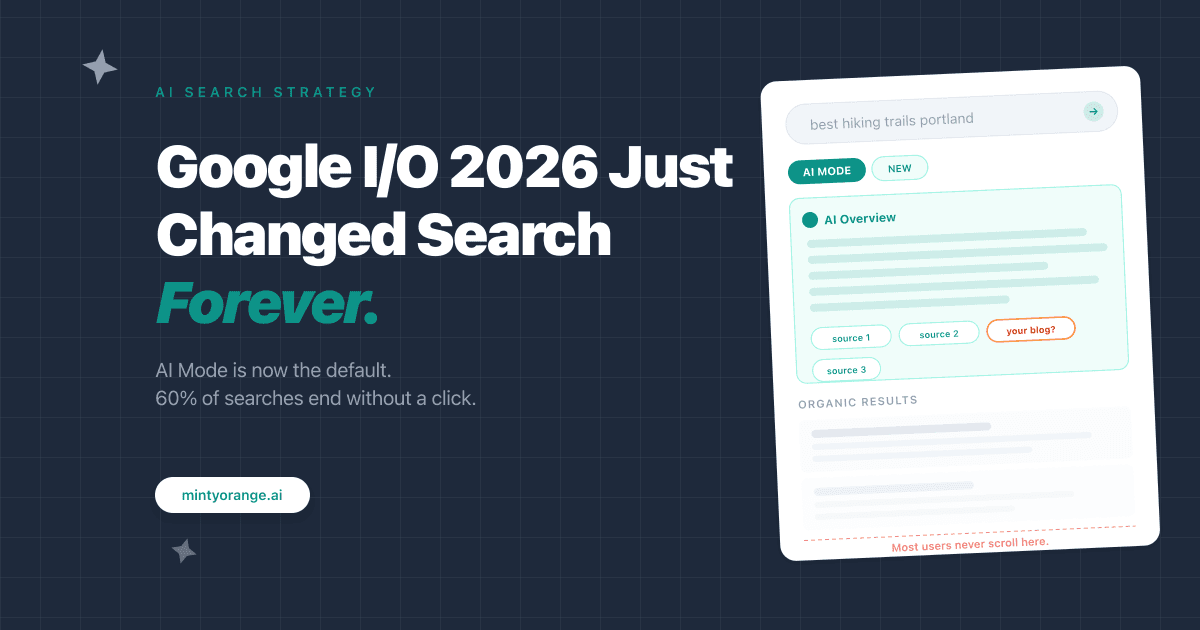
On May 19, 2026, at I/O (Google’s annual developer conference), Google unveiled what it called the biggest change to its search box in 25 years. AI Mode, powered by Gemini 3.5 Flash, is now the default for all users globally. The search box accepts text, images, files, videos, and even Chrome tabs. New “information agents” run in the background 24/7, tracking topics and pushing updates to users without them ever needing to search again. For publishers, this means AI-generated answers are now the core architecture of Google Search.
If you woke up on May 20 and your traffic dashboard looked normal, don’t let that fool you. What Google announced at I/O this week is a structural redesign of how search works, and it changes the math for every publisher and blogger who relies on Google for readers.
I want to be clear about something before we get into the numbers. Google rankings still matter. Your SEO work still matters. What changed is that rankings alone produce fewer clicks than they used to. The game expanded. The rules shifted. And if you’re a publisher, understanding what happened last week is the difference between adapting early and scrambling later.
What Google Announced (and Why It Matters)
Google’s Head of Search, Elizabeth Reid, described the new Search as “AI search through and through.” It’s a pretty accurate description of what they shipped.
Four things changed at once.
Gemini 3.5 Flash is now the default model in AI Mode, globally. Every Google user now gets AI-generated answers by default, not just people who opted into the beta. This is the single biggest change because it affects query volume at a scale nothing else can match.
The search box was redesigned for the first time in 25 years. It now accepts images, files, videos, and Chrome tabs alongside text. This sounds like a UX detail, but it fundamentally changes the types of queries people make. When you can drag a screenshot into the search box, the query becomes richer, more specific, and much harder for a traditional blue link to satisfy.
Information agents went live. These are autonomous AI processes that monitor topics on your behalf and push updates to you over time. If someone sets up an agent to track “best hiking trails near Portland,” they may never search that phrase again. The agent does it for them, pulling from sources without the user ever visiting your site.
Personal Intelligence expanded to 98 languages across nearly 200 countries. Search results are now personalized based on your history, preferences, and prior interactions. A brand you’ve engaged with before is more likely to surface. Cold keyword rankings without brand recognition carry less weight than they used to.
Each of these individually would be a significant update. Together, they represent a redesign of what Google Search fundamentally is.
The Numbers That Matter
The headlines are dramatic. And the data behind them is real.
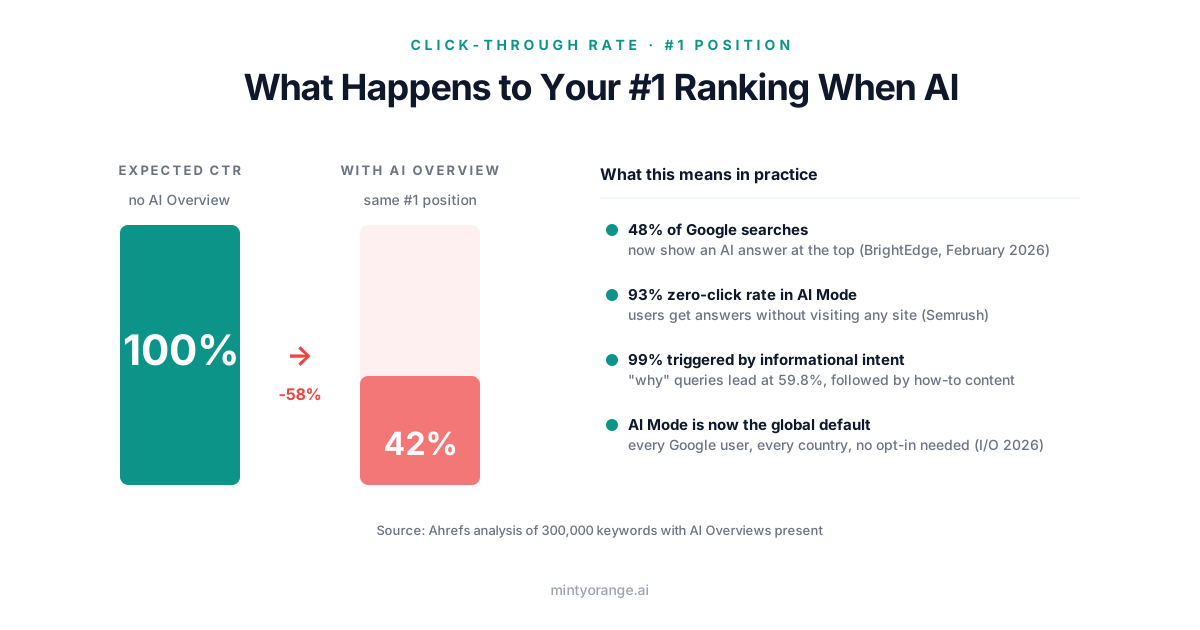
Zero-click searches (queries where the user gets their answer without visiting any website) now account for roughly 60% of all Google searches. For AI Mode specifically, that number is even starker: Semrush measured a 93% zero-click rate in AI Mode queries.
As of February 2026, 48% of Google searches already showed an AI-generated answer at the top of the page, up 58% year over year according to BrightEdge. That was before the I/O announcements made AI Mode the global default.
Publisher traffic from Google dropped 33% globally in the year to November 2025. Individual publishers have been hit much harder: HubSpot estimates it lost 70 to 80% of its organic traffic, Chegg reported a 49% decline, and DMG Media documented drops as steep as 89% for some queries.
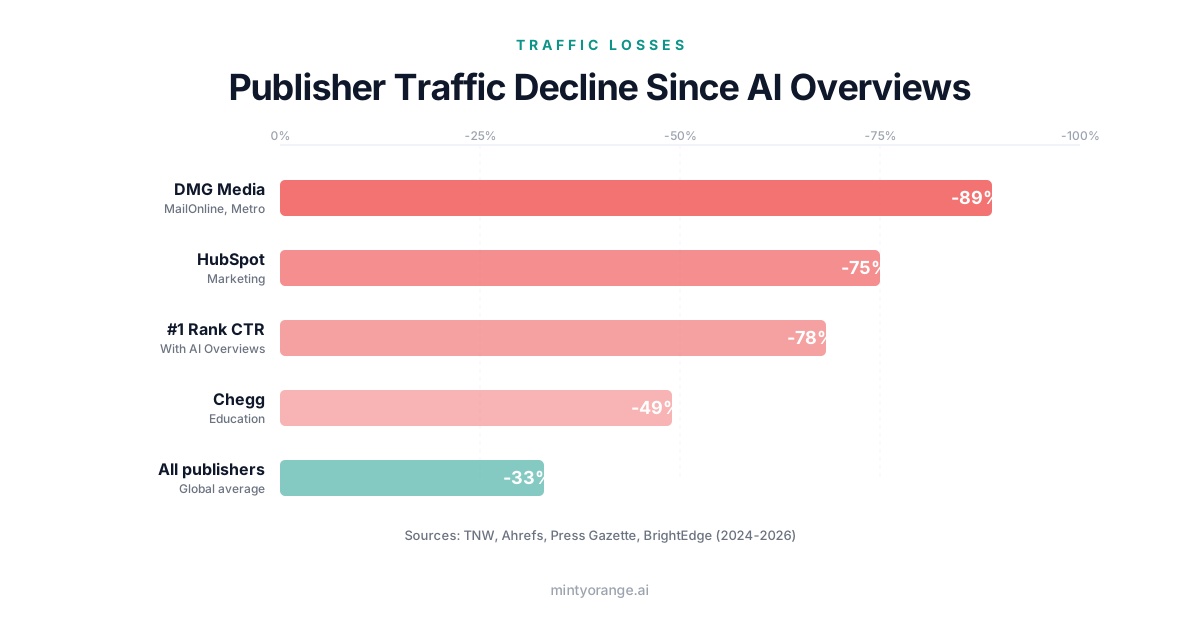
Click-through rates tell the same story. Ahrefs analyzed 300,000 keywords in February 2026 and found that the presence of an AI Overview correlates with a 58% lower click-through rate for the top-ranking page, measured against the click-through rate that position would otherwise earn.
The Verge’s publisher Helen Havlak had already warned on NPR that AI search could be an “extinction-level event” for online news publishers. Lily Ray, VP of SEO at Amsive, warned it would have a “devastating impact on the Internet.”
Those are real numbers from real publishers. They are not scare tactics.
Why Panic Is the Wrong Response
So here’s where I need to say the thing that most of these articles leave out. The traffic decline is real, but the picture is more nuanced than “everything is gone.”
The decline is not evenly distributed. It concentrates on one specific kind of content, and that is the key to understanding why the situation is more workable than the headlines suggest.
Here’s the pattern: informational queries show an AI Overview 36% of the time, against 8% for commercial and 5% for transactional. That is a seven times gap, measured by Seer Interactive across 5.47 million tracked queries in April 2026. How-to content, definitions, comparisons, and explainers are the hardest-hit categories. Transactional queries, product reviews, case studies, and original reporting are much less affected because AI can’t synthesize them from existing sources the same way.
So losing 33% of your visitors is painful, no question. But the loss is targeted. If your entire library is generic informational content, you are maximally exposed. If you publish original data, first-hand experience, and content AI can’t assemble on its own, far less of your traffic is in the firing line. The decline is real, but it is not uniform, and that distinction shapes the whole response.
The decline is hitting a specific kind of content losing a specific kind of traffic. The strategic response is to publish differently.
What Publishers Should Do Now
This is where I think the conversation needs to go, and it’s the part most coverage of I/O 2026 skips entirely.
Stop relying on a single traffic source
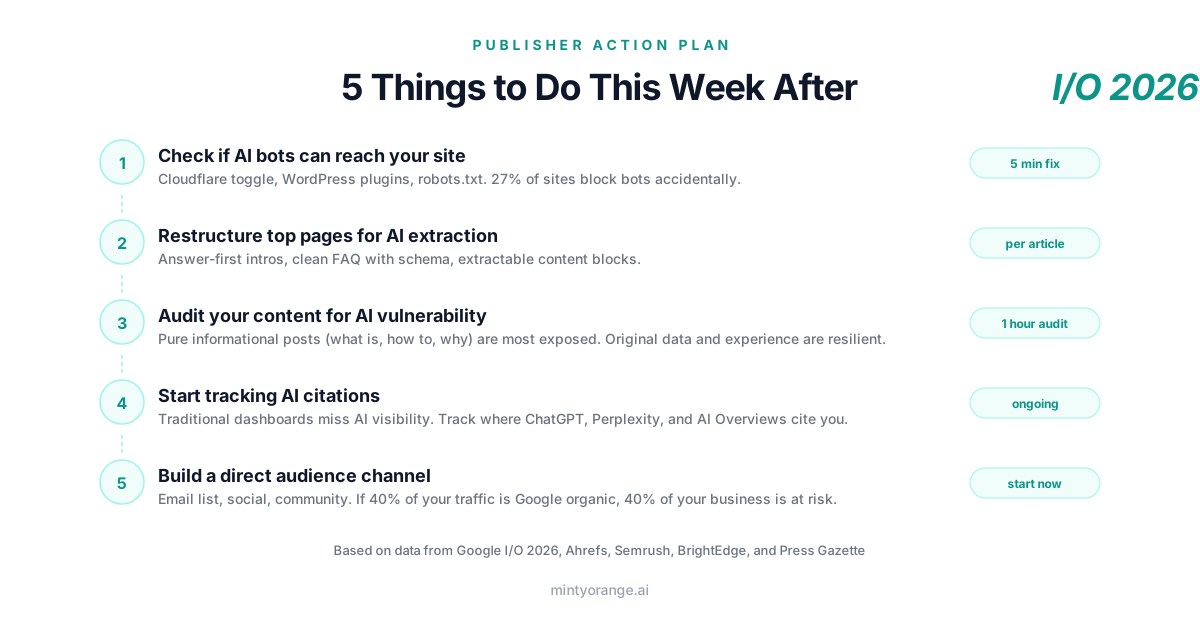
If 40% of your readers come from Google organic, the I/O 2026 changes directly threaten 40% of your business. The publishers who are weathering this best are the ones who built email lists, direct audiences, and social presence years ago. If you haven’t started, this is the week to start. Not next month.
Optimize for citation, not just ranking
The shift is from ranking for a position to earning a citation. Under the old model, you targeted a keyword, built a page, and captured clicks. Under the new model, your content needs to be structured so AI can extract and cite it, because being the cited source inside the AI answer is the new equivalent of being the #1 result.
This means answer-first intros, clean visible FAQ sections, and content organized in extractable blocks that AI can pull from cleanly. This is exactly what we built Minty Orange to do: it scores your content for both Google ranking and AI citation in one pass, so you’re optimizing for both eras of search at once. The I/O 2026 changes make this more urgent, not less.
Invest in content AI can’t synthesize
Informational content (“What is X? How does Y work?”) is the most vulnerable because AI can synthesize it from multiple sources without citing any of them. What AI cannot synthesize: original data, first-person case studies, proprietary analysis, expert interviews, and content that reflects genuine experience.
If you’re a travel blogger, a post about “Best beaches in Bali” is exactly the kind of content AI Overviews will answer directly. A post about “What we spent in 3 weeks in Bali with two kids, every receipt included” is something AI cannot generate from existing sources. That distinction is now the strategic dividing line.
Check whether AI can even reach your content
This sounds basic, but roughly 1 in 4 sites in a recent audit blocked at least one major AI crawler through Cloudflare settings, WordPress plugins, or robots.txt rules. If AI bots can’t reach your pages, none of the optimization work matters. This is a five-minute check that should happen before anything else.
Track AI citations alongside traditional rankings
Traditional SEO dashboards were not built for this. They track rankings, clicks, and impressions from organic results, but they don’t tell you whether your content is being cited in AI Overviews, pulled by ChatGPT, or referenced by Perplexity. If you’re not measuring citations, you have no way to know whether your strategy is working. That’s the gap citation tracking fills: seeing where Google ranks you and where AI cites you, side by side.
Key Takeaways
- ✓Google I/O 2026 made AI Mode the global default, with Gemini 3.5 Flash powering answers, a redesigned search box, 24/7 information agents, and personalized results across 98 languages.
- ✓Zero-click searches now account for 60% of all Google queries. In AI Mode specifically, the zero-click rate is 93% (Semrush).
- ✓Publisher traffic from Google dropped 33% globally. Individual publishers report losses from 49% (Chegg) to 89% (DMG Media) (TNW).
- ✓The #1 organic position earns a 58% lower click-through rate when an AI Overview is present, measured against the click-through it would otherwise get (Ahrefs, February 2026).
- ✓Informational content is the most affected (AI Overviews show on 36% of informational queries, against 5% of transactional ones). Original data, case studies, and experience-based content is significantly more resilient.
- ✓The strategic shift is from ranking for position to earning citation. Being the cited source inside the AI answer is the new #1.
The Bigger Picture
Google’s I/O 2026 announcement doesn’t invalidate anything you’ve already done. Your Google rankings still matter. Your content quality still matters. The structural work you’ve put into your site still matters. What changed is that those things alone will produce fewer clicks than they used to.
The publishers who adapt fastest will be the ones who treat AI search as a parallel channel alongside traditional SEO. A second channel that requires its own strategy, its own metrics, and its own optimization work.
That’s the shift. Two eras of search, running simultaneously. The old one is not gone. The new one is here. And the publishers who optimize for both are the ones who will keep their readers.
Questions
Frequently Asked.
Google announced four major changes to Search on May 19, 2026: Gemini 3.5 Flash as the default AI model in AI Mode globally, a redesigned search box that accepts images, files, videos, and Chrome tabs, information agents that monitor topics 24/7 and push updates to users, and Personal Intelligence expanded to 98 languages in nearly 200 countries.
Google search traffic to publishers dropped 33% globally in the year to November 2025, according to data cited by The Next Web. Individual publishers report steeper losses: HubSpot estimates 70 to 80%, Chegg reported 49%, and DMG Media documented drops up to 89% for certain queries.
No. Google rankings still drive traffic, and classic SEO work (structure, quality, technical optimization) remains the foundation for both Google visibility and AI citation eligibility. What changed is that rankings alone produce fewer clicks than before because AI answers satisfy many queries directly. Publishers need to optimize for both ranking and citation.
Semrush measured a 93% zero-click rate for queries answered in Google’s AI Mode, meaning users got their answer without clicking through to any website. Across all Google queries (including those without AI answers), the zero-click rate is approximately 60%.
Informational content is by far the most vulnerable. Seer Interactive tracked 5.47 million queries in April 2026 and found AI Overviews on 36% of informational searches, against 8% of commercial and 5% of transactional ones. Content that is harder for AI to synthesize (original data, first-person case studies, proprietary analysis, expert interviews) is significantly more resilient.
Five actions are most important: diversify away from single-source traffic dependence, structure content for AI citation (answer-first format, clean FAQs), invest in content AI cannot synthesize (original data, experience), verify that AI bots can actually crawl your site, and track AI citations alongside traditional rankings using tools like Minty Orange that cover both Google and AI search in one workflow.
You can block training bots (like GPTBot) to protect your intellectual property without affecting your AI search visibility. But blocking search bots (like OAI-SearchBot or PerplexityBot) will remove you from ChatGPT and Perplexity results entirely. The distinction between training bots and search bots is critical. We cover this in detail in our guide on accidental bot blocking.