Can a Second Summary Get Your Page Cited Twice?
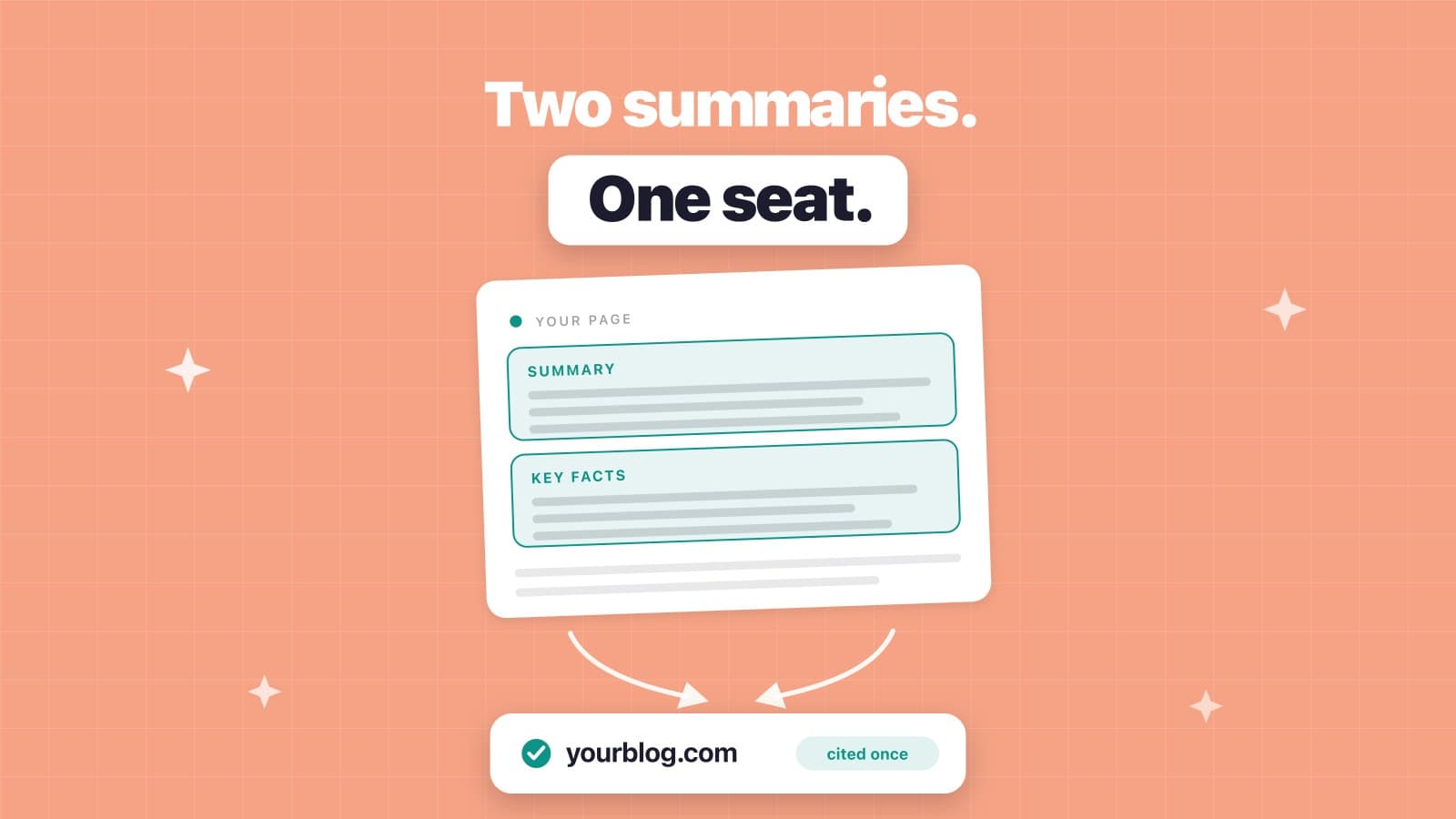
No. AI engines cite the page, not the paragraph. When an engine builds an answer it picks the single passage from your page that best fits the question, then lists your URL once as a source. A second summary at the top does not create a second slot in that list. It competes with your first summary over which one gets pulled, while every reader scrolls past both.
I keep seeing the same page layout arrive in publisher briefs this year. It goes: a lead summary at the top, then a key facts box that repeats most of the same points in bullets, then a row of jump links, and only then the actual article. Typically 100 or more words of apparatus before the first real sentence.
The reasoning behind it sounds plausible. If AI systems like extractable summaries, give them more surface to extract from. More entry points, more chances. I understand why the advice spreads. It is also the wrong model of how retrieval works, and once you see the actual mechanism the recommendation falls apart on its own.
How Retrieval Actually Works
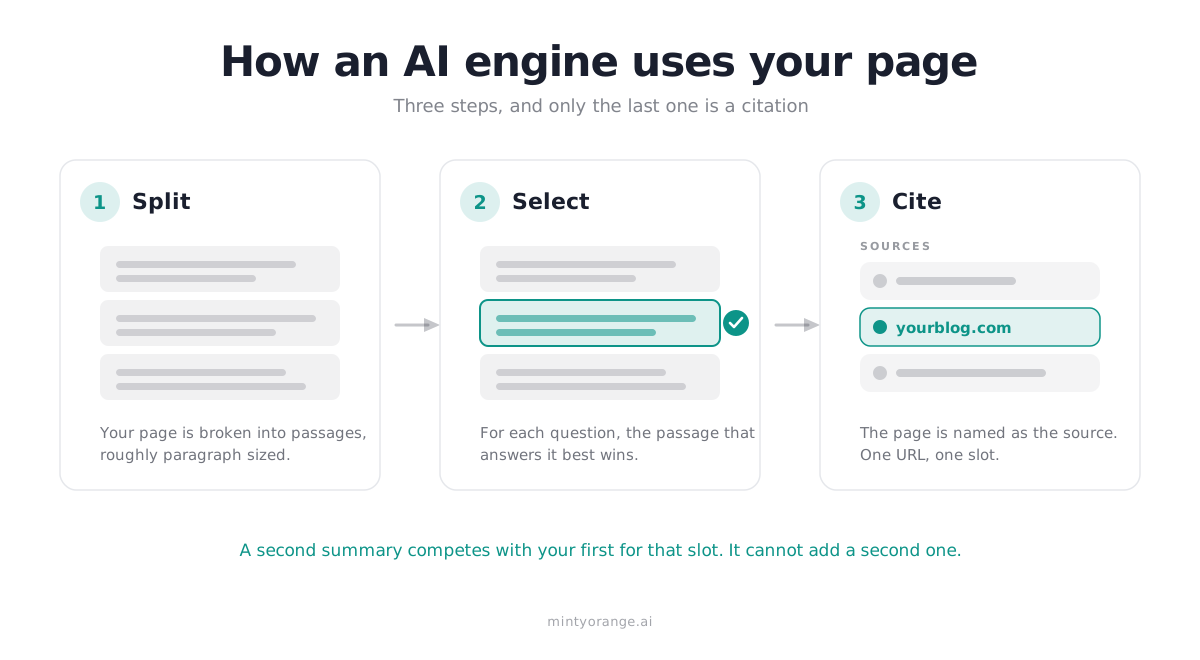
Step one, splitting. An AI system does not read your page as one continuous document and form an impression of it. It breaks the page into passages, roughly paragraph to box sized, and treats each one as a separate candidate.
Step two, selecting. When someone asks a question, the system searches across passages from many pages for the ones that answer that specific question best. From any single page, the best matching passage is the one that makes it through. Your page competes with other domains through its strongest passage, not through the sum of its parts.
Step three, citing. The answer names your page as the source. In the source list a URL appears once. Whether there was one passage on your page that matched or three makes no difference to that list.
That third step is the whole argument. A second summary is a second candidate for the same seat, not a second ticket.
If your key facts box and your lead summary say roughly the same thing, they are not covering more ground. They are two near-identical applicants for one job, and only one of them gets it. Meanwhile the reader who came for the article has to get past both before anything new starts.
The Machine Already Builds Its Own Table of Contents
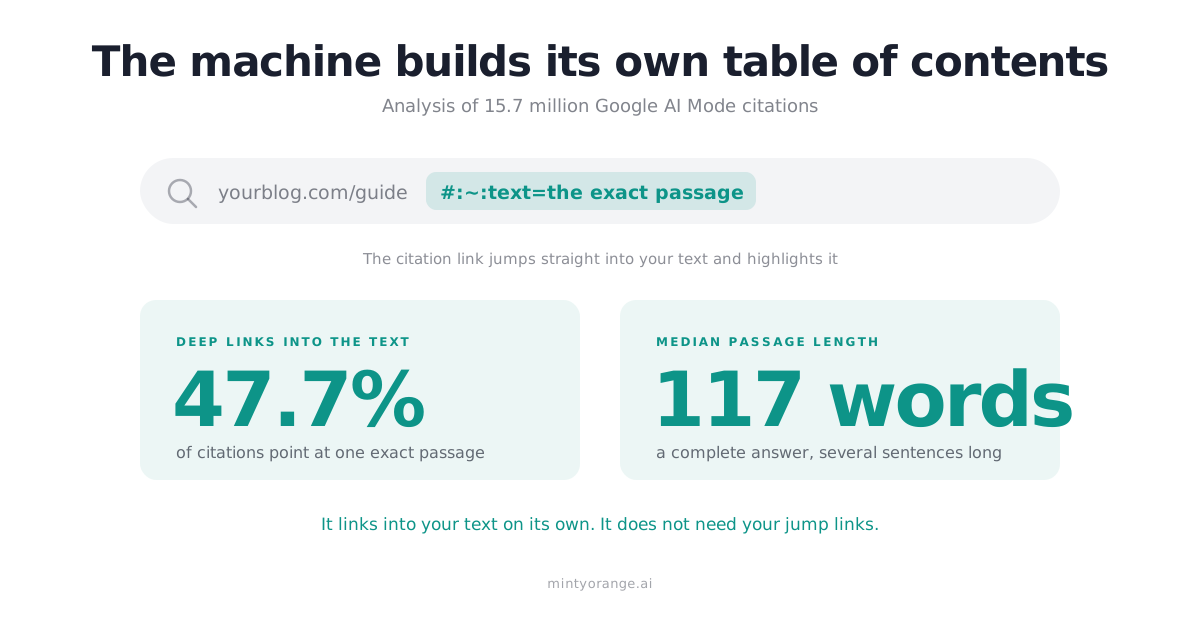
An analysis of 15.7 million Google AI Mode citations found that 47.7% of them are scroll-to-text links. Not a link to your page, a link that jumps to the exact passage that was quoted and highlights it on arrival. Across 2.7 million pages, the system generated 4.6 million of these deep links on its own.
So the engine is not standing at your front door hoping you left a map. It is walking straight to the paragraph it wants and pointing at it. Anchors and jump links are not what makes that possible. The text is.
The second number in that study is just as useful: the median highlighted passage is 117 words. Not a sentence, not a page. A complete answer, several sentences long, that holds together on its own. That is the shape worth writing toward, and it matches what other research on answer length has found, with passages of roughly 100 to 300 words covering most of what gets used.
What to Do Instead
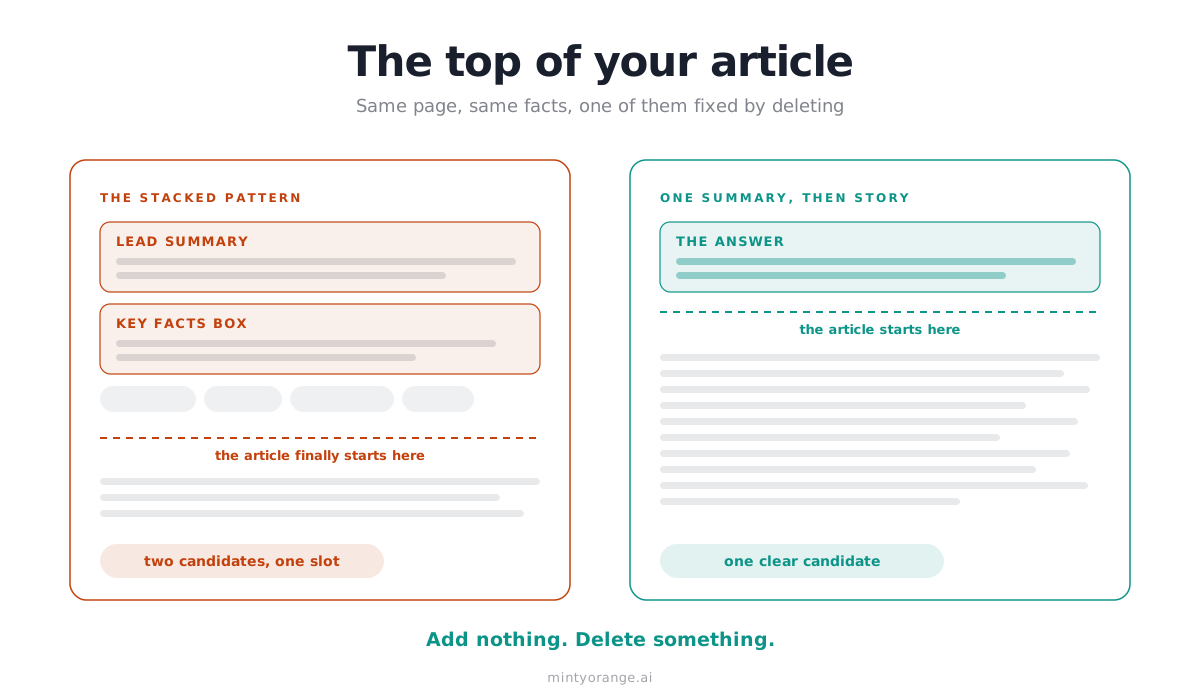
Keep one summary at the top and make it good. A short answer to the question the article is about, in plain sentences or a tight set of bullets, close enough to the start that a reader gets the point in the first few seconds. That block earns its place because it serves the reader and happens to be the passage most likely to answer a search question. It is also the only thing we add at the top when Minty Orange restructures an article, and the bullet summary goes to the end, where it recaps instead of competing.
Then let the article start. This is the part the stacked pattern quietly costs you: after two summaries and a link menu, the opening of your piece is no longer an opening. It is a third recap. If your strength as a publisher is that you were actually there, that you saw the thing, that you asked the price yourself, that has to survive the top of the page. Storytelling is not in tension with being citable. The engine wants a self-contained passage, and a well-told concrete paragraph is exactly that.
Structure the rest as sections that stand alone. Each one should make sense if it were lifted out and dropped into a different context, because that is precisely what happens to it.
What About the Jump Links?
Keep them if your readers use them. On a 4,000 word guide, a table of contents is a genuine service, and in classic search a set of anchors can occasionally produce jump links underneath your result. Those are the honest reasons, and they are about humans and about Google, not about AI citations.
There is no evidence that a table of contents lifts AI citations, and the deep-link data explains why. The structural information the engine needs is already in your headings, and it generates its own links into the text anyway. So put the jump links in for readers if readers want them. Just do not count them as GEO work, and do not let them push your article further down the page than it already is.
The Question to Ask Your Checklist
Whenever someone hands you a page template with more blocks in it than last year, there is one question that settles most of it quickly. What exactly does the second summary do that the first one does not?
If the honest answer is that it repeats the same points in a different shape, you have found something to delete. The cost of keeping it is certain: every single reader pays it in scrolling, and your own best passage gets a competitor. The benefit is unproven. That trade is not close.
Add nothing. Delete something.
Questions
Frequently Asked.
In practice, no. The source list carries one entry per URL. An engine selects the passage from your page that best answers the question and attributes the page as the source, so a second summary block does not add a second citation slot.
Yes, one. A short, direct answer near the top serves readers and tends to be the passage that matches a search question. The problem starts with the second block that repeats it, which competes with the first rather than adding reach.
Around 100 to 300 words is the practical range, and the median passage Google highlights when it cites a page is 117 words. Write sections that answer one thing completely, so they still make sense when lifted out of the article.
There is no evidence that they do. AI systems generate their own deep links into the exact passage they quote, and your headings already carry the structural information. Keep a table of contents for human readers on long guides, but do not count it as AI optimization.
No. AI systems look for self-contained passages that answer something completely, and a concrete, well-told paragraph does that better than a generic recap. The conflict people feel usually comes from stacking summary blocks on top of the piece, not from the writing itself.
This is one of several tactics that spread faster than the evidence behind them. If you want the wider picture, we checked the whole 2026 GEO checklist against the published studies in what is proven and what is folklore. Or run a page through our free check to see what genuinely gates it, starting with whether an AI system can retrieve and extract it at all.