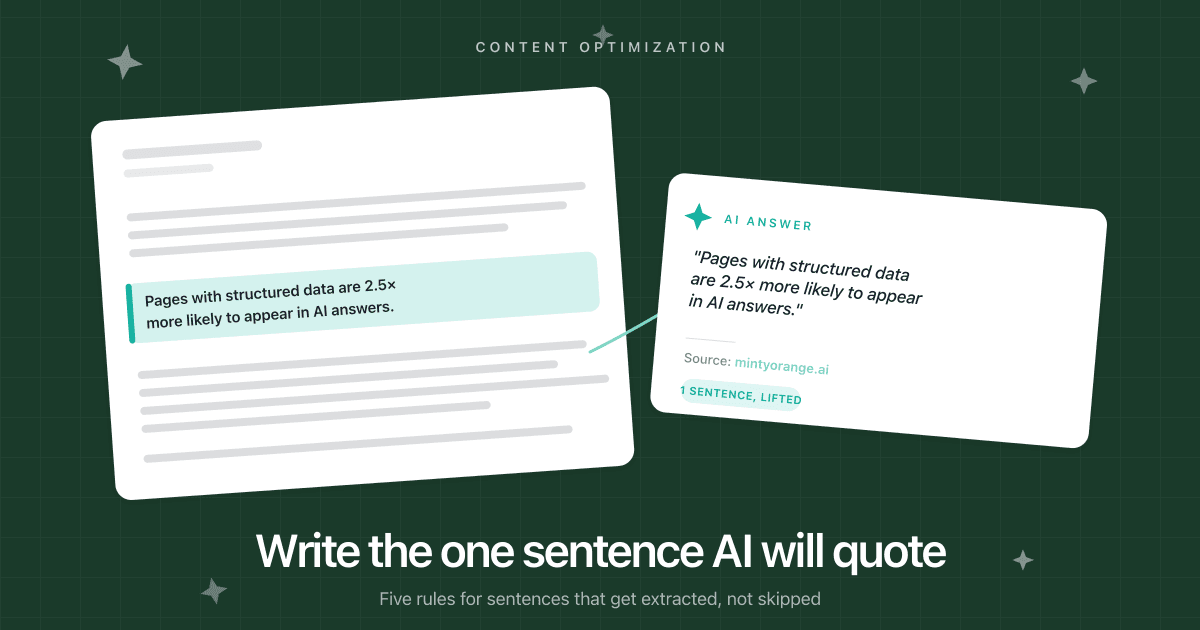
What Makes a Sentence Citable by AI?
A citable sentence is specific, self-contained, and answers a question directly without needing the sentences around it to make sense. AI search engines scan your page looking for statements they can lift and place into a generated answer. Sentences that are vague, hedged, or dependent on context get skipped. Sentences that state a clear fact, include a specific detail, and work as standalone statements get quoted. The difference between a sentence AI skips and a sentence AI cites usually comes down to five fixable patterns.
When ChatGPT, Perplexity, or Google AI Overviews cite your page, they do not quote your entire article. They extract one or two sentences, place them inside a generated answer, and link back to your page as the source.
That means the question is not whether your article is good. The question is whether your article contains a single sentence good enough to be pulled out and placed into a completely different context, and still make sense.
Most articles have zero sentences like that. The information is there, but it is buried in context, wrapped in qualifiers, or spread across three paragraphs instead of stated once clearly.
This is a fixable problem. And once you see the pattern, you will spot it everywhere.
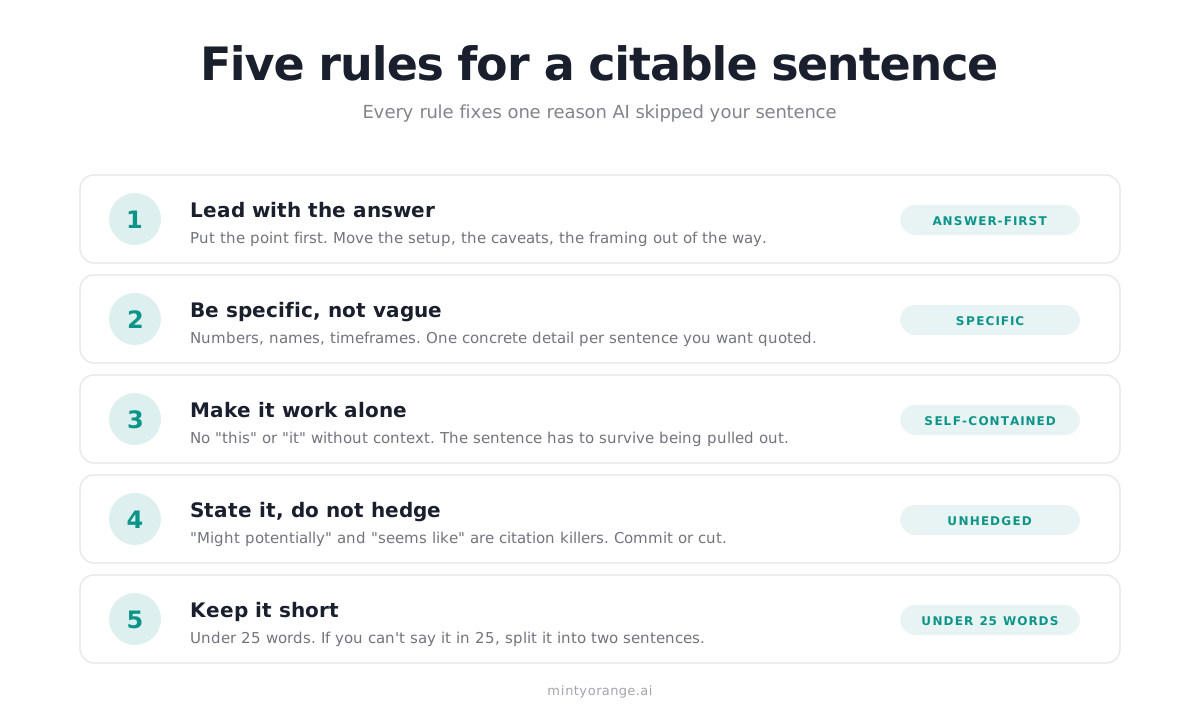
Rule 1: Lead With the Answer, Not the Setup
The most common reason AI skips a sentence is that it starts with context instead of the answer.
Before: "When it comes to choosing a CRM for small teams, there are many factors to consider, but most experts agree that ease of use is the most important one."
After: "Ease of use is the most important factor when choosing a CRM for small teams."
The before version takes 28 words to reach the point. The after version starts with it. AI engines scan from the top and extract the first clear statement they find. If your answer is hiding behind a setup clause, the AI moves on to a page where it is not.
Another example:
Before: "If you are planning a trip to Lisbon and wondering about the best time to visit, you should know that most travelers and locals would recommend the months between March and May."
After: "The best time to visit Lisbon is March through May, before the summer crowds and heat arrive."
Rule 2: Be Specific, Not Vague
AI prefers sentences with concrete details over sentences with general claims. Numbers, names, timeframes, and measurements all make a sentence more extractable because they give the AI something verifiable to cite.
Before: "Email marketing tends to have a pretty good return on investment compared to other channels."
After: "Email marketing returns an average of $36 for every $1 spent, making it the highest-ROI digital marketing channel."
The before version says nothing AI can use. "Pretty good" compared to what? The after version contains a specific number ($36 for every $1) and a specific claim (highest-ROI channel). AI can quote that with confidence.
This does not mean every sentence needs a statistic. But the sentences you want AI to extract should contain at least one specific detail: a number, a name, a timeframe, a comparison, or a measurable outcome.
Another example:
Before: "Sourdough bread takes quite a long time to make compared to regular bread."
After: "Sourdough bread requires 24 to 72 hours of fermentation, compared to 2 to 3 hours for standard yeast bread."
Rule 3: Make It Work Alone
A citable sentence needs to make sense when pulled completely out of your article and dropped into a different context. If a reader needs the paragraph before it or the paragraph after it to understand what the sentence means, AI will not extract it.
Before: "This is why it matters so much. If you do not get this right, everything else falls apart."
After: "AI crawlers like GPTBot do not execute JavaScript, so client-side-rendered pages index as empty shells."
The before version is meaningless without context. What is "this"? What is "it"? AI cannot cite a sentence that depends on pronouns and vague references. The after version states the what (no JavaScript execution), the who (AI crawlers like GPTBot), and the consequence (pages index as empty) in a single sentence. It works on its own.
Test your sentences by reading them in isolation. If a sentence does not make sense without the sentence before it, AI cannot cite it.
Another example:
Before: "They usually charge between those two amounts, depending on what you need done."
After: "Emergency plumbers in Denver charge between $150 and $400 per visit, depending on the time of day and complexity of the repair."
Rule 4: State It, Do Not Hedge It
AI engines avoid quoting sentences that hedge, qualify, or express uncertainty. If your sentence says "it might be the case that" or "some people believe that" or "it could potentially help to," the AI has no confident claim to attribute to your page.
Before: "It seems like structured data might potentially help your pages get noticed by AI search engines, though results can vary depending on a number of factors."
After: "Ahrefs tracked 1,885 pages that added schema markup in 2026 and found no measurable lift in AI citations on any platform."
The before version hedges with "seems like," "might potentially," and "results can vary." There is nothing for AI to cite because the sentence does not commit to a position. The after version makes a clear, specific, attributable claim.
This does not mean you should overstate things. If something is genuinely uncertain, say so clearly: "No conclusive data exists on X yet." That is a clear statement too. The problem is not uncertainty. The problem is mushy language that avoids saying anything definitive.
Another example:
Before: "Shopify could be a reasonable option for people who are maybe thinking about starting some kind of online store."
After: "Shopify powers 4.8 million online stores worldwide and is the most widely used e-commerce platform for independent sellers."
Rule 5: Keep It Short
AI citation slots are small. A generated answer contains maybe 3-5 sentences total, and citations are usually embedded inside one of them. Long, compound sentences with multiple clauses get cut or skipped in favor of shorter sentences that fit cleanly into the answer.
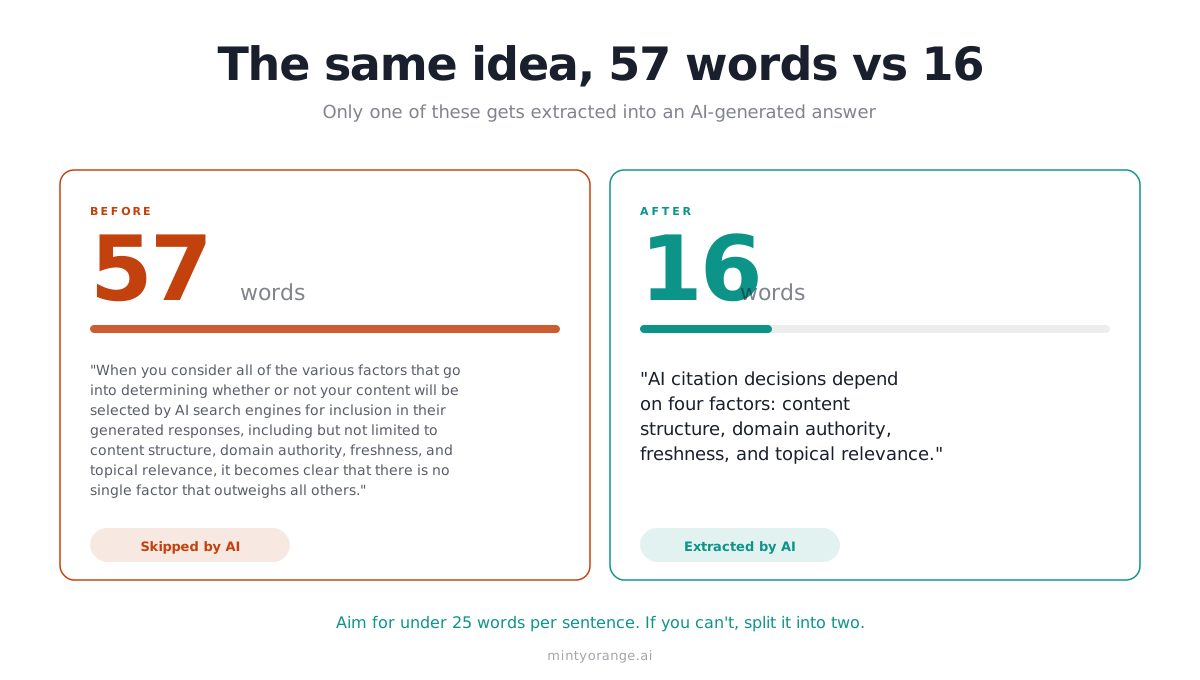
Before: "When you consider all of the various factors that go into determining whether or not your content will be selected by AI search engines for inclusion in their generated responses, including but not limited to content structure, domain authority, freshness, and topical relevance, it becomes clear that there is no single factor that outweighs all others."
After: "AI citation decisions depend on four factors: content structure, domain authority, freshness, and topical relevance."
The before version is 57 words. The after version is 16. They say the same thing. The short version gets cited. The long version gets skipped.
Aim for under 25 words on any sentence you want AI to extract. If you cannot say it in 25 words, split it into two sentences.
Another example:
Before: "The process of getting a Portuguese digital nomad visa, which is officially known as the D8 visa, involves gathering a number of documents, booking an appointment at the consulate, and then waiting for a period of approximately two to four months for a decision to be made."
After: "The Portuguese D8 digital nomad visa takes 2 to 4 months from application to approval."
The Quick Test
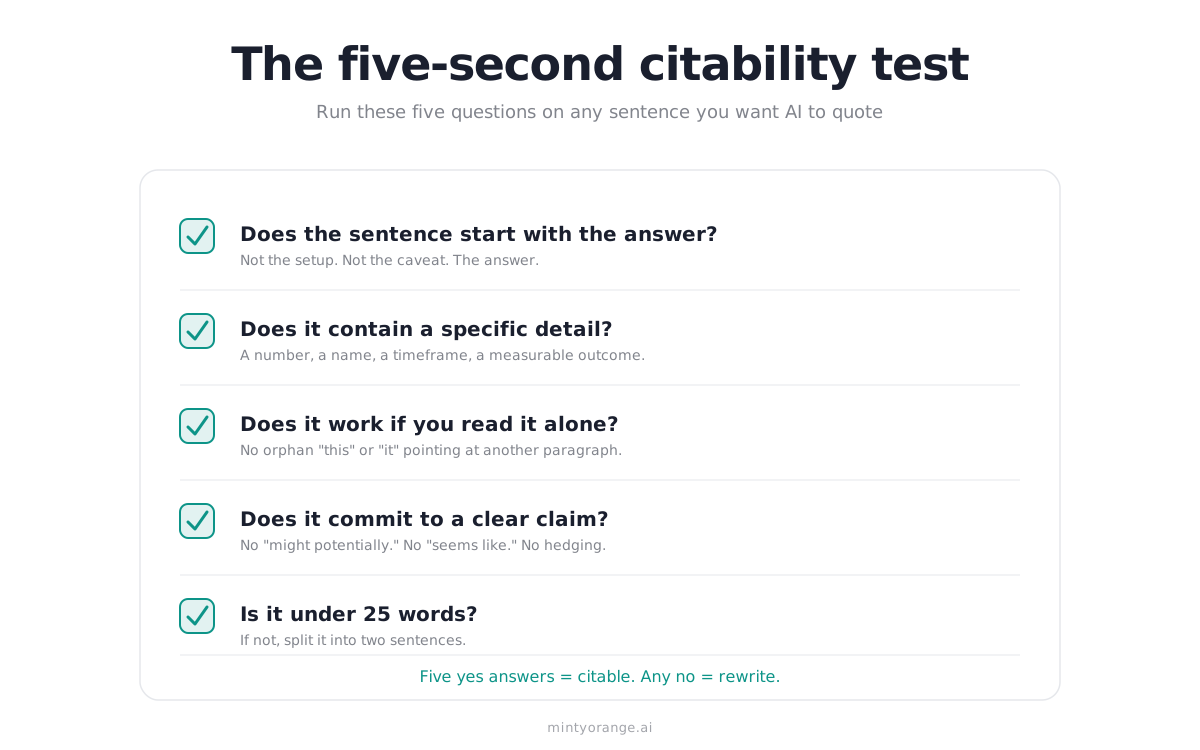
Before you publish, scan your article and find the three sentences you most want AI to quote. For each one, ask:
- 1.Does it start with the answer? (Not the setup.)
- 2.Does it contain at least one specific detail? (Number, name, timeframe.)
- 3.Does it work if I read it completely alone? (No "this" or "it" without context.)
- 4.Does it commit to a clear claim? (No "might" or "seems like.")
- 5.Is it under 25 words?
If all five are yes, that sentence is citable. If any are no, rewrite it. This takes five minutes and can be the difference between your article getting cited and getting summarized away.
Before and After: A Full Paragraph
Here is what this looks like when you apply all five rules to a real paragraph.
Before: "There are many different things you can do to improve your website's performance in terms of being found by AI search engines. One approach that seems to work well is making sure you have some kind of FAQ section on your key pages. This can help because AI tends to look for question-and-answer formats when it is trying to find information to include in its responses."
After: "Add a FAQ section to your top-performing pages: three to five questions, each answered in 80 to 120 words. AI engines prioritize question-and-answer formats because they can extract clean, attributable answers without rewriting the source material."
The before version is 76 words, contains zero specific details, hedges twice ("seems to work," "can help"), and has no sentence that works in isolation. The after version is 36 words, contains specific numbers (three to five questions, 80 to 120 words), commits to a concrete recommendation, and either sentence can be extracted on its own.
Key Takeaways
- ✓AI cites individual sentences, not entire articles. If your article has no sentence worth quoting in isolation, it will not get cited.
- ✓Five rules for citable sentences: answer-first, specific, self-contained, unhedged, and short (under 25 words).
- ✓The most common problem is sentences that start with context or setup instead of the answer. Move the answer to the front.
- ✓"Pretty good," "seems like," and "might potentially" are citation killers. State your claim or do not make it.
- ✓Test your key sentences by reading them alone. If they do not make sense without surrounding context, AI cannot use them.
- ✓This takes five minutes per article. Scan for your three most important sentences and apply the five rules.
Questions
Frequently Asked.
Most AI-generated answers cite 3-6 sources, and each source typically contributes one or two sentences to the response. You do not need every sentence in your article to be citable. Focus on the three to five sentences that contain your most important claims, data points, or answers. Those are the ones to optimize.
No. This applies to the specific sentences you want AI to extract, not to your entire article. Your natural voice, storytelling, and context-setting paragraphs still matter for human readers. The citable sentences are strategic anchors placed inside your existing writing style.
Near the top of each section. AI engines scan from the beginning and extract the first clear statement they find on a given subtopic. If your best sentence is in the third paragraph of a section, the AI may never reach it. Move your strongest, most specific statement to the first or second sentence of each section.
Yes, and it is one of the fastest ways to improve your AI visibility without rewriting entire posts. Open your top-performing articles, find the key claim in each section, rewrite it using the five rules, and move it to the top of the section. This takes about five minutes per article.
Yes. All three engines extract individual statements from source pages and place them into generated answers. The extraction logic varies slightly between engines, but the five rules (answer-first, specific, self-contained, unhedged, short) apply across all of them. A sentence that is citable by one engine is generally citable by all three.