How Does Minty Orange Compare to Frase for SEO and GEO?
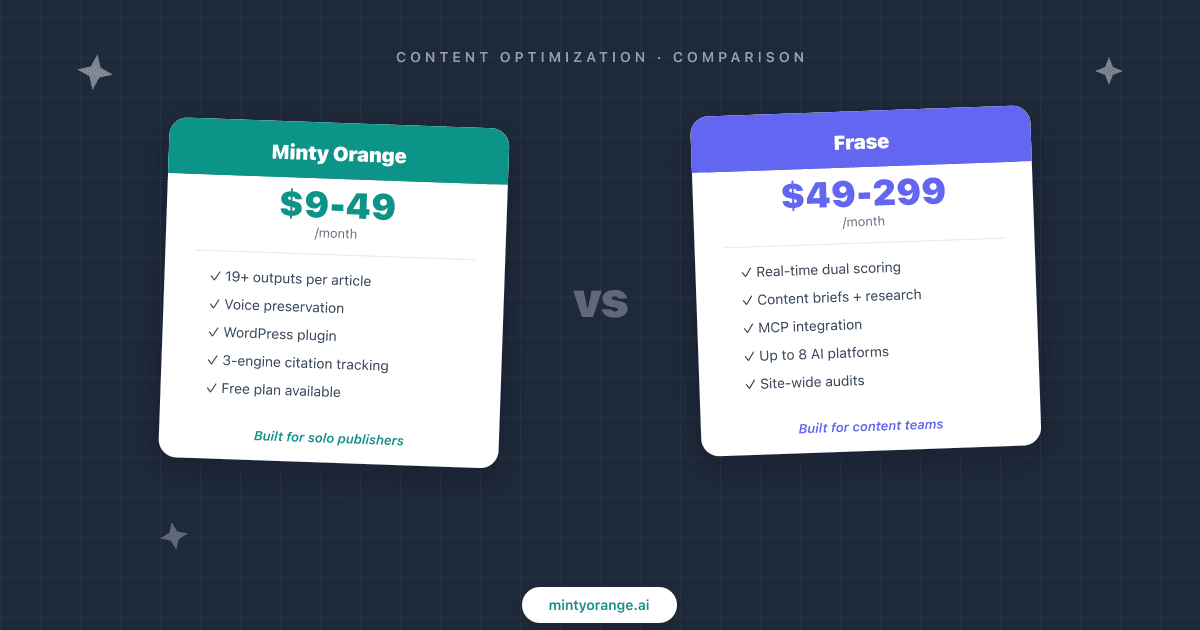
Both tools combine SEO and GEO optimization in one workflow. Frase is a comprehensive platform built for content teams, with a real-time editor, AI writing, dual scoring, and AI visibility tracking across up to 8 platforms. It starts at $49/month. Minty Orange is a focused optimization tool built for publishers and businesses, with a Live Editor that shows your score updating as you edit, a top-to-bottom optimization per article (from title tag to FAQ schema), citation tracking across 3 engines, voice preservation, and a WordPress plugin. It starts with a free plan and goes up to $49/month. The right choice depends on your workflow, your team size, and what you need the tool to do.
Frase and Minty Orange both sit in the same category: tools that help publishers optimize content for Google rankings and AI citations in one place. A few years ago, that category did not exist. In 2026, it is where most of the interesting product development is happening.
But “same category” does not mean “same tool.” These two products made different decisions about who they serve and how they serve them. Those differences matter when you are choosing where to spend your budget.
I have used both. Here is an honest breakdown.
What Each Tool Does
Frase
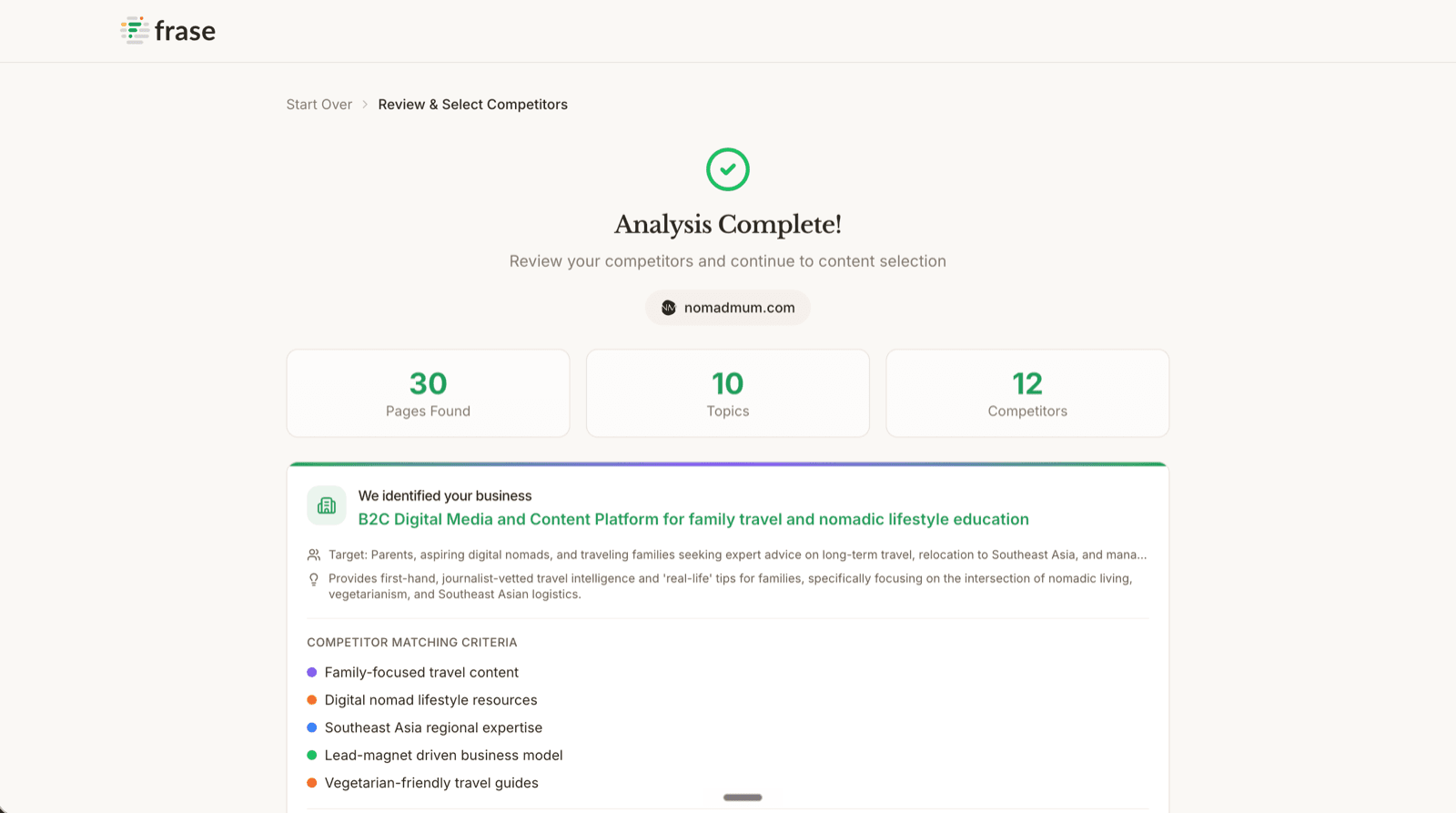
Frase is a content workflow platform. You give it a keyword, and it researches the top-ranking pages, generates a content brief, and opens an editor where you can write (or have AI write) with real-time optimization feedback. As you write, you see two scores side by side: an SEO score for Google and a GEO score for AI citation readiness.
Frase also includes AI visibility tracking that monitors where your brand appears across AI platforms. Depending on your plan, it tracks 2 to 8 platforms including ChatGPT, Perplexity, Claude, Gemini, Google AI Overviews, Grok, Copilot, and DeepSeek.
Additional features include site audits, a content decay recovery system, an MCP server for agent workflows, and an AI writing assistant with 80+ skills. Frase covers the full content pipeline from research to monitoring.
Minty Orange
Minty Orange is a content optimization platform for publishers. It analyzes your existing article against the live SERP and AI citation requirements, then rebuilds it section by section. You get a top-to-bottom optimization: first Q&A, FAQ schema, title tag, meta description, evidence, E-E-A-T recommendations, internal linking, off-site playbook, and a multi-engine score.
Minty Orange includes citation tracking across three engines (Google AI Overviews, ChatGPT, Perplexity) with automatic re-checks twice a month. It also includes a Clusters view for topic-based site analysis and an Insights dashboard that combines Google Search Console data with AI visibility in one place.
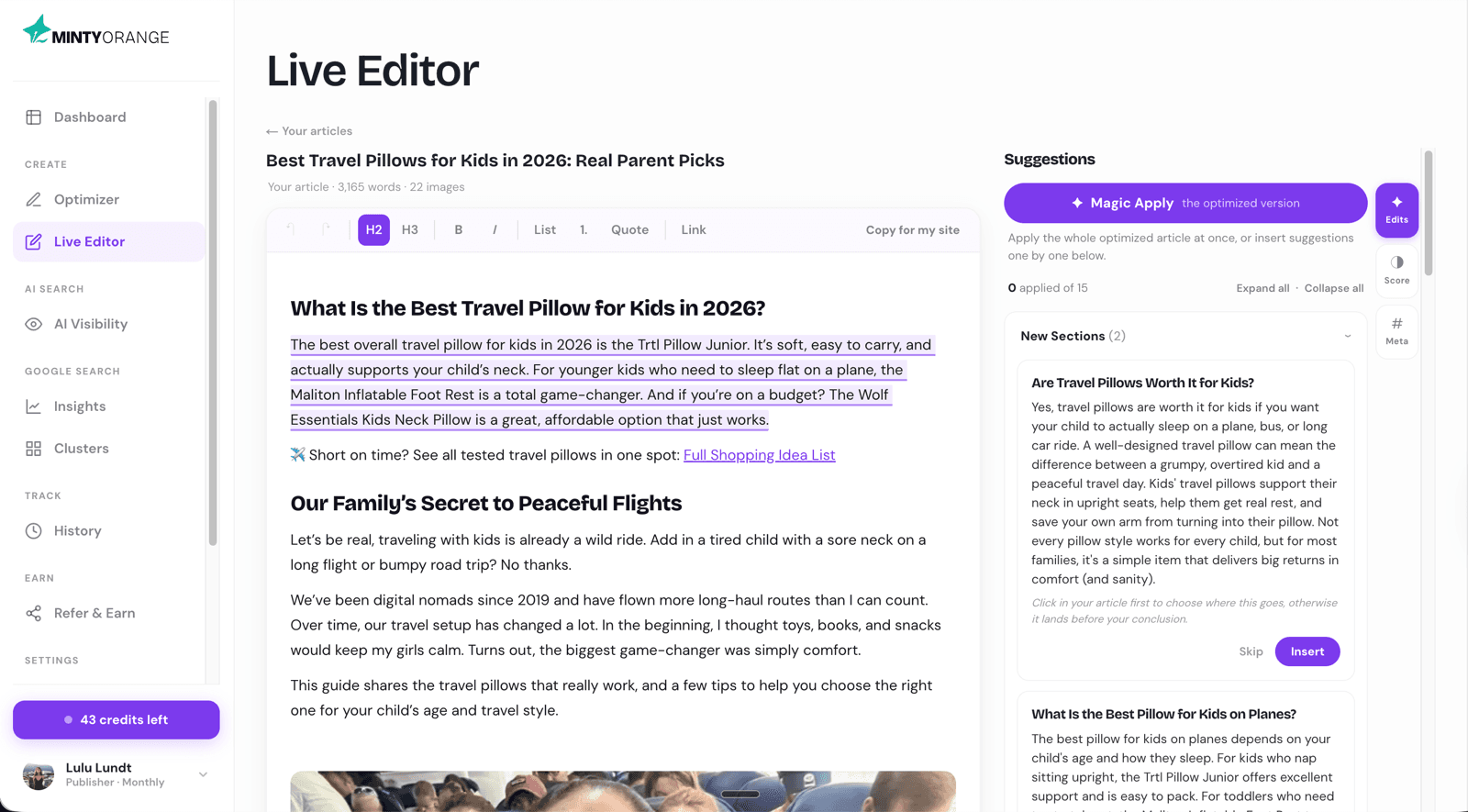
The built-in Live Editor lets you apply changes as you go and shows your optimization score updating live as you edit. A dedicated WordPress plugin connects to your site. Every rewrite preserves the author’s tone, sentence rhythm, and vocabulary by default, using Claude Sonnet 4-6 as the primary model specifically for voice fidelity.
Pricing Comparison
This is where the difference is sharpest.
Frase (monthly billing):
- ✓Starter: $49/month (2 AI platforms tracked)
- ✓Professional: $129/month (3 platforms)
- ✓Scale: $299/month (5 platforms)
- ✓Enterprise: custom (8 platforms)
- ✓All plans include full feature access. Tiers differ by volume and platform count.
- ✓Annual billing saves about 20%. 7-day free trial.
Minty Orange:
- ✓Free: $0/month (2 preview optimizations)
- ✓Starter: $9/month (5 optimizations)
- ✓Creator: $19/month (20 optimizations)
- ✓Publisher: $49/month (50 optimizations)
- ✓Citation tracking across 3 engines on all paid plans. No feature-gating.
- ✓Free AI-Readiness Score at mintyorange.ai/check (no account needed).
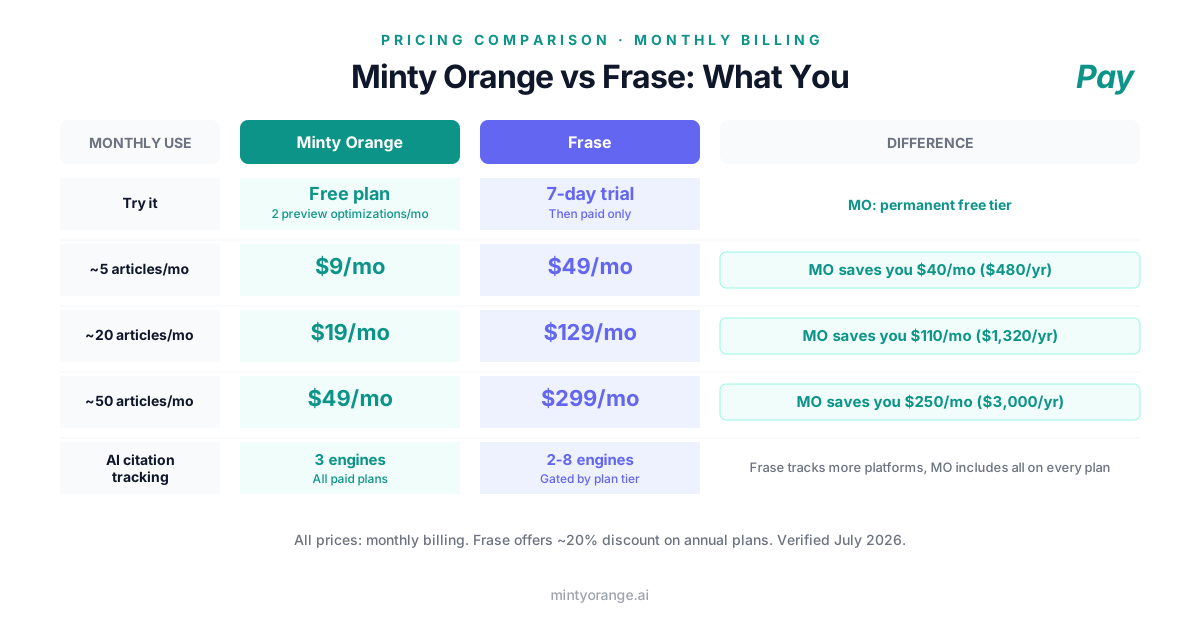
For a solo publisher optimizing 5 articles per month, the comparison is $49/month (Frase Starter) versus $9/month (Minty Orange Starter). For 20 articles per month, it is $129/month (Frase Professional) versus $19/month (Minty Orange Creator).
Minty Orange has a free plan. Frase has a 7-day free trial.
Where Frase Is Stronger
Being fair about this.
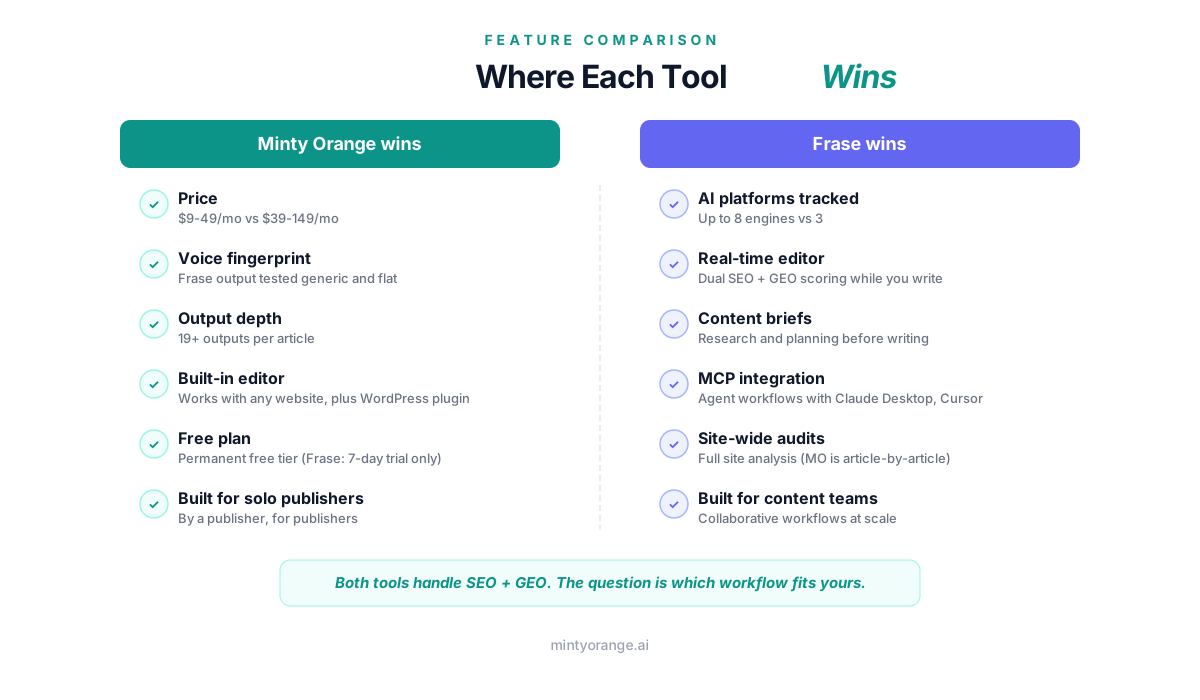
More AI platforms tracked. Frase monitors up to 8 AI platforms depending on your plan. Minty Orange tracks 3 (Google AI Overviews, ChatGPT, Perplexity). If you need visibility into Claude, Gemini, Grok, Copilot, and DeepSeek citations, Frase covers more ground.
Writing new articles with AI. Frase can generate a full first draft from a keyword and content brief, and its AI writing assistant comes with 80+ skills for producing sections and rewrites. Minty Orange is built to optimize content you have already written rather than produce it from scratch. If you want AI to write drafts for you, Frase covers that pipeline.
MCP server integration. Frase connects to Claude Desktop, Cursor, and other AI development environments through an MCP server. This matters for technical teams building automated content workflows. Most individual bloggers will never use this.
Where Minty Orange Is Stronger
Price. At every volume tier, Minty Orange is significantly cheaper. The Publisher plan ($49/month for 50 optimizations) costs the same as Frase’s entry-level Starter ($49/month for 10 articles). For the same budget, you get five times the volume.
Voice preservation. This is where the gap is widest, and honestly the point I did not expect to matter as much as it did. Minty Orange preserves your writing voice by default while restructuring for SEO and AI extraction. Every rewrite keeps the author’s tone, sentence rhythm, and vocabulary intact. It uses Claude Sonnet 4-6 as its primary model specifically because it preserves voice better than GPT alternatives. In direct comparison testing, Frase’s AI writing output was consistently generic, with a flat, interchangeable tone that required heavy editing to sound like the original author. Minty Orange maintained the voice fingerprint of the original text across every test.
Output depth per article. Minty Orange delivers a top-to-bottom optimization per article, from title tag to FAQ schema: first Q&A, FAQ with schema, title tag, meta description, evidence suggestions, E-E-A-T recommendations, internal linking, off-site playbook, multi-engine score, GSC impact card, and more. Frase delivers an optimization score and suggestions. The per-article depth is different.
Free tier. Minty Orange offers a permanent free plan (2 preview optimizations/month) plus a free AI-Readiness Score tool that requires no account. Frase offers a 7-day trial.
Built for individual publishers. Minty Orange was built by a publisher (Lulu Lundt, who runs nomadmum.com) specifically for bloggers and small publishers. The interface, the outputs, and the pricing all reflect that focus. Frase was built for content teams and scales toward agency and enterprise use cases.
Who Each Tool Is Best For
Frase is a better fit if:
- ✓You work on a content team and need collaborative workflows
- ✓You want AI to generate first drafts for you from a keyword and content brief
- ✓You want AI visibility tracking across more than 3 platforms
- ✓You are building automated content pipelines with MCP integration
- ✓Your budget supports $49-299/month
Minty Orange is a better fit if:
- ✓You are a publisher, blogger, or business owner who creates content
- ✓You write your own content and want to optimize it without losing your voice
- ✓You want the deepest optimization per article, from title tag to FAQ schema
- ✓You want citation tracking included from the cheapest paid plan
- ✓Your budget is $9-49/month
- ✓You want to try before you pay (free plan with preview optimizations, free AI-Readiness Score)
The Honest Summary
These tools solve the same core problem (optimize for both Google and AI search) but they approach it from opposite directions.
Frase starts with research and planning, then helps you write and optimize. It is a full content workflow platform built for teams.
Minty Orange starts with your existing content, optimizes it section by section, and lets you apply changes directly in its built-in editor. It is a focused optimization tool built for publishers and businesses who create their own content.
If you publish 5-20 articles per month and care about keeping your voice, Minty Orange will give you more per-article depth at a fraction of the cost. If you manage a content team of 3-10 people and need a full research-to-publish pipeline, Frase gives you the workflow infrastructure and platform breadth you need.
Both are good tools. The question is which workflow matches how you work.
My Personal Verdict
I have tested dozens of content tools over 21 years in search, so I try not to get too excited about any single product. But here is what stayed with me after running both tools through the same article.
Frase surprised me most, and not in a good way. Its AI writing output was generic. Frase’s rewrite of a piece I know well read like it could have been written for any business in the niche. Interchangeable. Flat. I would have had to rewrite most of it before publishing, and at that point I was wondering why I was using the AI writing at all.
Minty Orange kept the phrases I had written. Same sentence rhythm, same word choices, same little quirks that make writing sound like a person. It restructured the article for both Google and AI search without stripping the voice out of it. That is not a small thing, and it is the reason I would recommend it over Frase for any publisher who cares how their content sounds.
If you run a bigger team writing at scale and you need the full research-to-publish pipeline, Frase gives you more surface area. If you are optimizing your own writing and want it to still sound like yours after the tool has touched it, Minty Orange wins that comparison for me.
Key Takeaways
- ✓Both Minty Orange and Frase combine SEO and GEO optimization. They solve the same problem for different audiences.
- ✓Frase starts at $49/month (monthly billing) and is built for content teams. Minty Orange starts at $9/month (with a free plan) and is built for publishers and businesses.
- ✓Frase is stronger on: AI platform coverage (up to 8 vs 3), AI writing for first drafts, and MCP integration for automated pipelines.
- ✓Minty Orange is stronger on: price at every tier, voice preservation (Frase output tested noticeably generic), per-article optimization depth (top-to-bottom, from title tag to FAQ schema), and free tier.
- ✓Citation tracking is included on all Minty Orange paid plans. Frase gates platform count by tier (2 platforms on Starter, up to 8 on Enterprise).
Questions
Frequently Asked.
Yes, and some publishers do. You could use Frase to generate a first draft from a keyword and content brief, then optimize the finished article through Minty Orange for deeper per-article outputs and voice preservation. Whether that is worth the combined cost depends on your volume and budget.
Frase tracks more platforms (up to 8, including Gemini, Grok, Copilot, and DeepSeek alongside ChatGPT, Perplexity, and Claude). Minty Orange tracks 3 engines (Google AI Overviews, ChatGPT, Perplexity) but includes all three on every paid plan starting at $9/month. Frase gates platform count by tier.
Yes, both do. Frase offers a WordPress plugin for direct integration with your site. Minty Orange also has a dedicated WordPress plugin that connects its optimizer and Live Editor to your posts, so you can push optimizations without leaving WordPress.
Minty Orange, by a clear margin. It preserves the author’s voice by default, restructuring content for SEO and AI extraction while maintaining tone, sentence rhythm, and vocabulary. It uses Claude Sonnet 4-6 as the primary model specifically for voice fidelity. In direct side-by-side testing, Minty Orange consistently preserved the original author’s voice fingerprint. Frase’s AI writing output was noticeably generic and flat, requiring heavy editing to sound like a real person wrote it.
If you need research-to-publish workflow tools, tracking across 5-8 AI platforms, or MCP integration for automated pipelines, Frase offers capabilities Minty Orange does not. For individual bloggers focused on optimizing existing content with maximum per-article depth, Minty Orange delivers more value per dollar.
Yes. Both optimize content for AI citation readiness alongside traditional SEO, and both include editors with live scoring as you write. Minty Orange also rebuilds your content section by section and delivers a full optimization package with FAQ schema, evidence, and internal linking suggestions. The approach differs, but the goal is the same: content that ranks on Google and gets cited by AI.