Is Blogging Dead in 2026?
No, blogging is not dead. What’s dead is the click-based model where ranking #1 on Google reliably sent traffic to your site. AI Overviews now answer most informational questions directly on the search page, so readers get what they need without ever clicking through. The blogs that are still working in 2026 have stopped optimizing only for clicks and started optimizing for citations, brand mentions, and direct-to-publisher relationships.
A Small Story From My Own Blog
I’ve been writing on nomadmum.com since 2021. Years of articles. Real traffic. A real community of digital nomad families reading along.
One of my best-performing posts is “31 Best Things to Do in Koh Phangan.” For years, that post sat in the top three on Google for “best things to do in Koh Phangan” and the dozens of related queries around it. Steady traffic, steady comments, steady affiliate revenue. I knew the post worked because the same searches kept finding it.
Then I started watching the search results page change.
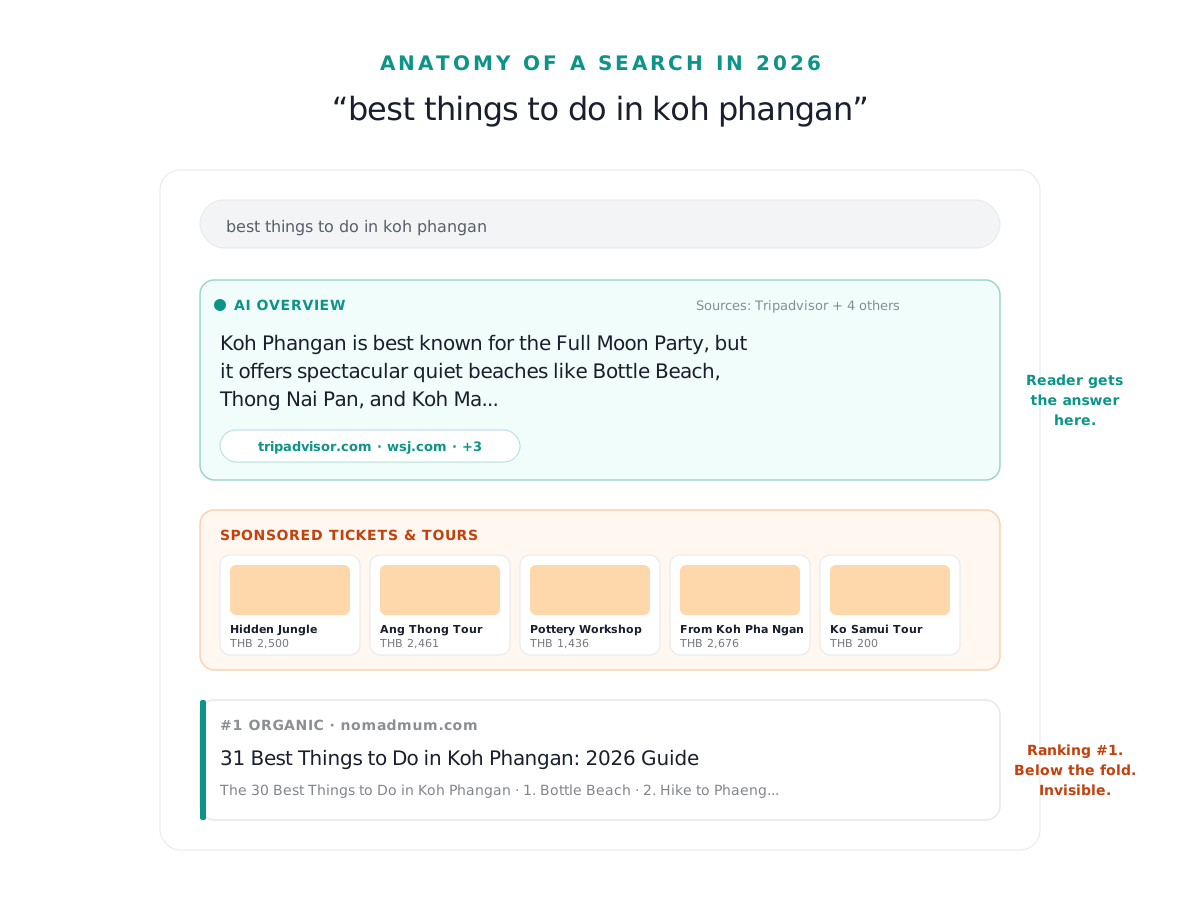
If you Google “best things to do in Koh Phangan” today, here is the order of what shows up. First, a full AI Overview. It tells you about Bottle Beach, Thong Nai Pan, Koh Ma, Malibu Beach, Ang Thong. It pulls structured bullet lists with descriptions. Sources cited: Tripadvisor and four others.
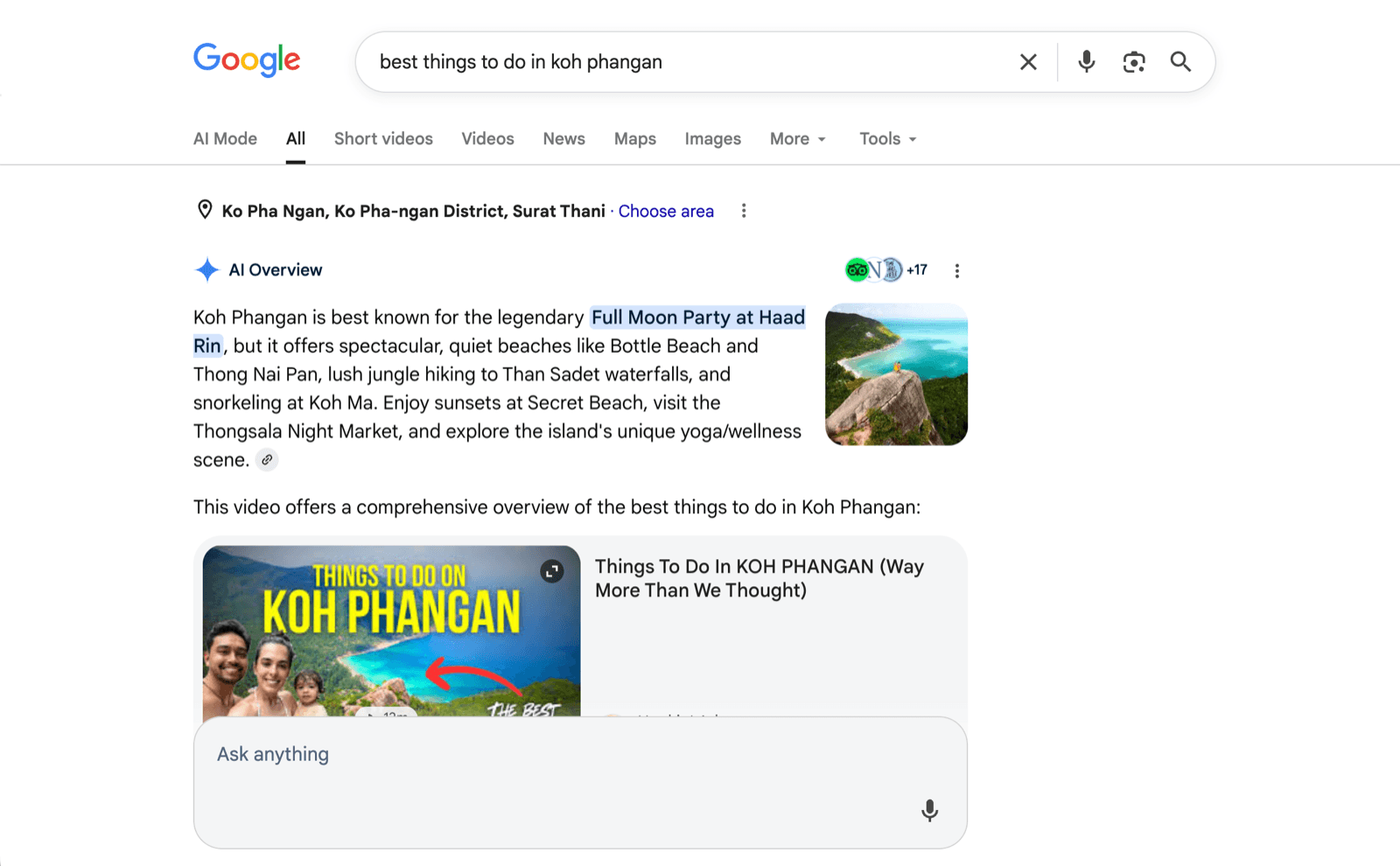
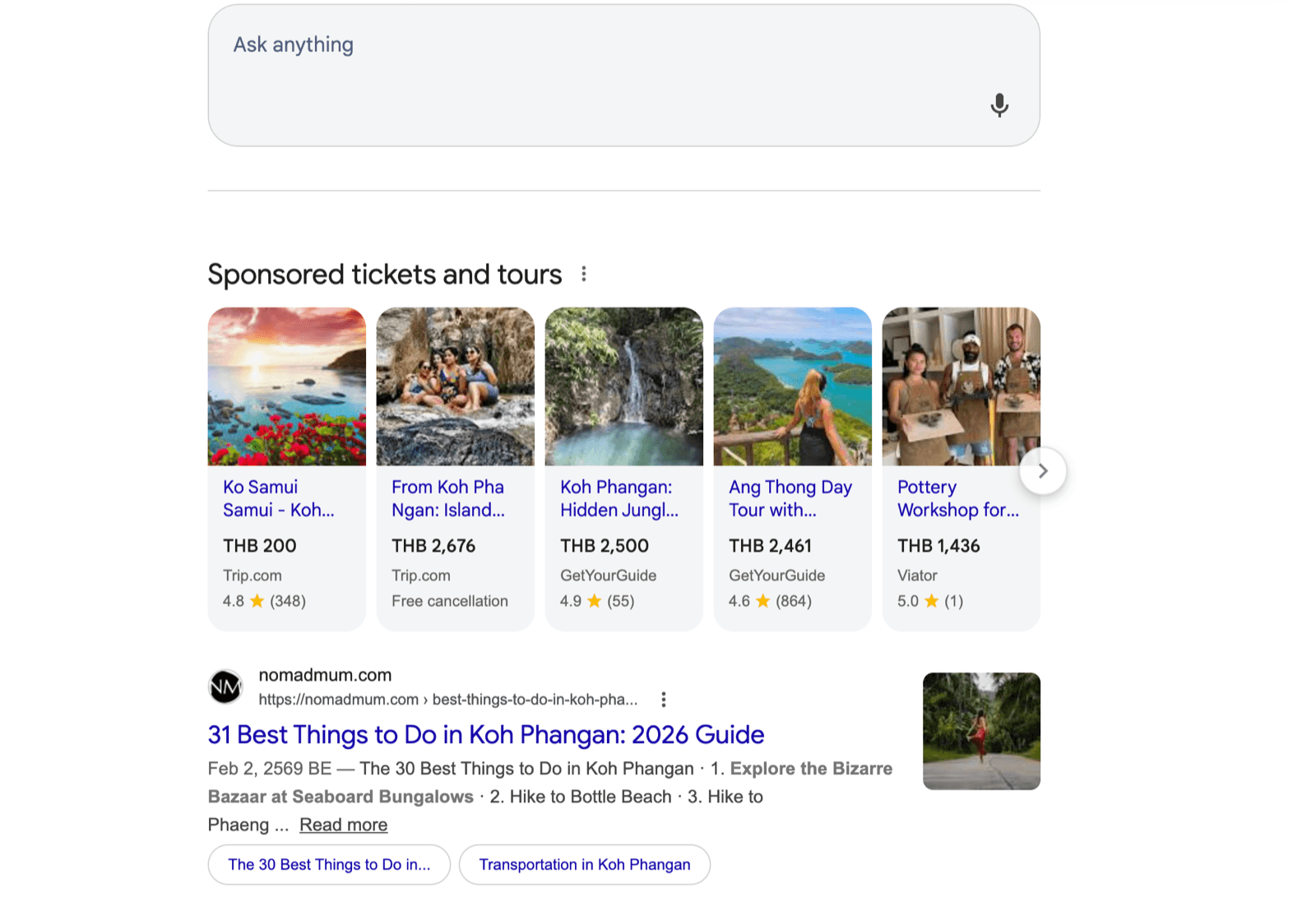
Below that, five sponsored tour cards from Trip.com, GetYourGuide, and Viator. Prices in Thai Baht. Review counts. Booking buttons.
Below all of that, finally, my article. Still ranking number one organic. Still showing up.
But notice what happened. The user got the full answer above the fold. They got the bullet list of beaches, the descriptions, the names. They got booking options for the tours. None of those sources are nomadmum.com. The AI Overview pulled from Tripadvisor. The bookings are paid placements. My number one organic ranking sits below all of it, technically present and functionally invisible.
That’s the new reality, and the writing didn’t cause it.
What Actually Changed
Three things shifted at once, and they shifted fast.
One: AI Overviews became the new top of the page. As of February 2026, 48 percent of Google searches showed an AI-generated answer at the top, per BrightEdge, and I/O 2026 then made AI Mode the default. When an AI Overview appears, click-through rates for the top organic result drop by roughly 35 to 58 percent across Ahrefs’ 2025 and 2026 studies.
Two: Readers got faster at being satisfied. A list of seven beaches in an AI Overview answers the question for most casual planners. They don’t need a 3,000-word guide. They got what they came for in three sentences. That used to be a problem only for thin content. Now it’s a problem for thorough content too, because the AI summarizes thorough content into thin content for you.
Three: ChatGPT and Perplexity stopped being side channels. Significant numbers of people now go straight to ChatGPT or Perplexity instead of Google. Those engines also cite sources. They also send some traffic. But the rules of who gets cited are different from Google rankings, and most blogs haven’t adjusted yet.
The combined effect: global publisher traffic from Google dropped roughly a third in the year to November 2025, with US publishers hit hardest at 38 percent.
That kind of drop in a single year qualifies as a structural reset.
What This Looks Like on the Ground
Search Console becomes confusing first.
You log in expecting to see what you’ve always seen: traffic, queries, CTR, average position. And you see that your average position is fine. Your impressions are even up in some cases. Google is showing your page more than ever.
Your clicks are down 30, 40, 50 percent.
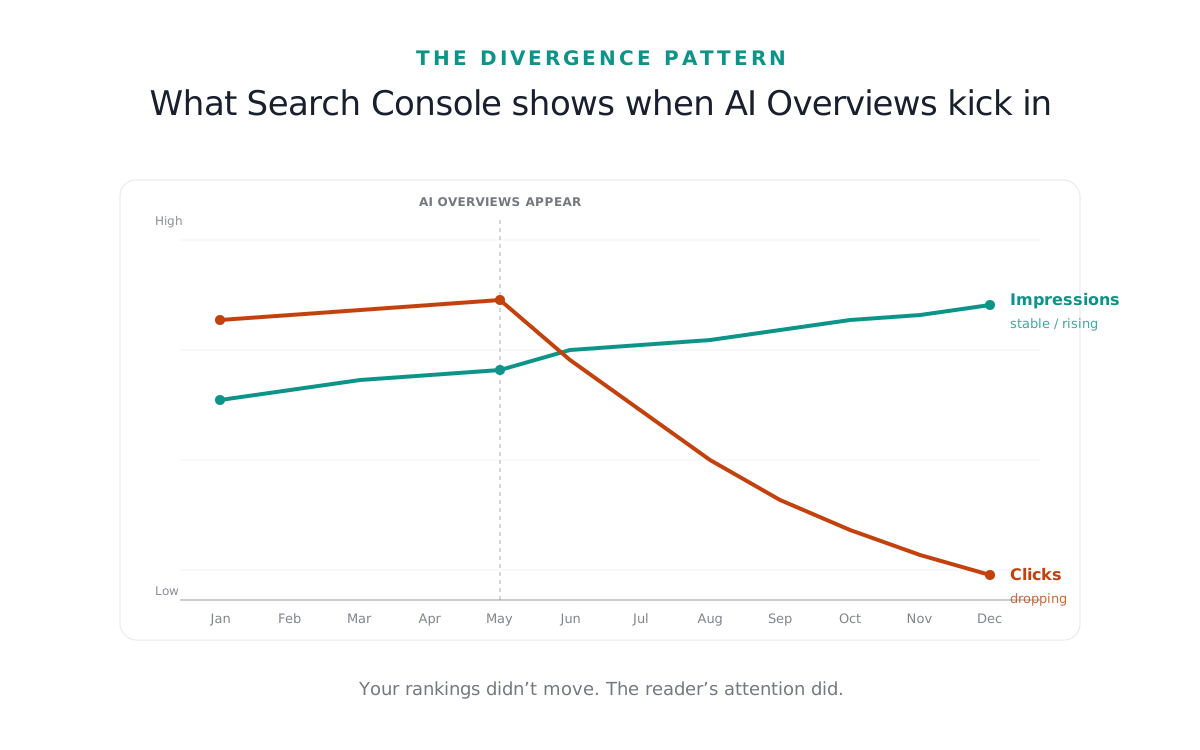
This is the divergence pattern that thousands of bloggers are seeing right now. Impressions up. CTR down. Average position stable or improving. It looks broken because it doesn’t match any of the patterns we learned. A penalty hits clicks AND impressions. A core update hits position. This hits only the click.
It’s the AI Overview eating the click. Your content is still being shown. Just not clicked.
The hardest part is that it feels personal. You start questioning the writing. You wonder if you’ve fallen behind. You compare yourself to bigger blogs and assume you must have made a mistake. None of that is true. The mechanism is mechanical. The shift happened to almost everyone in informational publishing, and it happened on roughly the same timeline.
That’s the relief part of this story. You didn’t write worse. The rules changed under you.
What Still Works in 2026
This is where the blog post could end on a doom note. The picture is more complicated than that. A lot of things still work. They just look different from what worked before.
Getting cited inside the AI Overview itself. Brands cited in AI Overviews earn 35 percent more organic clicks than non-cited competitors on the same queries, in Seer Interactive’s tracking of 25 million impressions from June 2024 to September 2025. A citation is notnothing. It’s a smaller pie, but you can still get a slice if your content is structured for extraction. Direct answers in the first 60 words. Clean question-as-H2 structure. FAQ blocks. The same fundamentals work across ChatGPT and Perplexity.
Brand searches. When someone searches your blog by name, AI Overviews actually help. They reinforce your authority instead of competing with it. Building a brand that people search for directly is now more valuable than ranking for generic keywords. This is slower and harder, but it compounds.
Email lists and direct relationships. Every newsletter signup you collected over the years is now worth more than it was, because the click is no longer guaranteed. The people who chose to come to you directly are the ones still coming.
Non-informational queries. AI Overviews are concentrated heavily on informational searches. In BrightEdge’s tracking, e-commerce queries trigger AI Overviews only about 4 percent of the time, compared to roughly 36 percent for informational searches. If you have transactional or commercial content, it’s less exposed. If you’re pure informational, it’s harder.
Refreshed content. Updating your best evergreens regularly still works. Perplexity especially favors recency. Refresh cycles every few months keep your strongest posts in active rotation across all three engines.
Communities. Reddit, Discord, niche forums. Real conversation in places AI hasn’t completely flattened yet. The smaller and more specific, the better.
So no, blogging is not dead. The blogs still working in 2026 just look different. They optimize for citation alongside ranking. They build email lists harder than they build sessions. They publish less but refresh more. They treat their site as a destination, not a search-traffic-funnel.
What I Changed About My Own Work
Three things, concretely.
I stopped chasing pageviews as the only metric. I started tracking whether my content gets cited in AI Overviews, in ChatGPT answers, in Perplexity responses. Citation tracking became my new top-of-funnel.
I restructured my most important posts. Direct answer first. Questions as section headings. FAQ blocks at the bottom.
And I went deeper on fewer topics instead of broader on more topics. The 5-article strategy works. Five strong, regularly updated pillar articles around one topic cluster outperforms 50 thin posts in the new system. Less is more was always true. Now it’s enforced by the algorithm.
The blog stopped being a traffic funnel. These days it works more like a publishing house that happens to have a website. The work itself, the writing, the thinking, the documentation, that hasn’t changed. The distribution rules around it have.
Key Takeaways
- ✓Blogging isn’t dead. Click-based blogging is.
- ✓Your rankings can stay flat while your traffic halves. The AI Overview ate the click.
- ✓The signal is divergence. Impressions stable, CTR dropping.
- ✓You didn’t write worse. The rules changed.
- ✓Citation is the new ranking.
- ✓Brand search and email lists got more valuable.
- ✓Less but better still wins.
Final Thoughts
The hardest part of this shift is emotional, not technical.
You spent years building something that worked under one set of rules. The rules changed without warning. Your work is still good. Your audience is still out there. The path from one to the other got rebuilt around you.
That’s frustrating. It’s also fixable. The blogs that are quietly winning in 2026 are the ones that stopped grieving the old model and started learning the new one. The old model was worth grieving. Grief just doesn’t pay hosting bills.
You’re early in the next chapter of a thing you already know how to do. The writing was always the point. The writing is still the point. Everything else is just distribution.
Keep going.
Questions
Frequently Asked.
Yes, with eyes open. Starting a blog as a pure traffic-from-Google play is harder than it was three years ago. Starting a blog as a long-term authority project, with email, community, and AI citation in the strategy from day one, is still a great move. The bar is higher. The opportunity is real.
Open Google Search Console and look for the divergence pattern. Pages where impressions are stable or up while clicks are down significantly are your AI Overview casualties. Since 2026 you can also check it directly: the Generative AI report, hidden under Performance and then “Search results,” counts how often your pages appeared in AI Overviews and AI Mode. It shows impressions only, so pair it with the divergence pattern rather than replacing it.
Maybe. Just go in with eyes open. YouTube and TikTok have their own AI summarization shifts coming. Diversifying formats is wise. Abandoning long-form writing because it’s harder this year is reactive. If writing is your strength, the right move is to write better and structure smarter, and to add other formats as a complement rather than a replacement.
Yes, and growing. ChatGPT and Perplexity both send referral traffic when their answers cite your site, and that traffic converts at a higher rate than traditional organic. The volumes are smaller than peak Google days, and the quality is significantly better. Track it as a separate channel in your analytics.
Probably not in the way bloggers want. Google has financial incentives to keep users on their results page. AI Overviews drive more queries per session, which is good for Google’s ad business. Expect AI Overviews to expand. Build your strategy around continued expansion as the working assumption.
Add a direct answer in the first 60 words of every important post. Make the first paragraph extractable, so an AI engine can quote it verbatim. That single change unlocks citations across all three major engines, and it improves human reading experience too. Everything else is downstream of that.